Alpha Coverage #151
AI, Robotics, Space, Quantum Computing, Climate Change/Energy Transition, Biotech/Genomics

Weekly newsletter bringing you a summary of unbiased, critical, thesis changing stock market news with long term impact. We cover news articles, opinion pieces and all forms of media to help you stay ahead of the curve. WealthWise Coverage Universe (Only for paying subscribers).
A Seeking Alpha subscription would help. Here is a 7 Day Free Trial + $30 off coupon to help you get started (Affiliate Link).
This Week’s Alpha Coverage: YouTube Playlist or Weekly Compilation.
Editor’s Pick:
[News] AMD to deploy up to 6 GW of AI chips for Meta’s AI infrastructure
On Tuesday, AMD announced that Meta intends to spend “double-digit billions” per gigawatt on AMD chips and equipment, as part of a 6-gigawatt deal.The first deployment will use a custom AMD Instinct graphics processing unit, or GPU, based on the MI450 architecture. Shipments supporting the first gigawatt deployment are slated to begin in the second half of 2026, powered by custom AMD Instinct MI450-based GPUs and 6th Gen AMD EPYC CPUs, codenamed “Venice,” running ROCm software and built on the AMD Helios rack-scale architecture.
Under the agreement, AMD has issued Meta a performance-based warrant for up to 160M AMD common shares, structured to vest as specific milestones associated with Instinct GPU shipments are achieved.
Last week Meta announced a similar deal with Nvidia.
Link to Seeking Alpha News Article - Feb. 24, 2026
Link to Seeking Alpha News Article - Feb. 24, 2026
Link to Seeking Alpha News Article - Feb. 17, 2026
XEL 0.00%↑ GOOG 0.00%↑ TAN 0.00%↑ FAN 0.00%↑
[News] Xcel Energy to power new Google data center in Minnesota
Xcel Energy (XEL) said Tuesday it will power a new Google (GOOG) (GOOGL) data center in Pine Island, Minnesota, while partnering to bring 1,900 MW of new clean energy to the grid.
Xcel (XEL) said the project would not raise costs for existing customers, as Google (GOOG) (GOOGL) agreed to pay all costs for its new service in line with Minnesota’s regulatory and legislative requirements for large loads, as well as invest $50M in Xcel’s Capacity Connect program.
Xcel (XEL) said the project will add 1,400 MW of new wind energy capacity, 200 MW of solar power, and 300 MW of long-duration energy storage.
The clean energy resources funded through the agreement include a 300 MW Form Energy iron-air battery system installation, the world’s largest battery project by gigawatt-hour energy capacity announced to date.
Link to Seeking Alpha News Article - Feb. 24, 2026
[News] Coinbase opens stock, ETF trading 24/5 alongside crypto to all U.S. customers
Coinbase said the move bridges the divide between traditional investments and the digital asset economy, allowing users to manage a unified portfolio – all within a single app and account.
The company said it is starting with the market’s leading equities and plans to expand to thousands more stocks over the coming months.
Also, Coinbase said it plans to offer tokenized stocks.
Link to Seeking Alpha News Article - Feb. 24, 2026
AIQ 0.00%↑ IGV 0.00%↑ MSFT 0.00%↑ NOW 0.00%↑ CRWD 0.00%↑ PANW 0.00%↑ #Anthropic #OpenAI
[News] Anthropic product event shows competition risk to software overblown: Wedbush
“While these use cases are impressive, the reality is that these new AI tools will not rip and replace existing software ecosystems and data environments with these AI tools only as useful as the data it can reach,” said Dan Ives and his team.
Foundation Models Do Not Equal Enterprise-Grade Software Platforms
The analysts said that the market is conflating foundation model capability with full enterprise software replacement, and the fear that generative AI will ‘rewrite legacy systems overnight’ ignores enterprise reality.
“Anthropic and OpenAI demos showcase raw model intelligence, not workflow orchestration, compliance infrastructure, auditability, security controls, integrations, billing systems, uptime guarantees, or enterprise grade SLAs [Service Level Agreements],” said Ives and his team.
The analysts added that companies like Microsoft (MSFT), Salesforce (CRM), ServiceNow (NOW), and Pegasystems (PEGA) are deeply embedded workflow systems of record, and replacing them would require ripping out mission-critical infrastructure, not simply layering in a large language model, or LLM.
AI Increases Complexity, Complexity Expands Cyber Spend
Ives and his team said that AI agents and autonomous workflows dramatically increase the attack surface — more Application Programming Interfaces, or APIs, more machine identities, more lateral movement risk, and more cloud-native workloads. AI does not reduce the need for endpoint, identity, cloud, and Security Operations Center, or SOC, automation, it multiplies it, the analysts added.
The analysts noted that the more enterprises deploy LLM-powered agents, the more run-time monitoring, identity governance, model security, and zero-trust enforcement they require. CrowdStrike (CRWD), Palo Alto Networks (PANW), and Zscaler (ZS) are winners and not losers in this AI world, according to the analysts.
Distribution Wins in Enterprise Software, Not Model Performance
The analysts said that Anthropic and OpenAI (OPENAI) do not have a 20-year enterprise distribution network, chief investment officer, or CIO, relationships, or embedded vertical workflows. Salesforce, ServiceNow, and Microsoft sit at the application layer where business logic lives.
Link to Seeking Alpha News Article - Feb 25, 2026
[News] IonQ Non-GAAP EPS of -$0.20 beats by $0.03, revenue of $61.89M beats by $21.51M
IonQ press release (IONQ): Q4 Non-GAAP EPS of -$0.20 beats by $0.03.
Revenue of $61.89M (+429.0% Y/Y) beats by $21.51M.
2026 Financial Outlook
For the full year 2026, IonQ expects revenue to be between $225 million and $245 million vs $192.63M consensus, with between $48 million and $51 million for the first quarter
For the full year 2026, IonQ anticipates an Adjusted EBITDA loss of between ($330) million and ($310) million*
Niccolo de Masi, Chairman and CEO said, “Our strategic evolution into the world’s only full-stack quantum platform company, and strong organic growth, positions us with continued momentum to achieve $235 million in revenue for 2026, at our current guidance midpoint.”
De Masi announced the largest acquisition in quantum history, an agreement to acquire SkyWater, positioning IonQ to “accelerate manufacturability of IonQ’s entire Quantum platform roadmap.” He noted that with SkyWater, IonQ will become “the largest quantum merchant supplier in the world,” and the acquisition will help ensure U.S. quantum manufacturing scaling.
Jefferies kept its Buy rating on IonQ but lowered the price target on the stock to $90 from $100.
“Strong December Q and outlook reinforces IonQ’s ability to scale across multiple growth vectors, backed by a semiconductor-leveraged roadmap and clear operating momentum. The 256‑qubit system remains on track for 4Q26, commercial demand continues to broaden, and, importantly, the core business saw +80% Y/Y growth in FY25, helping settle the organic vs. inorganic debate. We continue to view the setup for IONQ shares favorably,” said analysts led by Kevin Garrigan.
The analysts noted that IonQ delivered a revenue beat-and-raise quarter, and they view the company as well-positioned to scale across multiple growth vectors, including hardware/system sales, quantum networking/security deployments, and quantum sensing.
Link to Seeking Alpha News Article - Feb 25, 2026
Link to Seeking Alpha News Article - Feb 26, 2026
Link to Seeking Alpha News Article - Feb 26, 2026
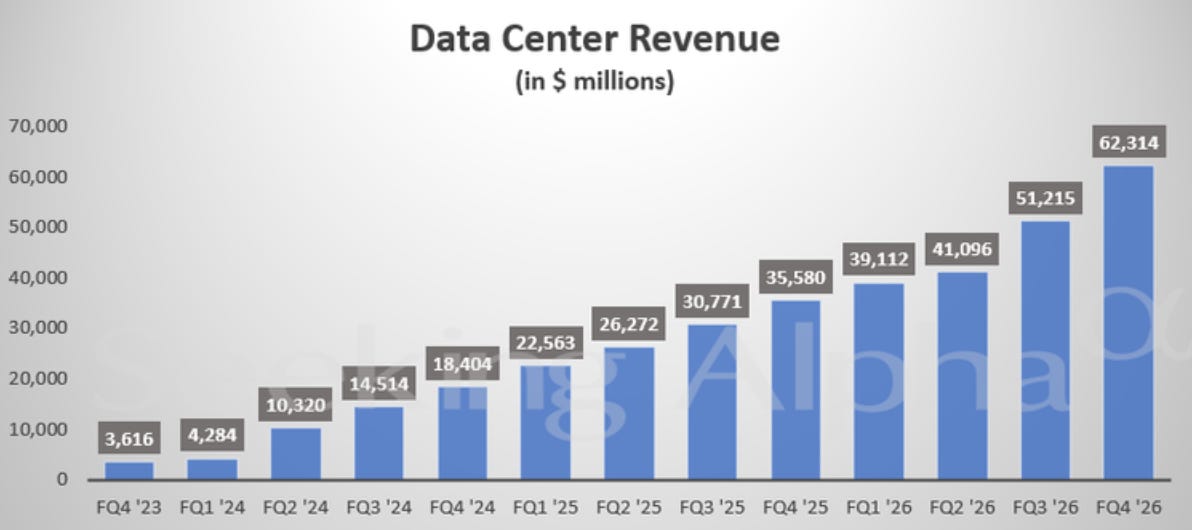
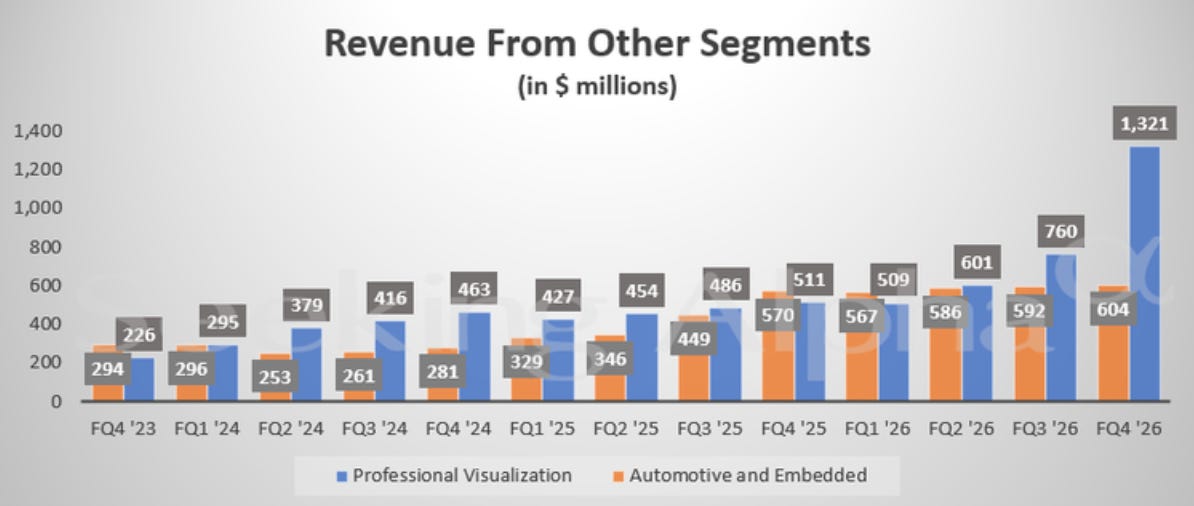
[News/Charts] Nvidia Non-GAAP EPS of $1.62 beats by $0.08, revenue of $68.13B beats by $1.9B
Nvidia press release (NVDA): Q4 Non-GAAP EPS of $1.62 beats by $0.08.
Revenue of $68.13B (+73.2% Y/Y) beats by $1.9B.
Record quarterly Data Center revenue of $62.3 billion, up 22% from Q3 and up 75% from a year ago
Record full-year revenue of $215.9 billion, up 65%.
During fiscal 2026, NVIDIA returned $41.1 billion to shareholders in the form of shares repurchased and cash dividends. As of the end of the fourth quarter, the company had $58.5 billion remaining under its share repurchase authorization.
NVIDIA’s outlook for the first quarter of fiscal 2027 is as follows:
Revenue is expected to be $78.0 billion, plus or minus 2% vs consensus of $72.03B. NVIDIA is not assuming any Data Center compute revenue from China in its outlook.
Link to Seeking Alpha News Article - Feb 25, 2026
Link to Seeking Alpha News Article - Feb 25, 2026
AIQ 0.00%↑ IGV 0.00%↑ MSFT 0.00%↑ CDNS 0.00%↑ SNPS 0.00%↑ NOW 0.00%↑
[News] Nvidia’s Jensen Huang pushes back on AI cannibalization fears in software sector
“I think the markets got it wrong,” Huang told CNBC’s Becky Quick, pushing back against concerns that AI agents will cannibalize the enterprise software industry.
Rather than replacing software companies, Huang said he expects many firms to adopt agentic AI to build better products and improve efficiency. He argued that AI agents won’t eliminate existing tools, but will rely on them.
“Imagine a future home robot. It’s highly intelligent. Does it invent a new microwave? Design a novel food processor? Of course not. It reads the manual and uses the tools already there. Digital agents are no different. Software platforms are the microwaves, wrenches, and screwdrivers of the enterprise world,” Huang said.
Huang cited tools such as Microsoft (MSFT) Excel, Cadence (CDNS), Synopsys (SNPS), ServiceNow (NOW) and SAP (SAP), arguing they “exist for a fundamentally good reason” and that agentic AI will use them “on our behalf and help us be more productive.”
“Nobody’s going to service better than ServiceNow,” he added, noting companies will build agents optimized around their own tools.
Link to Seeking Alpha News Article - Feb. 26, 2026
WealthWise Research - Feb. 26, 2026
NFLX 0.00%↑ WBD 0.00%↑ PSKY 0.00%↑
[News] Paramount wins the bidding war for Warner Bros. as Netflix walks away
Netflix (NFLX) announced that it will not raise its bid for Warner Bros. Discovery (WBD) after the media giant’s board deemed a sweetened, all‑company takeover offer from Paramount Skydance (PSKY) as “superior.”
The streaming company said a higher price for Warner Bros. (WBD) was no longer financially attractive. The revised Paramount (PSKY) offer was at a purchase price of $31.00 per share in cash, a one-dollar increase from its earlier bid, which valued the company at around $108B.
“This year, we’ll invest approximately $20 billion in quality films and series and will expand our entertaining offering. Consistent with our capital allocation policy, we’ll also resume our share repurchase program,” read a statement from Netflix (NFLX).
Warner Bros. Discovery (WBD) is contractually obligated to pay Netflix a $2.8B breakup fee for terminating the original deal.
Some Wall Street insiders are even antagonistically rooting for Paramount to win only to fail down the line so that Netflix can buy the combined company for cheaper while pocketing the $2.8B in termination fees from Warner, which would also be funded by Paramount.
Link to Seeking Alpha News Article - Feb. 26, 2026
Link to Seeking Alpha News Article - Feb. 26, 2026
#Anthropic
[News] Anthropic CEO rejects Pentagon demand for unrestricted model access, says threats won’t sway it
Anthropic (ANTHRO) on Thursday said that the company “cannot in good conscience” allow the Department of Defense to use its models in all lawful use cases without limitation, adding that the agency’s threats do not change its position.
“Partially autonomous weapons, like those used today in Ukraine, are vital to the defense of democracy. Even fully autonomous weapons (those that take humans out of the loop entirely and automate selecting and engaging targets) may prove critical for our national defense. But today, frontier AI systems are simply not reliable enough to power fully autonomous weapons. We will not knowingly provide a product that puts America’s warfighters and civilians at risk,” he added.
The AI startup has been engaged in tense negotiations with the Pentagon lately, and it said Thursday that those discussions are still ongoing. Defense Secretary Pete Hegseth has threatened to label Anthropic a “supply chain risk” or to invoke the Defense Production Act to force the company to comply with its demands.
Link to Seeking Alpha News Article - Feb. 26, 2026
[News] Rocket Lab targets Q4 2026 for Neutron’s first launch while expanding backlog and vertical integration
CEO Peter Beck announced a record annual revenue of $602 million for 2025, reflecting 38% year-on-year growth, and Q4 revenue of $180 million, up 36% from Q4 2024. Beck highlighted, “At the end of Q4, our backlog sat at a record $1.85 billion, which is up 73% from the same time in 2024.”
On Neutron, Beck addressed the Stage 1 tank hydrostatic test failure, attributing it to a manufacturing defect from a handlaid process and confirmed, “Neutron’s first launch is now targeted for Q4 2026.”
Beck explained that “none of the other hardware that’s qualified as being halted, obviously, it’s just that tank,” and Spice added, “the actual cost to produce that second tank is quite low.”
Xin Yu, Deutsche Bank: Inquired about space data centers and customer interest. Beck said, “We’re early with data centers,” but Rocket Lab has developed silicon arrays for megawatt-scale power. On customer type, he said, “there’s certainly more nontraditional looking at this kind of solution than traditional players.”
Link to Seeking Alpha News Article - Feb. 27, 2026
#SpaceX #Grok #xAI
[News] US agencies raise concerns over use of xAI’s Grok: report
In recent months, officials at several U.S. federal agencies have raised concerns about the safety and reliability of Elon Musk’s xAI’s (X.AI) AI tools, showing continuing disagreements within the U.S. government about which AI models to deploy, The Wall Street Journal reported, citing people with knowledge of the matter.
The warnings came before the Pentagon’s decision this week to allow xAI’s AI chatbot Grok to be used in classified settings, the report added.
OpenAI’s CEO Sam Altman too told his staff that the company was working on a deal with the Pentagon over the use of AI in classified settings, after Pentagon’s fallout with Anthropic, The Wall Street Journal reported.
Link to Seeking Alpha News Article - Feb. 27, 2026
Link to Seeking Alpha News Article - Feb. 27, 2026
[YouTube | The Compound] Data Centers Are the New Fracking | TCAF 231
On episode 231 of The Compound and Friends, Michael Batnick and Downtown Josh Brown are joined by Daniel Clifton and Chris Verrone of Strategas Research to discuss: AI’s backlash, the Stock Rerating, Midterms, Anthropic vs The DoD and more!!
Link to Full Video (01:23 Hours) - Feb. 27, 2026
News, Facts, Analyst & Market Commentary - Short Reads:
Trump’s EPA rolls back rules on mercury emissions from power plants
The Environmental Protection Agency this week rescinded regulations limiting mercury and other hazardous toxins from power plants.
The move is President Trump’s latest effort to lift the U.S. coal sector, including earmarking more than $500M to help upgrade existing plants, using emergency powers to keep older facilities from retiring, and allowing coal plants to access the Energy Department’s loan program, which has hundreds of billions of dollars in financing authority.
In 2024, the Biden administration finalized updates to the Mercury and Air Toxic Standards for coal-fired plants that would have cut allowable mercury pollution from coal plants by 70% and imposed a 67% reduction in emissions of nickel, arsenic, lead, and other toxic metals.
On Friday, the EPA announced it has repealed Biden’s updated MATs, reverting compliance back to 2012 standards.
Coal- and oil-fired power plants also will no longer have to comply with a 2027 deadline set under Biden to install technology on smokestacks for continuous monitoring of soot, and a stricter mercury emissions standard for certain coal plants, finalized in 2024, also is being replaced with the original 2012 standard.
Link to Seeking Alpha News Article - Feb. 21, 2026
Lumentum in focus as GF ups target on rising growth prospects
“We see 2027 as a key inflection year for Lumentum, driven by CPO/NPO adoption across both scale-out and scale-up AI,” analyst Jeff Pu wrote in a note to clients. “We expect total CPO/NPO laser revenue to reach ~$124m/500m/1.7b in 2026/2027/2028, representing +389%/+305%/+245% YoY growth, and accounting for 3%/9%/20% of total revenue. For scale-out, ~80k NVIDIA CPO switches in 2027 could generate ~$273m in CW laser revenue, with additional upside from 3.2T ramps in 2028. On the scale-up side, potential CPO/NPO adoption in Rubin Ultra and future platforms offers a long-term annual revenue opportunity >$1bn, with volume ramp starting late 2027.”
Pu maintained his Buy rating on Lumentum and raised his price target to $765.
Link to Seeking Alpha News Article - Feb. 23, 2026
[Newsletter Exclusive] ServiceNow, TCS team up to offer AI solutions to enterprises
ServiceNow (NOW) has signed a multi-year partnership with India’s Tata Consultancy Services to help enterprises speed up AI adoption across their businesses and functions.
Under the collaboration, TCS will develop solutions on the ServiceNow platform that will use trusted AI and a unified governance model to make enterprise workflows more efficient, proactive, and insight-driven. These solutions will be offered via TCS’ AI-led, autonomous global business solutions portfolio.
Link to Seeking Alpha News Article - Feb. 23, 2026
[Newsletter Exclusive] Snowflake expands Cortex Code CLI to support any data system
Snowflake (NYSE: SNOW) on Monday said its Cortex Code CLI, an AI coding agent for developers, now supports workflows beyond Snowflake, including dbt and Apache Airflow, enabling secure, context-aware AI assistance across multiple data systems.
The company said the expanded platform allows developers to build, manage, and optimize data pipelines more efficiently while maintaining enterprise-grade controls, and introduces a self-service subscription plan for teams not yet using Snowflake.
Since launching in November 2025, Cortex Code has attracted more than 4,400 users, with Snowflake highlighting its ability to accelerate multi-system workflows and improve code quality.
The update also provides support for leading AI models, administrative controls, and governance features.
Link to Seeking Alpha News Article - Feb. 23, 2026
NVDA 0.00%↑ AVGO 0.00%↑ ALAB 0.00%↑ MRVL 0.00%↑
Networking & Optics checks positive for Broadcom, Nvidia: Evercore
“Our checks with 20 AI-Engineers confirm our view that connectivity remains a key bottleneck in AIsystems (both supply and speed), and that companies that deliver solutions at scale will enjoy tailwinds to revenues and margins. Every hyperscaler has a different strategy and supply chain – we think the checks are positive for NVDA, AVGO, ALAB, MRVL and MTSI, and we reiterate our OP [Outperform] ratings on each,” said analysts led by Mark Lipacis.
Nvidia (NVDA)
The analysts said Nvidia appears to be working towards having a Co-packaged Optics, or CPO, scale-up version of the NVLink switch in alignment with the Rubin Ultra release in the second half of 2027, although some believe it will more likely happen in 2028.
The analysts noted that they believe Peripheral Component Interconnect Express, or PCIe, and Ethernet have a chance to take share from NVLink, but NVLink will be viewed as having superior performance. The analysts added that Nvidia developed its own Digital Signal Processors, or DSPs, at 1.6T (terabits per second) and is expected to serve 50% of its internal demand with them and the remaining from Broadcom (AVGO).
Broadcom (AVGO)
Lipacis and his team said that Broadcom’s Electro-Absorption Modulated Lasers, or EML, capacity is increasing from 43M to 44M in 2025 to 50M in 2026, and the Continuous Wave, or CW, laser is expanding from 15M to 16M in 2025 to 30M in 2026.
The analysts added that non-Broadcom switches struggle to support Linear-drive Pluggable Optics, or LPO modules. The analysts noted that the company’s 1.6T DSPs are considered best-in-class, and a majority of Meta Platforms’ (META) 1.6T DSP demand is expected to go to Broadcom.
Astera Labs (ALAB)
Amazon’s (AMZN) Trainium-3 is expected to include ALAB’s Scorpio X switches for two out of three Trainium-3 SKUs, with the third SKU being switchless, according to the analysts. The analysts said that Astera is increasingly being viewed as a mature supplier versus a start-up.
Marvell Technology (MRVL)
Lipacis and his team said that all of Google’s (GOOG) (GOOGL) 1.6T DSP demand is expected to be serviced by Marvell. The analysts added that for 800G DSPs, sources believe Marvell has a 70% share, and Broadcom has the remaining 30% share. Marvell is viewed as having a superior 1.6 TIA on performance and new packaging architecture.
In addition, the analysts said that Celestial AI is seen as part of a broader strategy to more meaningfully compete with Broadcom as a full-stack, one-stop application-specific integrated circuit, or ASIC, design partner.
Link to Seeking Alpha News Article - Feb. 23, 2026
ASML shows off new light advance that could boost chip production by 50%: report
ASML (ASML) has unveiled a new advancement in light sourcing technology for its extreme ultraviolet lithography machines that could increase the number of chips by 50% by 2030, Reuters reported.
“It’s not a parlor trick or something like this, where we demonstrate for a very short time that it can work,” Michael Purvis, ASML’s lead technologist, told the news outlet. “It’s a system that can produce 1,000 watts under all the same requirements that you could see at a customer.” Purvis made the comments while speaking at ASML’s offices near San Diego.
The current power of an EUV light source is 600 watts, so the jump to 1,000 watts is fairly substantial, Jorge J. Rocca, a professor at Colorado State University, told the news outlet.
ASML’s Purvis said the hope is that the company can continue advancing the technology to move past 1,000 watts and further strengthen its position. “We see a reasonably clear path toward 1,500 watts, and no fundamental reason why we couldn’t get to 2,000 watts,” Purvis told Reuters.
Link to Seeking Alpha News Article - Feb. 23, 2026
[Newsletter Exclusive] Wells Fargo upgrades Google on AI compute capacity advantage
Wells Fargo noted that hyperscalers are facing a compute capacity shortage. However, they expect Google to have an advantage in the medium term as they forecast the tech giant to expand compute capacity to 35GW by 2028 from 15GW in 2025.
They also expect Google’s Gemini consumer subscription revenue business to exit 2027 at $12B ARR from $4B exiting 2025 and see upside options in the Apple Siri relationship, which will most likely contribute beyond 2027.
Link to Seeking Alpha News Article - Feb. 23, 2026
AVGO 0.00%↑ MRVL 0.00%↑ ARM 0.00%↑ QCOM 0.00%↑
Broadcom is ‘best-in-class’ in ASIC market, but Marvell, Qualcomm catching up: Evercore
Broadcom is considered the “premium, one-stop shop” for ASICs, given that it has leading intellectual property in both analog and digital and is the best at execution, Lipacis added. The company also has strength in its high-speed I/O offering, and its experience working with Taiwan Semiconductor (TSM) and its deep, technical bench are both assets, Lipacis explained. Conversely, its high cost (margins are 10% higher than Marvell) and its lack of flexibility are considered negatives, he added.
For Marvell, its flexibility compared to Broadcom is considered a major strength, Lipacis added, notable, given its intellectual property assets are not as strong as Broadcom’s. However, it does have advantages over its Taiwanese competitors, notably its “superior front-end circuit design capabilities,” analyst Mark Lipacis explained.
It also has two major customers—Amazon (AMZN) and Microsoft (MSFT)—with its Amazon work improving, as the defect rate may have been cut by 65% when it took over work on Trainium 2. It is also seen as “indispensable” for Microsoft’s Maia program. (Microsoft released a new Maia AI accelerator last month.)
Arm, on the other hand, is working to “aggressively” compete for development programs at the major hyperscalers and show off its capabilities in CPUs, XPUs and data processing units. It’s also believed to be working with OpenAI (OPENAI) on a custom CPU or DPU and Meta (META) on a custom CPU, Lipacis said.
Lastly, Qualcomm (QCOM), which has made some progress in the competitive ASIC market, has shown that its offerings are capable of running small language models on “most devices,” Lipacis said.
Qualcomm chips are running small language models in Meta’s Ray Bans and other AI wearables.
Link to Seeking Alpha News Article - Feb. 23, 2026
IonQ in focus as quantum computing firm selected for Golden Dome contract
IonQ (IONQ) was in focus on Monday as the quantum computing firm announced it has been awarded a government contract for the Missile Defense Agency Scalable Homeland Innovative Enterprise Layered Defense initiative related to the Golden Dome.
The company did not disclose the size of the contract it was awarded but noted the total value of the contract has a ceiling of $151B. More than 2,400 companies are eligible to compete for future task orders issued under the SHIELD IDIQ contract framework.
Link to Seeking Alpha News Article - Feb. 23, 2026
Centrus Energy CEO warns looming ‘supply gap’ threatens U.S. nuclear resurgence
A looming supply crunch of enriched uranium fuel due to fast-rising demand and a ban on Russian imports threatens the resurgence of nuclear power in the U.S., Centrus Energy (LEU) CEO Amir Vexler told the Financial Times in an interview Monday.
“It is my strong belief that there is a gap between supply and demand for the existing market, just the operating reactors that we have now, Vexler said, adding that plans to build new fleets of large and small nuclear reactors in the U.S. would pose longer-term challenges.
“I feel the market is strained and will continue to be strained until large amounts of new capacity are going to come online, and that will be in the next decade,” the CEO said.
For the moment, Centrus sources most of the enriched uranium it sells to US utilities from Russia — a trade that will be prohibited from January 1 2028 because of sanctions legislated by Congress in 2024. The company is building new uranium enrichment capacity that is due to come online in 2029.
Centrus (LEU) is racing to build enrichment capacity at its Ohio plant to help meet a $2.3B backlog in sales of enriched uranium to customers, but the restart of several U.S. nuclear plants and upgrading of the reactor fleet to boost electricity production will pressure the handful of western suppliers of enriched uranium, Vexler told FT.
Centrus (LEU) and Urenco, a private company owned jointly by the British and Dutch governments, currently are the only companies licensed to enrich uranium in the U.S., and there are no U.S.-based commercial suppliers of the highly enriched fuel required to power the new generation of smaller nuclear reactors that are under development.
Link to Seeking Alpha News Article - Feb. 23, 2026
Link to FINANCIAL TIMES News Article - Feb. 23, 2026
BWXT outlines $3.75B 2026 revenue target while expanding commercial nuclear and medical growth
Rex Geveden, President and CEO highlighted a year-end backlog of $7.3 billion, up 50% year-over-year, and emphasized strategic wins including new pricing agreements for naval propulsion, initial contracts for U.S. defense uranium enrichment, and expanded high-purity depleted uranium production. The company completed the acquisitions of AOT and Kinectrics, supporting major contract wins and international expansion, including a $1.6 billion contract and the owner’s engineer role for Bulgaria’s Kozloduy AP1000 project.
The CEO stated, “We shipped 2 large steam generators for CVN 81, a Ford-class aircraft carrier from our Mountain Vernon, Indiana facility, highlighting our rhythm delivery for naval reactors... we are considering expansion there to supply the U.S. commercial nuclear market.”
In commercial operations, Geveden stated, “We reported impressive organic revenue growth of 31% in the quarter and total revenue growth of 95%.” Commercial backlog ended 2025 at $1.7 billion, up 85% year-over-year and 16% sequentially, driven by CANDU refurbishments, SMR projects, and the Bulgaria AP1000 contract.
Deuschle inquired about AI use. Geveden explained, “The first phase was BWXT using machine learning to improve certain internal functions... The third phase is going to be a factory automation... we’re quite excited about that.”
Sam Straker, Truist Securities: Asked about NASA and military microreactor programs and TRISO fuel. Geveden outlined current progress on Pele, Janus, and opportunities in vision surface power, with commercial TRISO opportunities being evaluated.
Link to Seeking Alpha News Article - Feb. 23, 2026
[Newsletter Exclusive] Beam Therapeutics GAAP EPS of $2.33, revenue of $114.1M
Beam Therapeutics press release (BEAM): Q4 GAAP EPS of $2.33.
Revenue of $114.1M (+279.4% Y/Y).
Beam expects that its cash, cash equivalents and marketable securities as of December 31, 2025, combined with the anticipated $200 million minimum drawdown from the Sixth Street facility, will enable the company to cover its anticipated operating expenses and capital expenditure requirements into mid-2029, funding the company through the anticipated launch of risto-cel in SCD, execution of the BEAM-302 pivotal development plan in AATD, and clinical proof of concept for BEAM-304 in PKU.
Link to Seeking Alpha News Article - Feb. 24, 2026
INTU 0.00%↑ #Anthropic
Intuit stock up after announcement on multi-year partnership with AI safety firm Anthropic
Through the partnership, Intuit aims to bring custom AI agents to mid-market businesses on its platform. Businesses are expected to be able to build and customize AI agents to support compliant workflows using Anthropic’s Claude Agent SDK, regardless of technical expertise.
Furthermore, the Mountain View, California-based company said its tax, finance, accounting, and marketing expertise and tools will be surfaced directly inside Anthropic products.
The facilities will begin rolling out to Intuit customers and Anthropic users in spring 2026.
Link to Seeking Alpha News Article - Feb. 24, 2026
Ocean Power Technologies receives $1.5 million order from U.S. Coast Guard
Ocean Power Technologies (OPTT) has received an ~$1.5 million Purchase Order from the United States Coast Guard (USCG) for the installation and deployment of buoy systems previously ordered, the company said on Tuesday.
This award completes the acquisition cycle and enables near-term fielding of the systems in support of Department of Homeland Security (DHS) maritime security missions.
Under the scope of work, OPT will execute deployment, commissioning, and operational activation to ensure the systems are fully integrated and mission ready. The buoys are expected to enter active service shortly following installation.
Link to Seeking Alpha News Article - Feb. 24, 2026
Qualcomm’s data center strategy prompts upgrade by Wells Fargo
Qualcomm’s (QCOM) data center strategy has the potential to create a $5B to $7B revenue opportunity by 2027, prompting Wells Fargo to upgrade the stock to Equal-weight from Underweight.
Wells Fargo highlighted Qualcomm’s partnerships with Humain and Adobe and its recent acquisitions of Alphawave Semi and Ventana Micro Systems.
“We see synergies within its recent acquisitions as potentially underappreciated, including scale-up connectivity and potential custom HBM4 architectures, assisted with Alphawave expertise (UCIe die-to-die, PCIe/CXL, HBM PHY, and more), and potential CPU-host attach opportunities with Ventana-Veyron V2 RISC-V CPU (scalability up to 192 cores/socket, performance data below) - Ventana has previously noted commitments from ‘leading hyperscalers and HPC customers in the Americas, Europe, and Asia’, as well as previous disclosures of customers spending triple digit $M on being able to build their own server-class platform using the Ventana Veyron architecture,” he added.
Link to Seeking Alpha News Article - Feb. 24, 2026
IGV 0.00%↑ AIQ 0.00%↑ EXPE 0.00%↑ BKNG 0.00%↑
Booking Holdings has little to fear from agentic AI disruption—Morgan Stanley
As agentic AI reshapes the software as a service (SaaS) ecosystem, Morgan Stanley believes the adoption of this transformative technology will only benefit online travel agents (OTA), changing behaviors and diverting traffic to OTA apps and websites for purchase rather than direct in-agent checkout.
Despite their assertive embrace of generative artificial intelligence, Google (GOOG) and Meta (META) have both remained hesitant to be the “merchant of record” in the travel business given the payment risk and necessary traveler customer service support, a dynamic Nowak believes is unlikely to change in an agentic world.
Link to Seeking Alpha News Article - Feb. 24, 2026
GOOG 0.00%↑ CRM 0.00%↑ #Anthropic
Anthropic adds new plugins for Cowork, expanding reach of potential enterprise clients
The new plugins cover human resources, design, engineering, operations, brand voice, financial analysis, investment banking, equity research, private equity, and wealth management.
Anthropic has partnered with a wide range of enterprise software providers to create connectors between Claude Cowork and the primary software that businesses are already using. This includes Google Workspace (GOOG)(GOOGL), Docusign (DOCU), Apollo, Clay, Outreach, Similarweb, MSCI, LegalZoom, FactSet, WordPress, and Harvey. Plugins for joint customers have also been built for Slack by Salesforce (CRM), LSEG, S&P Global (SPGI), Apollo, Common Room, and Tribe AI.
Link to Seeking Alpha News Article - Feb. 24, 2026
Solid Power outlines plans for 75 metric tons electrolyte capacity by end of 2026 while strengthening liquidity
CEO Van Scoter announced a joint evaluation agreement with Samsung SDI and BMW for all solid-state battery development, describing it as “validation of our electrolyte sampling efforts.”
The CEO reported completion of factory acceptance testing and near completion of site acceptance testing at SK On’s facility as a key technical milestone, supporting partners’ all solid-state battery (ASSB) efforts.
Van Scoter said, “We expect to commission our continuous electrolyte production line by the end of 2026 which we designed to expand our annual electrolyte production capacity to up to 75 metric tons.”
The company aims to pursue a potential JV partnership for commercial scale electrolyte production in Korea, targeting an annual capacity of up to 500 metric tons through collaboration.
Christopher Pierce, Needham: Questioned SK On pilot line timeline and capital runway for commercialization. Van Scoter: “SK On has specifically... stated that they wanted to have SOP for their batteries in 2029... I would expect 2027 to be, again, a strong development year at the cell level and then probably ‘28 being more mature leading up to the SOP in ‘29.”
Link to Seeking Alpha News Article - Feb. 24, 2026
First Solar forecasts 2026 sales up to $5.2B as CuRe and perovskite tech ramp, eyes $2.6B–$2.8B EBITDA
First Solar (FSLR): Q4 GAAP EPS of $4.84 misses by $0.33.
Revenue of $1.68B (+11.3% Y/Y) beats by $110M.
But the company projected full-year revenues of $4.9B-$5.2B, likely below the $5.2B total for 2025 and far below the $6.16B FactSet analyst consensus estimate, on a volume of 17.0-18.2 GW of modules sold after selling 17.5 GW of modules in FY 2025.
On First Solar’s (FSLR) earnings conference call, CEO Mark Widmar said the reasons for the lower guidance included the strategic underutilization of its Southeast Asian factories, describing the company’s strategy as “buying some time to see how these tariffs ultimately get played out,” according to PV Magazine.
The company also said it anticipates a $125M-$135M impact from Trump’s tariffs in 2026.
Management advanced its U.S. manufacturing footprint, initiating commercial production at its fifth U.S. factory in Louisiana and announcing a new finishing facility in South Carolina, targeting operational readiness for Q4 2026.
The CEO shared progress on technology, specifying, “Based on laboratory and field testing results, CuRe has demonstrated the expected advantaged energy profile... These results continue to support a disciplined factory-by-factory CuRe conversion rollout expected to begin next month, starting at our Ohio Series 6 factory.” He also noted the launch of a perovskite development line and a pilot for a Series 6 perovskite module, aiming for operational readiness in early 2027.
CFO Alexander Bradley stated, “As of December 31, 2024, our contracted backlog totaled 68.5 gigawatts valued at $20.5 billion... For the full year 2025, we sold 17.5 gigawatts of modules, secured 7.4 gigawatts of gross bookings and recorded 8.3 gigawatts of debookings.” He added, “We ended the year with a contracted backlog of 50.1 gigawatts valued at $15 billion.”
Link to Seeking Alpha News Article - Feb. 24, 2026
Link to Seeking Alpha News Article - Feb. 24, 2026
Link to Seeking Alpha News Article - Feb. 24, 2026
Workday outlines 12%–13% FY ’27 subscription revenue growth while advancing agentic AI adoption
Aneel Bhusri, Co-Founder, CEO & Executive Chairman emphasized the company’s focus on organic development, saying, “The accelerating growth will come from the agents we built on top of Workday, both inorganic and organic... we believe that FY ‘27 and beyond will prove that customers will buy our organically built agents that are in early access today.”
Gerrit Kazmaier, President of Product & Technology, reported, “In full year ‘26, we delivered 1.7 billion AI actions across the Workday platform and this is all organically developed AI in Workday.” He added, “In Q4, we generated over $100 million in new ACV from emerging AI products, that’s growing over 100% year-over-year, and our overall ARR from these solutions is now over $400 million.”
S. Kirk Materne, Evercore ISI: “The guide for next year seems fairly conservative... Does that reflect just your general view that some of the agentic offerings are going to take a little while...?” Bhusri replied, “I’m pretty optimistic about this year. I would hope that we significantly surpassed that. But...the opportunities on the agentic front...are more second half based in terms of the agents coming into production.”
Gabriela Borges, Goldman Sachs: “How do you manage the risk that vendors or customers build solutions next to Workday...?” Bhusri replied, “It’s our metadata, it’s our security model, it’s our data model. It’s our business process framework, and people underestimate the power of our business process framework.”
Link to Seeking Alpha News Article - Feb. 24, 2026
[Newsletter Exclusive] TransMedics outlines 20–25% 2026 revenue growth target while advancing OCS programs and European expansion
CEO Waleed Hassanein detailed key quarterly achievements: “Total revenue for 4Q ‘25 was $160.8 million, representing approximately 32% growth year-over-year and approximately 12% sequential growth from 3Q 2025. U.S. transplant revenue grew approximately 11% sequentially to $155 million, while OUS transplant revenue grew approximately 33% sequentially to $5 million. Finally, we delivered an operating profit of approximately $21.3 million in 4Q, representing approximately 13.2% of total revenue for fourth quarter while making substantial investments to fuel our growth.”
Clinical adoption highlights included strong growth in OCS Liver transplants, with OCS responsible for 5,139 U.S. transplants in 2025, up from 3,735 in 2024. OCS Liver reached 36% of U.S. liver transplant volume, up from 26% in 2024. OCS Heart comprised 18% of heart transplants, up from 17%.
Forthcoming initiatives include the ENHANCE Heart and DENOVO Lung programs, European NOP model expansion, and OCS Kidney system development.
Link to Seeking Alpha News Article - Feb 25, 2026
Circle Internet Group, Inc. GAAP EPS of $0.43 beats by $0.27, revenue of $770M beats by $25.05M
Circle Internet Group, Inc. press release (CRCL): Q4 GAAP EPS of $0.43 beats by $0.27.
Revenue of $770M (+76.9% Y/Y) beats by $25.05M.
USDC in circulation of $75.3 billion at year end grew 72%; USDC onchain transaction volume in Q4’25 of $11.9 trillion, up 247%
Reserve Income of $733 million increased 69% year-over-year, primarily from 100% growth in average USDC in circulation, partially offset by a 68 bps decline in the reserve return rate.
Other Revenue of $37 million increased $34 million year-over-year as subscription and services revenue and transaction revenue grew strongly.
The fintech behind USDC stablecoin (USDC-USD) expects 2026 other revenue of $150M-$170M (vs. the Visible Alpha consensus of $143M). Revenue less distribution cost margin is anticipated to be 38%-40% vs. 2025’s 39%, and adjusted operating expenses are expected to be $570M-$585M vs. $478M in 2025.
Jeremy Allaire, Co-Founder, Chairman & CEO, highlighted the convergence of blockchain, stablecoins, and artificial intelligence, stating, “We are entering a world where, in my view, likely tens or hundreds of billions of AI agents will interact and perform economic functions over the Internet.”
Allaire detailed product and platform expansion, citing the launch of Arc Testnet and plans for Mainnet launch in 2026, along with the introduction of StableFX and xReserve. He emphasized partnerships with Intuit, Visa, and Polymarket, and noted USDC’s adoption by Cash App, Gusto, Deel, Interactive Brokers, JPMorgan, and Mastercard.
Allaire underscored the acceleration in developer activity around AI and its potential to drive USDC adoption. He described initiatives such as the Agentic payment standard from Google and Circle’s participation in the AI agent consortium, and shared, “We just went into Testnet release of a new capability with Circle Gateway that allows for agents to autonomously and programmatically automate cross chain USDC transactions with a transaction cost of [ $0.00001].”
Devin Ryan, Citizens JMP Securities, LLC: Asked about the timing and scope of the Agentic evolution, and Arc’s role. Allaire responded that Arc is “purpose built for this moment,” citing its validation and consensus model and ultra-low transaction costs. On the Arc token, Allaire said exploration is ongoing but no timeline is set.
John Todaro, Needham & Company: Asked about Arc’s evolution and its asset-agnostic potential. Allaire described Arc as a “general-purpose OS for economic activity on the Internet,” designed as a liquidity and distribution hub for asset issuers.
Jeffrey Cantwell, Seaport Research: Requested a breakdown of other revenue guidance and Arc rollout. Allaire said Arc’s Mainnet launch will start with proof of authority validation by world-class financial infrastructure companies, with deep integration into Circle’s product stack. Fox-Geen confirmed other revenue was $36.8 million in the quarter, with growth in subscription, services, and transaction revenue.
Link to Seeking Alpha News Article - Feb 25, 2026
Link to Seeking Alpha News Article - Feb 25, 2026
Link to Seeking Alpha News Article - Feb 25, 2026
Eyes on the sky: Uber and Joby take ride-hailing to the air
Uber Technologies (UBER) is firmly in the eVTOL business with the introduction of Uber Air powered by Joby, which it described as a seamless way for riders to book Joby Aviation’s (JOBY) all-electric air taxi directly through the Uber app.
Joby Aviation (JOBY) expects to carry its first passengers later this year in Dubai.
An electric air taxi can be booked by simply opening the Uber (UBER) app and entering their destination in the “Where to?” bar. If a trip qualifies, Uber Air powered by Joby will appear as an option. With a single tap, the app seamlessly connects and books every leg of the journey, including Uber Black pickup and drop-off.
Link to Seeking Alpha News Article - Feb 25, 2026
Workday’s AI investment push lowers short-term margins: analysts
“Workday sees a massive opportunity in further automating the workflows around their systems with Agentic solutions, with organically built Agents providing a deeper and better integrated functionality, which should ultimately prove more defensible,” said Morgan Stanley analysts, led by Keith Weiss, in a Wednesday note. “This strategic vision, the correct one in our view, is that core Financial and HR systems should prove the least likely to be disrupted by GenAI, while the expanded capabilities of the models/agents enable a major expansion of the scope of work which can be automated, with incumbent vendors bringing significant advantages in effectively bringing these solutions to market.”
“You’ve all heard the narrative out there that HR and ERP will be replaced or relegated to the background by AI,” CEO Aneel Bhusri said. “I personally just don’t see that happening. Our application domains are really, really hard to build. I’ve been working in the HR and ERP space for over 30 years. These are true systems of record that must process transactions with absolute accuracy and speed, enforce complex security models, and comply with statutory and regulatory requirements all over the world. That kind of complexity is very hard to replicate. No amount of vibe coding is going to produce an HR or an ERP system … You can’t have probabilistic outcomes in running a payroll, it needs to be 100% accurate and completed 100% of the time.”
“So what is the future? It’s the marriage of deterministic enterprise apps with probabilistic AI that leads to 3 things: a redefined user experience that is prompt-based, a greatly improved business process automation and execution platform with work done by agents and humans, and lastly, much deeper AI-generated insights,” he added.
Link to Seeking Alpha News Article - Feb 25, 2026
[Newsletter Exclusive] Array, Shoals upgraded at BNP Paribas as utility-scale solar growth accelerates
Cumulative utility-scale solar capacity additions between 2026 and 2030 could exceed 250 gigawatts, compared with broader industry and Wall Street expectations of 150 to 200 gigawatts, according to the bank. Concerns around permitting, Foreign Entity of Concern tax equity constraints and engineering procurement and construction capacity appear overstated, Sutton wrote.
BNP upgraded Array Technologies (ARRY) to Outperform from Neutral and raised its price target to $19 from $9. The firm sees Array (ARRY) as a key beneficiary of faster utility-scale deployment, assuming it maintains stable market share and generates solid revenue from non-tracker products.
The primary risk to the thesis would be a shift in market share if large developers dominate U.S. solar construction through 2030, as Array (ARRY) has greater exposure to mid-sized and smaller developers than some peers.
Link to Seeking Alpha News Article - Feb 25, 2026
[Newsletter Exclusive] Redwire GAAP EPS of -$0.58 misses by $0.40, revenue of $108.79M beats by $10.01M
For the full year ended December 31, 2026, Redwire is forecasting revenues of $450 million to $500 million.
During 2025, launched 14 PIL-BOXes, studying 18 unique molecules, to the International Space Station (“ISS”); as of December 31, 2025, Redwire had eleven active payload facilities on the ISS.
Link to Seeking Alpha News Article - Feb 25, 2026
Link to Seeking Alpha News Article - Feb 25, 2026
Joby Aviation generates $31M in revenue, slashes quarterly loss
Driven by sales associated with its Pentagon contracts, corporate partnerships, and recent Blade Urban Air Mobility acquisition, Joby Aviation (JOBY) reported better-than-expected results for the fourth quarter and set FY26 revenue guidance above consensus estimates.
For the quarter ending December 31, the electric air taxi enterprise generated revenue of $30.8M, up significantly from $55K a year earlier and nearly double what was anticipated.
And while the company continued to incur costs to support certification and expenses tied to the Blade acquisition, the company’s net loss narrowed to $121.5M from a loss of $246M in the same quarter last year thanks to increased revenue.
This translated into a loss of $0.14 per share, narrowing from a loss of $0.34 per share a year earlier and 6 cents better than expected.
Joby’s (JOBY) operating loss, however, widened to $206.8M from a loss of $149.9M last year, and adjusted EBITDA for the quarter widened to a loss of $154M from a loss of $119M in Q4 2024.
Joby’s (JOBY) balance sheet improved as well, with total cash and cash equivalents increasing 51% to $1.41B.
Looking ahead to FY26, Joby (JOBY) expects to generate $105M to $115M in revenue, straddling the consensus estimate of $111.1M.
JoeBen Bevirt, Founder and CEO confirmed that “the first FAA conforming aircraft is now ready to fly,” and production is underway for all aircraft required for TIA testing. He noted record progress in FAA certification, stating, “we continue to make excellent progress, posting a record 18-point increase on the FAA side of the Stage 4 of certification.”
Bevirt cited $1.8 billion in recent capital raises and highlighted deepening partnerships, noting, “With Delta Airlines, we met a key warrant milestone… after which they exercised the first tranche of their warrants.”
Bevirt also pointed to operational milestones, including demo flights with Toyota in Japan, the integration of Joby and Blade services into the Uber platform, and advancements in autonomous and hybrid aircraft development: “This quarter, we also flew our turbine electric autonomous VTOL aircraft for the first time.”
Link to Seeking Alpha News Article - Feb 25, 2026
Link to Seeking Alpha News Article - Feb 25, 2026
[Newsletter Exclusive] The Trade Desk outlines at least $678M Q1 revenue target as AI innovation and CTV momentum continue
CEO Jeffrey Green described persistent macro headwinds for consumer packaged goods (CPG) and automotive verticals, which represent over a quarter of the business, citing “levels of uncertainty that we haven’t seen for most of the last 15 years.” He pointed out that other verticals such as tech, travel, pharma, and communications performed well.
Davis provided Q1 2026 guidance: “For the first quarter, we expect revenue to be at least $678 million, representing 10% year-over-year growth. We estimate adjusted EBITDA for Q1 to be approximately $195 million.”
WealthWise Research notes that 10% YoY growth rate is slower than the 14.27% YoY growth achieved last quarter and a significant slow down from the 25.4% YoY recorded in Q1, 2025.
The Trade Desk’s revenue growth rate has been falling for 4 straight quarters.
Link to Seeking Alpha News Article - Feb 25, 2026
[Newsletter Exclusive] Snowflake outlines 27% product revenue growth outlook for FY ‘27 while expanding AI offerings and closing $400M contract
CEO Sridhar Ramaswamy reported product revenue for Q4 of $1.23 billion, representing 30% year-over-year growth, and remaining performance obligations of $9.77 billion, up 42%. He noted, “Our net revenue retention was at a healthy 125%.
The CEO called out the addition of 2,332 net new customers for the year, with strong AI adoption: “This quarter, we delivered the largest sequential increase in accounts using AI, bringing the total to more than 9,100 accounts.”
CFO Brian Robins guided Q1 fiscal 2027 product revenue between $1.262 billion and $1.267 billion, representing 27% year-over-year growth. For full year fiscal 2027, product revenue is expected at approximately $5.66 billion, also representing 27% year-over-year growth.
Robins noted, “We signed the largest deal in Snowflake’s history, greater than $400 million in total contract value and signed 7 9-figure contracts compared to 2 in the same period last year.”
Link to Seeking Alpha News Article - Feb 25, 2026
[Newsletter Exclusive] Array Technologies plunges by a third after weak earnings guidance; Deutsche Bank downgrades
The company sees full-year adjusted EPS of $0.65-$0.75, well short of the $0.88 FactSet consensus; revenues of $1.4B-$1.5B, in line with the $1.45B consensus; adjusted EBITDA of $200M-$230M, compared to the $256.4M consensus; and adjusted gross margin of 26%-27%, shy of the 28% consensus estimate.
Link to Seeking Alpha News Article - Feb. 26, 2026
[Newsletter Exclusive] Eos Energy Enterprises misses top-line and bottom-line estimates; introduces FY26 outlook
Eos Energy Enterprises press release (EOSE): Q4 Non-GAAP EPS of -$0.72 misses by $0.48.
Revenue of $57.99M (+699.9% Y/Y) misses by $35.7M.
Adjusted EBITDA loss was $71.5 million compared to $44.6 million in the prior year period.
Total cash of $624.6 million, including restricted cash, as of December 31, 2025.
Order backlog totaled $701.5 million, representing 2.8 GWh, up 9% sequential quarter, reflecting strong commercial momentum and growing demand.
Commercial opportunity pipeline of $23.6 billion, a 4% increase compared to prior quarter and 64% increase compared to December 31, 2024.
Initiates 2026 revenue guidance of $300 million to $400 million consensus of $471.26M.
CEO Joseph Mastrangelo highlighted that “our volume was up. Our margins improved sequentially quarter-over-quarter and year-over-year. We had a great quarter as far as orders being booked,” but clarified, “the bottom line is we missed our guidance, and that falls on me as the CEO of the company.”
Mastrangelo indicated the company is expanding its installed base, now covering 20% of the United States with 20 projects, and targets reaching 25% coverage in the next few months, with international expansion into Germany and the U.K. planned.
He emphasized, “on the bottom, yes, 7x year-over-year growth on revenue, combined with our highest cash position that we’ve had in the company’s history, along with closing the gap and moving towards profitability, we’ve removed the going concern language inside of our 10-K filing.”
Link to Seeking Alpha News Article - Feb. 26, 2026
Link to Seeking Alpha News Article - Feb. 26, 2026
[Newsletter Exclusive] Market confused on AI winners, investors must focus on compute costs, strategist Ray tells CNB
Ray Wang, principal analyst at Constellation Research highlighted a fundamental shift in how expertise and experience are valued in the AI era. “Expertise is now a commodity; experience isn’t,” he said, emphasizing that understanding this distinction is crucial for identifying which companies will thrive. Enterprise leaders aren’t looking to build and manage software themselves—they want solutions that deliver results without the operational burden.
When it comes to long-term investment strategy, Ray advised looking backward from compute power to identify opportunities. The focus should be on who can deliver compute at the lowest cost, which ultimately depends on energy infrastructure and efficiency. He pointed to regions like Saudi Arabia as examples, where low-cost energy is being converted into high-value, high-margin compute capabilities.
Ray concluded that the most valuable companies going forward will be those building “data ink companies”—businesses that can monetize their data effectively. “If you have the data, you get to play in AI, you get to build additional products and services on top of that data, and that creates the opportunity,” he said, underscoring the importance of data gravity in determining long-term winners.
Link to Seeking Alpha News Article - Feb. 26, 2026
[Newsletter Exclusive] Enovix outlines path to $400M smart eyewear battery TAM by 2030 as commercialization accelerates
President and CEO Raj Talluri highlighted that “the fourth quarter represented continued progress as we transition from qualification into early commercialization across multiple end markets.” He emphasized advancements in smartphone qualification for the AI-1 platform, expanded engagement with smart eyewear, and ongoing revenue from defense and industrial programs. Talluri stated, “We are currently preparing production to support initial high-volume demand from our lead smart eyewear customer.”
Talluri described a strong liquidity position, with “$621 million in cash, cash equivalents and marketable securities,” supporting commercialization and a recently authorized share repurchase program.
Talluri indicated initial smartphone-related revenue in 2026 is expected to support system integration and launch preparation, with larger scale commercialization targeted for late 2026 or early 2027. He noted, “We expect to ship our first smart eyewear batteries for use in AI/AR devices in the second half of 2026.”
Mark Shooter, William Blair asked about smart glasses commercialization timing. Talluri confirmed, “You absolutely should think of the question you asked as a purchase order, and we are manufacturing them now to our lead customer.”
Link to Seeking Alpha News Article - Feb. 26, 2026
[Newsletter Exclusive] FTAI Aviation targets $1.625B 2026 EBITDA and launches FTAI Power amid demand surge
David Moreno, President, announced the launch of FTAI Power, a new platform converting CFM56 engines into aero derivative power turbines, with the first production units of Mod-1 targeted for delivery in Q4 2026 and a goal of 100 units in 2027.
Myles Walton, Wolfe Research, explored the Power initiative ramp. Adams expressed confidence in a smooth ramp, not expecting a steep curve, and emphasized potential for multi-location production.
Link to Seeking Alpha News Article - Feb. 26, 2026
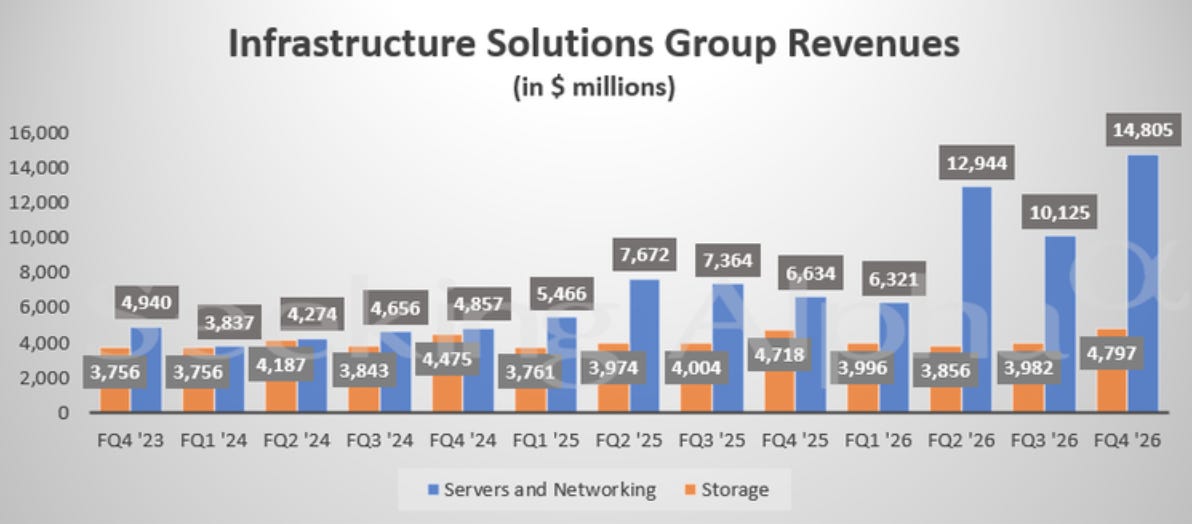
Dell Non-GAAP EPS of $3.89 beats by $0.38, revenue of $33.38B beats by $1.75B
For the period ending Jan. 30, Dell said it earned an adjusted $3.89 per share as revenue rose 39% year-over-year to $33.38B. Of the company’s two units, Client Solutions Group generated $13.49B in revenue, up 14% year-over-year. Dell’s Infrastructure Solutions Group delivered $19.6B in revenue for the quarter, up 73% year-over-year. Included in that was a stunning 342% rise in servers and networking revenue at $9B.
Analysts were anticipating adjusted earnings of $3.52 per share on $31.74B in revenue.
Looking to the first-quarter of fiscal 2027, Dell anticipates adjusted earnings of $2.90 per share at the midpoint, while sales should be between $34.7B and $35.7B. Analysts were anticipating earnings of $2.34 per share on $28.99B in revenue.
For the full-year, it expects to earn $12.90 per share, excluding one-time items, at the midpoint, well above the $11.45 per share estimate. Full-year revenue is expected to be between $138B and $142B, with the $140B midpoint above the $124.69B estimate.
In addition to the results, Dell upped its dividend by 20% and added $10B to its share buyback program.
Jeffrey Clarke, COO & Vice Chairman highlighted Dell’s transformation through AI, stating, “In FY ‘26, we closed $64.1 billion in AI orders, shipped $25.2 billion and exited with a record $43 billion in AI backlog”.
David Kennedy, Chief Financial Officer projected, “For FY ‘27, we expect $50 billion in AI revenue, about 100% growth year-over-year.
Link to Seeking Alpha News Article - Feb. 26, 2026
Link to Seeking Alpha News Article - Feb. 26, 2026
Link to Seeking Alpha News Article - Feb. 26, 2026
Link to Seeking Alpha News Article - Feb. 26, 2026
[Newsletter Exclusive] D-Wave outlines accelerated dual platform strategy and signals higher revenue growth in H2 2026 as bookings surpass historic highs
Alan Baratz, President, CEO & Director, highlighted D-Wave’s commercial and technical progress, including the first sale of an Advantage quantum computer system to the Julich Supercomputing Centre and demonstration of quantum supremacy on a real-world problem with the Advantage2 system. Baratz asserted, “We are the only quantum computing company to demonstrate quantum supremacy on a useful real-world problem.”
The CEO announced the acquisition of Quantum Circuits, positioning D-Wave as “the only dual platform quantum computing company” and stating, “No other gate-model vendor today” has a comparable architectural advantage.
Harsh Kumar, Piper Sandler: Asked about timing advantage from built-in error correction in gate-model. Baratz: “We believe that this combination will allow us to build and deploy scaled error-corrected superconducting gate-model systems ahead of anybody else.”
Link to Seeking Alpha News Article - Feb. 26, 2026
MP Materials targets 6,000 metric ton NdPr oxide annual run rate in 2026 while accelerating 10X build-out
MP Materials (MP) -3% post-market Thursday after posting better-than-expected Q4 adjusted earnings but a 13.6% Y/Y decline in revenues to $52.7M, following its decision to stop shipping rare earths to China for processing as part of its agreement with the U.S. government.
Last year, the Pentagon took a 15% stake in MP (MP) as part of a deal in which the company agreed to build a new factory to make rare earth magnets; in return, MP ended all sales to China, which resulted in no revenue recognized from rare earth concentrate during the quarter, causing the overall decline in revenue, the company said.
CEO James Litinsky highlighted that NdPr oxide output doubled to 2,599 metric tons, and the year ended with an annualized run rate of nearly 4,000 metric tons for separated NdPr oxide. The company signed a significant long-term NdPr offtake agreement with a new strategic customer, now counting direct agreements with four leading manufacturers across automotive, consumer electronics, and physical AI sectors.
MP Materials exceeded 50,000 metric tons of REO produced, marking another record. The company remains the world’s second largest producer of total REO.
Within the Magnetics segment, Litinsky noted the production of first magnets on commercial scale equipment and the expansion of both recycling and magnet capacity.
Management expects to begin commissioning heavy rare earth separation circuits mid-2026, with production of separated heavy rare earths, specifically dysprosium and terbium, expected late in the year.
MP Materials (MP) said Thursday it selected a 120‑acre site in Northlake, Texas, to develop its planned “10X” rare earth magnet manufacturing campus; it is located less than 10 miles from MP’s existing Independence facility in Fort Worth.
MP (MP) said it plans to spend more than $1.25B to develop “the largest and most strategic U.S. rare earth magnet manufacturing asset in history,” supported by a significant state and local incentive package and a 10-year Pentagon offtake commitment.
Once operational, the new campus is expected to contribute to MP’s (MP) total production capacity of ~10K metric tons/year of NdFeB rare earth magnets, advancing the ability of the U.S. to produce the strategic components domestically.
Engineering and equipment procurement are well underway, with commissioning set to begin in 2028, the company said.
Link to Seeking Alpha News Article - Feb. 26, 2026
Link to Seeking Alpha News Article - Feb. 26, 2026
Link to Seeking Alpha News Article - Feb. 26, 2026
ASML says next-gen chipmaking tool ready for high-volume production: report
ASML Holding’s (ASML) next-generation chipmaking machine is ready for manufacturers to start bringing it into use for production at high volumes, a senior executive told Reuters, a big step for the chip industry.
It has taken ASML years to develop the costly, next-generation tools as chipmakers have attempted to determine at what point it makes economic sense to begin to use them for mass production.
The new tools cost roughly $400 million, twice the cost of the original EUV machines.
The High-NA EUV tools now experience limited downtime, have produced 500,000 dinner-plate-sized silicon wafers, and can draw sufficiently precise patterns that make up the circuits on the chip, the ASML data shows, Pieters said.
Link to Seeking Alpha News Article - Feb. 27, 2026
C 0.00%↑ #BTC
Citigroup to launch Bitcoin integration into core banking later this year
Citigroup (C) aims to roll out infrastructure in 2026 that will embed Bitcoin (BTC-USD) into its core banking systems, according to Nisha Surendran, the bank’s head of digital asset custody development.
Surendran outlined the plan at Strategy World, an industry event hosted by Bitcoin treasury firm Strategy (MSTR), describing it as part of a broader push to make Bitcoin accessible within traditional finance.
The Wall Street giant also plans to extend the same tax, reporting, and compliance workflows currently used for traditional assets to cover Bitcoin holdings. Citi (C) manages approximately $30 trillion in client assets across securities and money market products.
Link to Seeking Alpha News Article - Feb. 27, 2026
Meta inks yet another AI chip deal, this time with Google - report
Meta Platforms (META) inked a multi-billion-dollar deal to rent artificial intelligence chips from Google (GOOGL), The Information reported, citing a person involved in the talks.
Meta (META) is also in talks to buy Google’s (GOOGL) Tensor Processing Units (TPUs) for its data centers as early as 2027. It’s unclear how advanced these discussions are.
The report added that Google (GOOGL) and an unidentified large investment firm reached a deal for funding a joint venture that would lease TPUs to other customers.
Link to Seeking Alpha News Article - Feb. 27, 2026
META 0.00%↑ NVDA 0.00%↑ AMD 0.00%↑
Meta’s internal chip design efforts face hurdles: report
Meta Platforms (META) is facing issues with AI chips being developed internally and has discarded its most advanced chip, shifting focus to a less complicated version, The Information reported, citing people with knowledge of the matter.
Last week, the company scrapped its most advanced chip in development for training AI models after struggling with the chip’s design.
Meta discarded one version of its second-generation training chip, internally known as Iris. The company then started working on a more advanced training chip called Olympus, but it has now scrapped this as well, the report noted.
One person who works on Meta’s chips said there is internal skepticism about the company’s plans to develop chips that match Nvidia’s in capabilities, due to the risk of delays or redesigns. Such work needs a large team of engineers to design and debug the chips and to ensure their power consumption is not too high, which would not make the chips worth using compared to Nvidia’s products, said the person, as per the report.
The Iris training chip is based on a computing approach called single instruction, multiple data, or SIMD. SIMD is usually easier for hardware engineers to design but difficult for software engineers to program when training AI models. Olympus was based on a computing approach similar to that used for Nvidia’s AI chips: single instruction, multiple threads, or SIMT, makes it usually easier for software engineers to program but difficult for hardware engineers to design, the report noted.
Several tech companies favor this approach, which Nvidia popularized, as it provides more flexibility and is better suited for training modern AI models. Meta aimed to complete the design of Olympus by the fourth quarter of 2026 at the earliest. However, new chip designs usually take another nine months or longer after initial development to mass-manufacture, the report added.
The central part of Olympus that handled AI calculations — the graphics processing unit —would have used a design from chip startup Rivos, acquired by Meta last year. Rivos said its GPUs could efficiently run Nvidia’s Cuda software code, the dominant software for training and running AI models, the report noted.
Meta initially intended to develop large clusters of servers with Olympus, but executives decided that doing so would have posed a risk to training new models as it races to compete against OpenAI (OPENAI) and Google (GOOG) (GOOGL), the report added.
The software for training the chips would not have been as stable as Nvidia’s products, for example, and Olympus’ complicated design could have made it harder to make in large quantities. For now, Meta plans to continue using training chips made by others, for which the software is more established, the report noted.
Link to Seeking Alpha News Article - Feb. 27, 2026
AMZN 0.00%↑ NVDA 0.00%↑ AMD 0.00%↑
Amazon seeks to use in-house chips to develop AI models, exec says
Amazon (AMZN) is going to attempt to use its Trainium and Inferentia processors to develop its artificial intelligence models in an effort to cut costs, The Wall Street Journal reported.
“If we can build our models on our chips, we can build them at a fraction of the cost of a pure-play AI model provider,” Amazon’s new artificial intelligence czar, Peter DeSantis, told the news outlet in an interview.
“AI has a cost problem,” DeSantia added. “If we ultimately want AI to transform everything, the costs have to be different.”
Earlier this month, Amazon said it would spend $200B in capital spending in 2026, far higher than what Wall Street was expecting. Part of that outlay will be on chips, Amazon CEO Andy Jassy said.
Link to Seeking Alpha News Article - Feb. 27, 2026
#OpenAI
OpenAI confirms astonishing $110B funding round, with $50B from Amazon, and $30B from Nvidia, SoftBank
“Today we’re announcing $110B in new investment at a $730B pre-money valuation. This includes $30B from SoftBank, $30B from NVIDIA, and $50B from Amazon,” OpenAI said in a statement. “We’ve also signed a strategic partnership with Amazon and secured next generation inference compute with NVIDIA. Additional financial investors are expected to join as the round progresses.”
OpenAI provided some details on its business and said it had more than 900M weekly active users, including more than 50M paying consumer subscribers and more than 9M paying business users.
“Subscriber momentum accelerated meaningfully to start the year, with January and February on track to be the largest months for new subscribers in our history,” OpenAI added.
OpenAI explained that the tech space has moved into a new phase where AI moves from research into daily use at scale and that the winners will be defined as to which companies “can scale infrastructure fast enough to meet demand, and turn that capacity into products people rely on.”
As part of the funding round, OpenAI and Amazon signed a deal to have Amazon Web Services be the “exclusive third-party cloud distribution provider for OpenAI Frontier, which enables organizations to build, deploy, and manage teams of AI agents,” OpenAI said in a separate statement.
OpenAI will also consume 2 gigawatts of Trainium capacity through AWS infrastructure, and they will develop customized models to power Amazon’s customer-facing apps, the companies said.
The commitment also goes beyond existing Trainium chips and includes the upcoming Trainium4, expected to be delivered next year.
Amazon’s $50B will come in two tranches: $15B initially and then $35B in the coming months when certain conditions are met. The companies did not specify what those conditions were, but previous reports indicated the additional money could be tied to an OpenAI IPO or its achievement of artificial general intelligence.
OpenAI will use 3 gigawatts of dedicated inference capacity and 2 gigawatts of training on Nvidia’s upcoming Vera Rubin systems.
Upon completion of the funding round, SoftBank now owns approximately $64.6B worth of OpenAI, or roughly 13% of the company.
Given the more in-depth relationship between Amazon and OpenAI, OpenAI also provided an update on its relationship with Microsoft (MSFT).
Core tenets of the relationship include that the two companies will continue to “work closely” across research, engineering, and product development; Microsoft still has its exclusive licenses and access to intellectual property across OpenAI models and products; the commercial and revenue share relationships are unchanged; and Azure is still the exclusive cloud provider of stateless OpenAI APIs.
OpenAI added that its first-party products, including Frontier, will still be hosted on Azure, and the definition of artificial general intelligence and processes remains unchanged.
OpenAI (OPENAI) is attempting to raise another $10B on top of the $110B fundraising effort the ChatGPT maker just confirmed today, according to The Information.
Link to Seeking Alpha News Article - Feb. 27, 2026
Link to Seeking Alpha News Article - Feb. 27, 2026
#BTC #ETH #SOL
[Newsletter Exclusive] Crypto at 50% discount to trend offers multi-year opportunity, Pantera’s Morehead says
Dan Morehead, founder and managing partner of Pantera Capital, believes now is an excellent time to invest in cryptocurrency for those with a multi-year investment horizon.
The former CFO and head of macro trading at Tiger Management noted that Bitcoin follows a predictable four-year cycle tied to its halving events, when the number of new bitcoins issued gets cut in half. He pointed to Pantera’s accurate forecast from several years ago that predicted Bitcoin would hit $117,482 on a specific date in August 2025. “It did that day,” Morehead confirmed, though he acknowledged the subsequent pullback was also expected.
Regarding how far Bitcoin could fall, Morehead observed that the severity of downturns has been decreasing with each cycle. “The first cycle… it was 87%, then it was 80%, then 74% loss. Now it’s at 50,” he said, suggesting the current correction’s floor is likely around $50,000 to $60,000. “But again, if you have a multiyear time frame, these are great prices.”
Beyond Bitcoin, Morehead emphasized the importance of portfolio diversification within crypto, noting that Pantera maintains a large position in Solana despite its recent decline. He also highlighted real-world blockchain applications, citing the example of $20 billion in mortgages already placed on blockchain technology, which is reducing spreads between borrowers and lenders by over 100 basis points.
Link to Seeking Alpha News Article - Feb. 27, 2026
$NIKE
[Newsletter Exclusive] Will Pou Sheng’s profit warning lead to a major Chinese announcement from Nike? -- BNP Paribas
As one of the two largest distributors for Nike (NKE) in China, Pou Sheng’s profit warning overnight could have broad ramifications for the sportswear giant given its significant exposure to the Chinese market.
Pou Sheng—number two to Topsports International—said that its profits in FY25 were down 57.1% and were “significantly constrained” by elevated industry inventory levels in Mainland China, weak consumer demand, and aggressive promotions.
BNP Paribas analyst Laurent Vasilescu views this development as another “red flag” in Nike’s Chinese business and could precipitate an announcement from Nike (NKE) regarding its future in the country.
That possibility takes on added significance given Nike’s decision to delay its fiscal third quarter results from its preferred third Thursday of March to April 2.
Is the Q3 timing deliberate?
Vasilescu thinks a major restructuring program will be announced at that time, given that Nike (NKE) has warned over the past two quarters that “China is facing structural issues.”
His “red flag” over China was amplified when days sales outstanding (DSO) were materially increasing in China.
“We warned that China was overly dependent on classics (The Great Wall of Jordans). Now Nike needs to clean up this market…and we are concerned the same could happen in the North American market,” Vasilescu writes.
Since adidas is expected to report strong trends in China, this leaves Nike (NKE) vulnerable to “particular weakness,” given that Pou Sheng’s inventory is 70% Nike (NKE) and adidas (ADDYY) (ADDDF), and the other top distributor, Topsports, is 90% Nike/adidas.
Link to Seeking Alpha News Article - Feb. 27, 2026
Applied Optoelectronics targets over $1B in 2026 revenue as 800G and 1.6T production ramps
CEO Chih-Hsiang Lin highlighted record quarterly results, stating “total revenue increased 83% compared to 2024 to a record $456 million.” He emphasized the “robust demand in both our CATV and data center business” and noted a “fourth 800G buying order from one of our major hyperscale customers to support its AI data center growth.” Lin added, “We have become ramping up production of this 800G module in anticipation of a strong volume ramp starting in Q2.”
Lin discussed manufacturing expansion, saying, “due to the software investment we have made, we have materially expanded our manufacturing capacity.”
CFO Stefan Murry stated, “we expect to generate over $1 billion in revenue this year with a non-GAAP operating profit of over $120 million.”
Management stated that “this revenue level is limited by our production capacity and supply chain, not market demand, which we believe is much larger.”
Q4 2025 revenue was $134.3 million, up 34% year-over-year and 13% sequentially, and in line with guidance of $125 million to $140 million.
Non-GAAP loss per share was $0.01, narrower than the guidance range of a loss of $0.13 to a loss of $0.04.
Data center revenue was $74.9 million, up 69% year-over-year and 70% sequentially. Sales of 100G products increased 54% year-over-year; 400G products increased 141% year-over-year.
CATV revenue was $54 million, up 3% year-over-year but down 24% sequentially from a record Q3.
Simon Leopold, Raymond James: Asked for clarification on 800G revenue, to which Murry replied “it was below $4 million.” Lin added, “a lot below it is delayed to Q1, but we have emphasized the revenue will be big in Q2 next year across the target.”
Leopold inquired about gross margin trajectory. Lin responded, “the gross margin for 1.6T is much, much higher than the other products...I believe we’re going to achieve 40% gross margin by late Q3 or Q4 next year.”
Leopold questioned CATV outlook. Murry explained, “they’re spending this year and next year a significant amount of their spend...towards the amplifiers...and that’s where we play.”
Michael Genovese, Rosenblatt Securities: Asked about 800G ramp milestones. Murry said, “the firmware has to be modified to work with all those different platforms...that should be done in the middle of next month...that’s basically the last hurdle to kind of unleash the ramp.”
Genovese questioned production mix. Lin explained, “by end of next year, I would say more than 55% will be manufactured in the U.S. or even 60% or 65%...but let me say that more than 80%, 85% of investment will be in Texas.”
George Notter, Wolfe Research: Asked about tariffs. Murry stated, “the one place where I’m pretty confident in saying it’s not going to be tariff, it’s product that’s made in the U.S., and that’s what we’re scaling up to do.”
Ryan Koontz, Needham & Company: Inquired about laser supply. Murry said, “we’re planning to triple our production of indium phosphide-related devices here...by the middle part of next year.”
Link to Seeking Alpha News Article - Feb. 27, 2026
[Newsletter Exclusive] SA Analyst sees a signal in the noise as stocks retreat on sticky PPI
According to Seeking Alpha analyst Alex King of Cestrian Capital Research, underlying market dynamics may be shifting despite the day’s losses.
“There is signal in the noise this week,” King said. “For some weeks now the Nasdaq has been the weaker of the three main U.S. equity indices. This week — of all weeks, the week in which we are being told that software is going to zero — the Nasdaq will close more or less flat on the week, versus declines in the S&P, the Dow and the Russell 2000.”
King added that the relative resilience could mark the early stages of a rotation back into technology shares, particularly software.
“We believe that sleeping on software will be a mistake,” he added.
Link to Seeking Alpha News Article - Feb. 27, 2026
[Newsletter Exclusive] Energy Fuels outlines uranium production guidance of up to 2.5M pounds in 2026 while expanding rare earth capabilities
The company exceeded upgraded guidance, mining over 1.7 million pounds of uranium and processing over 1 million pounds of finished U3O8. Chalmers indicated plans for “materially” increasing uranium mining production and sales in 2026, and highlighted progress in the rare earth segment with pilot production of dysprosium and upcoming terbium oxide production, and qualification of NdPr and Dy products by major automobile manufacturers.
Ross Bhappu, President, detailed the White Mesa Mill’s capabilities, stating, “We have a current capacity of 1,000 tonnes per annum of NdPr…we produced 29 kilograms of dysprosium oxide…and next month, we plan to produce our first kilogram of terbium oxide.”
Mark Chalmers, CEO, announced 2026 guidance for mined uranium of 2 million to 2.5 million pounds, processed uranium of 1.5 million to 2.5 million pounds.
Management underscored expansion plans in rare earths, with commercial quantities of heavy rare earth oxides targeted for 2027 and commissioning of Phase 2 expansion at White Mesa Mill planned for late 2028 or early 2029.
Nathan Bennett, CFO, stated, “For the year, we reported a net loss of $86 million or $0.38 per share compared to a net loss of $47 million or $0.28 per share in fiscal 2024.” The year-over-year increase was attributed to higher costs following the Base Resources acquisition and increased investment in projects. Uranium sales increased by 200,000 pounds to 650,000 pounds, resulting in an $11.8 million increase in uranium revenue year-over-year.
Joseph Reagor, ROTH: Asked about uranium sales breakdown and contract pricing. Curtis Moore, SVP, said contract sales for 2026 are 650,000 to 880,000 pounds, with likely price-sensitive spot sales. Moore added, “It will be in the $70s plus…and depending on how uranium prices are, it can go into the $80s.”
Link to Seeking Alpha News Article - Feb. 27, 2026
YouTube:
[Deepwater Asset Management | Pressure Points] Nvidia 4Q’26 Earnings
Three takeaways on Nvidia:
1. The stock being down 1% underscores that investors’ long term growth concerns remain.
2. The fundamentals and outlook came in better than elevated whisper numbers.
3. Most importantly, the guidance reinforces just how early we are in AI.
Link to Full Video (10:41 Minute) - Feb. 26, 2026
[Steve Eisman | The Weekly Wrap] Trump Tariff Turmoil, Private Credit Risk Grows, & AI’s Software Fears
On this episode of The Weekly Wrap, Steve Eisman breaks down the latest developments with the Supreme Court striking down President Trump’s tariffs. He also discusses Blue Owl and the rising anxiety in the private market/private credit world, AI software fears, and the latest in weekly earnings. Lastly, Steve takes a couple of mailbag questions from viewers regarding the market’s response to Trump’s tariffs and retail investor resources.
Watch to understand the Blue Owl situation primarily.
Link to Full Video (24:33 Minute) - Feb. 28, 2026
Disclosure: We own positions in some/all of the tickers mentioned in this article.