Alpha Coverage #170
AI, Robotics, Space, Quantum Computing, Climate Change/Energy Transition, Biotech/Genomics

Weekly newsletter bringing you a summary of unbiased, critical, thesis changing stock market news for long term impact. We cover news articles, opinion pieces and all forms of media to help you stay ahead of the curve. WealthWise Coverage Universe (Only for paying subscribers).
A Seeking Alpha subscription would help. Here is a 7 Day Free Trial + $30 off coupon to help you get started (Affiliate Link).
This Week’s Alpha Coverage: YouTube Playlist or Weekly Compilation.
Editor’s Pick:
[News] Tesla rolls out robotaxi service in Miami
Tesla (TSLA) expanded its Robotaxi service to Miami on Sunday, marking another step in the company’s rollout of autonomous ride-hailing services.
For now, operations are restricted to a small section of the city’s western and central areas, excluding downtown Miami and Miami Beach.
Link to Seeking Alpha News Article - Jul 06, 2026
[News] Broadcom gains after landing five-year deal with Apple to provide custom ASIC chips
“Broadcom Inc. and Apple Inc. have agreed to expand their long-standing technology collaboration through 2031 by entering into new multi-year long-term agreements for Broadcom to develop and supply a range of custom ASIC silicon products for use in multiple generations of Apple products,” Broadcom said in a Monday filing with the U.S. Securities and Exchange Commission.
Broadcom has served as a key supplier for Apple for several years, including networking components such as custom radio frequency chips, 5G components, and Wi-Fi and Bluetooth connectivity chips used in iPhones and other Apple devices. Apple accounts for about 20% of Broadcom’s annual revenue, according to analysts’ estimates.
Apple announced an expanded multiyear, multibillion-dollar agreement with Broadcom back in 2023.
Apple (AAPL) said its new multiyear agreement with Broadcom (AVGO) is expected to exceed $30B and will lead to the production of over 15B U.S.-made chips and support hundreds of American jobs.
Link to Seeking Alpha News Article - Jul 06, 2026
Link to Seeking Alpha News Article - Jul 08, 2026
[News] Planet Labs launches Gen 2 Pelican satellite aboard SpaceX
Planet Labs PBC (PL) Tuesday announced the successful launch of Pelican-11, the tech demonstration satellite (TD2) for the second generation (Gen 2) of its high-resolution Pelican fleet.
The spacecraft was launched to orbit aboard the Transporter-17 rideshare mission with SpaceX (SPCX) from Vandenberg Space Force Base in California.
Planet has successfully made initial contact with the satellite and has begun the commissioning process, it said in a statement.
Link to Seeking Alpha News Article - Jul 07, 2026
Compass gains on new late-stage trial data for psychedelic therapy in depression
Compass Pathways (CMPS) added ~8% in early premarket trading on Tuesday after the U.K.-based biotech announced additional data from a second ongoing late-stage trial for its psychedelic therapy COMP360 against treatment-resistant depression.
The 26-week results from the Part B portion of its 581-patient Phase 3 COMP006 trial confirmed COMP360’s potential to treat treatment-resistant depression with a rapid onset of action and a durable clinical profile, the company said.
In February 2026, Compass Pathways released the Part A (6-week) data for this study which proved that the treatment worked rapidly. They announced that a significant number of patients hit their primary endpoint (a reduction in depression symptoms) just six weeks after receiving the drug.
There were no new safety events, and the experimental therapy continued to indicate a well-tolerated safety profile. An ongoing rolling submission for a new drug application is expected to conclude in Q4, and the company expects to launch COMP360 in H1 2027, subject to FDA approval.
Evercore ISI on Wednesday upgraded Compass Pathways (CMPS) to Outperform from Inline and raised its price target to $21 from $8 after the U.K.-based biotech updated results from a late-stage trial supporting the long-term efficacy of its psychedelic therapy COMP360.
Link to Seeking Alpha News Article - Jul 07, 2026
Link to Seeking Alpha News Article - Jul 08, 2026
[News] Apple reportedly testing DRAM chips from China’s CXMT
Apple (AAPL) has reportedly begun testing DRAM chips from China’s state-backed ChangXin Memory Technologies for devices sold within China and is lobbying the U.S government to permit broader use of CXMT’s products.
CXMT is poised to become central to Beijing’s efforts to build a self-sufficient AI supply chain and is expected to become one of the most profitable technology companies to list in Shanghai, the FT said. It reportedly plans to raise at least 29.5 billion yuan ($4.3 billion) in an upcoming IPO.
Link to Seeking Alpha News Article - Jul 08, 2026
[News] Alibaba shares jump on AI cloud market
Shares of Alibaba Group (BABA) rose about 10% in premarket trading on Wednesday after investors responded positively to signs of improving profitability and growth in its artificial intelligence businesses.
The move came after a briefing indicated that losses in Alibaba’s instant-commerce business narrowed significantly in the June quarter, while overall profitability remained steady. The update helped ease concerns over the company’s spending on its on-demand delivery expansion ahead of its August 28 earnings report.
Investor sentiment was also boosted by reports that Alibaba Cloud’s AI-driven growth accelerated and that the company has consolidated its AI services under the Qwen brand.
Separately, Stablestock said in a post on X, formerly Twitter, that a Frost & Sullivan report showed Alibaba Cloud held a 40.1% share of China’s full-stack artificial intelligence cloud market. The post said Alibaba Cloud’s share was higher than the combined share of Baidu (BIDU), ByteDance’s (BDNCE) Volcano Engine, and SenseTime (SNTMF).
The post also highlighted a legal development, saying a U.S. federal judge had temporarily paused the Pentagon’s ban on Alibaba (BABA) hiring U.S. lobbying firms while the company’s broader legal challenge proceeds.
The gain comes amid a rally of Hong Kong-listed shares, with investors returning to the sector on improving expectations for AI growth and earnings.
Link to Seeking Alpha News Article - Jul 08, 2026
[News] Waymo to roll out driverless vehicles in four new U.S. cities
Alphabet (GOOG) unit Waymo (WAYMO) on Wednesday said it will start driverless vehicle service in San Diego, Las Vegas, Tampa, and Denver. It will be initially offered to Alphabet employees before expanding it to the public.
Link to Seeking Alpha News Article - Jul 08, 2026
KSTR 0.00%↑ KWEB 0.00%↑ MAGC 0.00%↑ BABA 0.00%↑ #DeepSeek
[News] China reportedly considers curbing access to top AI models American companies love
Across Silicon Valley, models made by Chinese companies such as DeepSeek (DEEPSEEK) and Moonshot AI have become core to daily work at companies large and small, offering a less costly alternative and supplement to the products of OpenAI (OPENAI) and Anthropic (ANTHRO), the Wall Street Journal reported.
China is now considering stricter rules to stop homegrown AI models from reaching foreign rivals, including treating tech leaks as national security offenses and limiting foreign investment in AI startups.
Reuters Wednesday reported that Chinese authorities have held meetings with top tech firms over the past month about potentially restricting overseas access to China’s most advanced AI models, including those yet to be released.
Companies present at the talks included tech giants Alibaba (BABA) and ByteDance (BDNCE) as well as startup Z.ai. Alibaba’s Qwen and ByteDance’s Doubao are two of the most widely used AI models in China. Z.ai recently set Silicon Valley abuzz as the capabilities of its GLM-5.2 model come close to leading U.S. offerings but at a fraction of the cost, reports said.
For every week since February 8, 2026, Chinese-origin AI models have accounted for at least 30% of the enterprise token volume on OpenRouter. By mid-2026, that share reached a weekly peak of 46%, according to a CNBC investigation published July 7. That figure stood at 11% averaged over the prior twelve months — and just 4.5% in the first half of 2025.
The scale of this shift is underscored by the growth of OpenRouter itself, which expanded from roughly 5 trillion tokens per week in April 2025 to over 20 trillion by April 2026.
Link to Seeking Alpha News Article - Jul 09, 2026
[Opinion] Bloom’s Big Lie
The promise: Bloom has “no China supply chain” and is “not dependent on China for scandium,” the rare earth at the core of each Bloom fuel cell. Bloom’s claim matters because Beijing now requires an export license for every shipment of scandium leaving China. If Bloom depends on Chinese scandium, China holds an off-switch on Bloom — and on the American data centers that may one day use its power.
The problem: Bloom is, in fact, reliant on C5 Chinese scandium, according to global trade data, Chinese corporate filings, satellite imagery, and Hunterbrook’s messages with Bloom’s suppliers in China. Hunterbrook traced four separate China-linked routes into Bloom’s supply chain — scandium oxide shipped directly to its Delaware plant, plus scandium-bearing ceramics and powders flowing through intermediaries in Thailand, Japan, and South Korea. A sales representative of Hunan Oriental Scandium — which claims over 50% of the global market for fuel-cell-grade scandium oxide — told Hunterbrook: “We are also BE’s largest supplier of scandium.” Asked how the material reaches U.S. customers under Beijing’s controls: “Not exported directly.” Hunan Oriental was featured at Bloom’s May supplier conference as one of three Chinese scandium-linked suppliers. One received Bloom’s “Impact Supplier Award.”
Show Me the Scandium: Even with supply from China, the scandium math fails. Hunterbrook’s supply-demand model — built from government filings, Bloom’s patents, industry data, and peer-reviewed studies — shows Bloom alone needs roughly 220 tons of scandium oxide to meet Wall Street’s 5 GW expectations. But that’s against total projected global supply of only about 240 tons versus total global demand of about 310 tons, including supply locked up by customers like Lockheed Martin (for the F-35 fighter jet). Bloom already claims to be the largest scandium consumer in the world. On the numbers, the production ramp underpinning Bloom’s valuation appears physically and commercially unattainable — with essentially all Wall Street models of Bloom’s production implying a scandium shortage by 2028 based on Hunterbrook’s model.
The demand side of the story is also not what it appears. In 4Q25, 74% of Bloom’s revenue — $574 million of $778 million — came from joint ventures Bloom part-owns with Brookfield. Bloom’s own footnotes concede these customers “may be a project-finance affiliate rather than the ultimate end user.” What Bloom’s recent revenue growth shows is that Brookfield will finance Bloom’s production, not that a meaningful customer base has adopted Bloom’s fuel cells. And it appears Bloom has been recognizing revenue well before its fuel cells have actually been deployed.
Bloom markets an unaudited $20 billion “backlog” of orders. Its remaining performance obligations (RPO) — the analog to backlog that its auditor reviews — total $492.6 million as of March 31. That’s roughly 2.5% of the backlog. Among 10 peers Hunterbrook analyzed, including GE Vernova, Oracle, Microsoft, and CoreWeave, the widest comparable gap between backlog and RPO was about 2x. Bloom’s is over 40x, in part because it includes ongoing servicing revenue customers are not obligated to pay and tax credits the government has not agreed to grant.
The two flagship projects presumably driving that backlog are both facing serious challenges to their viability. Oracle’s Project Jupiter in New Mexico has no approved air permit for fuel cells and no gas pipeline to feed the fuel cells, leading research firm SemiAnalysis to push back its base case for first power from 2027 to 2029. Hunterbrook interviews with New Mexico officials and an environmental group suing to stop the Oracle project indicate it could be delayed into the 2030s, or even canceled outright like Blackstone’s data center in Virginia last week. Meanwhile, AEP’s $2.65 billion fuel cell order also appears to have slipped, with the utility updating its investor deck from a target deployment by the end of 2028 to one “no later than 2030.” That deal, which represents a meaningful share of Bloom’s backlog — related to a campus that reportedly lost its developer Crusoe in June — is backstopped by an unnamed hyperscaler that can walk away by covering AEP’s costs incurred, plus roughly 10%. Both new Oracle and AEP delays followed Bloom raising guidance in its last earnings call.
Bloom Energy (BE) up 7.4% pre-market Thursday after saying it “categorically rejects” the “false and misleading” claims from short-seller Hunterbrook Capital regarding the company’s financial results and accounting.
“We stand behind the accuracy and integrity of our audited financial statements and financial reporting, and we refer investors to the disclosures in our most recent Forms 10-K and 10-Q,” the company said.
Bloom Energy (BE) said it has a sufficient supply of scandium oxide to meet current fuel cell demand and backlog and does not depend upon China for supply or to scale scandium oxide to meet future demand growth.
“We have clear visibility into our supply chain to support production of 25 GW of fuel cells per year, and we will continue to expand this capacity,” the company said.
Link to Hunterbrook News Article - Jul 08, 2026
Link to Seeking Alpha News Article - Jul 09, 2026
[YouTube | Ticker Symbol: YOU] Top Stocks I’m Buying For Massive Growth In July 2026
One month ago, the stock market was rallying ahead of the SpaceX ( SPCX stock ) IPO. Just last week, the stock market was nearing extreme fear. Some of the best AI stocks to buy now are down by 10-30%, giving investors a huge opportunity buy them at the best prices. My name is Alex and that’s exactly how I made so much money investing in #stocks like #nvidia ( #nvda stock ), Micron ( MU stock ), and Taiwan Semiconductor ( TSM stock ). So in this video, I’ll show you the major market stories already changing which stocks are the top stocks to buy now to get rich without getting lucky.
Link to Full Video (15:43 Minute) - Jul 08, 2026
[YouTube | BWB - Business With Brian] This Dip Won’t Last – 8 Stocks I’m Buying!
The AI trade looked like it was finally breaking—the chip index fell 10%, nuclear stocks gave back 30%, quantum names got cut nearly in half. Then #Micron reported revenue up 346%, its best margins ever, and its most advanced #AI memory sold out through 2026, with the shortage running into 2028. That’s not a bubble cooling down—it’s the buildout speeding up.
Here’s what almost everyone gets wrong: the money isn’t in the chips the crowd is chasing. It starts where the electricity does—the power, the #datacenters, the infrastructure every #AI server runs through. While everyone piles into obvious winners like #Nvidia and #Palantir, the best companies in the buildout just got dragged down with everything else—and now have the most room to run. I break down 8 of them, from the power and #nuclear names to the small-cap picks-and-shovels suppliers you’ve never heard of—and exactly how I’d size each one.
Link to Full Video (16:55 Minute) - Jul 09, 2026
[YouTube | CNBC Television] AI sector now checks all the classic bubble signs, says Rockefeller International’s Ruchir Sharma
Ruchir Sharma, Rockefeller International chairman, joins ‘Squawk on the Street’ to discuss how geopolitics have impacted equity markets, threats to equities and much more.
Link to Video Timestamped (01:29 Minute) - Jul 09, 2026
[YouTube | The Compound] The Real Ticking Time Bomb | TCAF 250
On episode 250 of The Compound and Friends, Michael Batnick and Downtown Josh Brown are joined by Michael Cembalest to discuss: the strength of the U.S. dollar, China’s challenge to American economic dominance, foreign demand for Treasuries, the federal debt reckoning, the rapidly changing AI investment landscape, Nvidia’s growing competition, semiconductor cyclicality, and more!
Link to Full Video (01:16 Hours) - Jul 10, 2026
News, Facts, Analyst & Market Commentary - Short Reads:
AXT signs three-year supply agreement with Coherent
AXT (AXTI) said its subsidiary AXT-Tongmei has entered into a three-year agreement with Coherent (COHR) to develop and supply 6-inch indium phosphide water substrates, according to a recent SEC filing.
Under the deal, AXT (AXTI) will expand production capacity at its Beijing facility between 2026 and 2028 and commit output to Coherent. Coherent (COHR) will make a prepayment of about $22.29 million, which will be applied towards future water purchases.
Link to Seeking Alpha News Article - Jul 03, 2026
[Newsletter Exclusive] Tesla caps employee AI spending at $200 per week
The Elon Musk-owned company has told its employees to obtain approval if they require additional usage beyond the spending limit, according to a report published by The Information. The usage cap will not apply to xAI, an AI chatbot owned by Musk’s rocket and satellite company, SpaceX (SPCX).
Link to Seeking Alpha News Article - Jul 04, 2026
Nvidia next-gen ‘Kyber’ AI rack delayed to 2028 on manufacturing snags: report
NVIDIA’s (NVDA) next marquee product — the Kyber rack-scale architecture designed to house its 2027 Rubin Ultra chips — has been delayed by more than 12 months to 2028, CNBC reported, citing research firm SemiAnalysis.
Kyber is a server cabinet that packs 144 of Nvidia’s most powerful chips into a single unit so they can work together as one giant computer, providing the horsepower AI companies need to train and run their most advanced models.
The design mounts graphics processing units in compute trays that sit vertically instead of horizontally to boost density and reduce latency and had been slated to debut with Vera Rubin Ultra, Nvidia’s next-generation rack-scale system, in 2027.
The setback stems from difficulties manufacturing a key circuit board at the heart of the system, SemiAnalysis said in a post on Monday.
“Kyber NVL144 rack architecture has been delayed to 2028 as the PCB midplane remains challenging from a manufacturability standpoint,” the firm said, referring to a specialized, multi-layer printed circuit board that connects electronic modules within a system.
NVL576 — a larger system linking eight racks via optical connections — is also likely delayed or limited to small volumes, the research firm said.
SemiAnalysis also projects Nvidia’s data-center compute revenue will run 20% above Wall Street consensus in the second half of fiscal 2027.
Link to Seeking Alpha News Article - Jul 06, 2026
Nvidia rises as it refutes report of next-gen delay
Nvidia (NVDA) shares rose more than 1% on Monday after the Jensen Huang-led company refuted a report that said its next-generation ‘Kyber’ AI rack was delayed until 2028.
“Our roadmap is intact,” an Nvidia spokesperson told Seeking Alpha via email.
Link to Seeking Alpha News Article - Jul 06, 2026
Micron rises as it unveils new memory deal with Ford
Micron Technology (MU) announced on Monday that it has signed a long-term Strategic Customer Agreement with Ford (F) to supply the U.S. automaker with memory and storage.
Based in Boise, Idaho, Micron is increasing the memory needed for the automotive sector to go with its ongoing capacity expansions that are aimed at long product lifecycles.
Micron’s expansion of its advanced DRAM production at its Manassas, Virginia fab aided the agreement.
Earlier this month, Micron said it had secured a long-term Strategic Customer Agreement with General Motors (GM).
Link to Seeking Alpha News Article - Jul 06, 2026
[Newsletter Exclusive] Samsung plans to raise DRAM prices by 20% in Q3: report
Samsung Electronics (SSNLF) is planning to raise Dynamic Random-Access Memory, or DRAM, prices by about 20% in the third quarter, The Korea Herald said, citing a Chinese media outlet
The company has verbally notified some customers of the plan, the Chinese media outlet reported on Saturday, citing industry sources.
An executive at a Chinese electronics maker told the outlet that the company had discussed the matter with Samsung last month and had already received verbal notice of the planned price increase, the report added.
The executive confirmed the move, noting that higher DRAM prices could eventually lead to price increases for electronic products.
Another industry source also said to the outlet that the South Korean tech giant had verbally informed some customers of the planned increase, according to the report.
Link to Seeking Alpha News Article - Jul 06, 2026
XLK 0.00%↑ SMH 0.00%↑ SPY 0.00%↑ IWM 0.00%↑ TLT 0.00%↑
[Newsletter Exclusive] HSBC says tech pullback is broadening equity rally, sees earnings backdrop intact
The recent pullback in U.S. technology stocks has improved market breadth rather than undermined the broader equity rally, with earnings revisions remaining strong and valuations becoming more attractive, HSBC said in a June U.S. equity strategy note.
The S&P 500 fell 1% in June as investors rotated out of technology and into defensive sectors, including healthcare, utilities, and consumer staples.
The firm said the correction marked the first meaningful improvement in market breadth in four months, with the equal-weighted S&P 500 outperforming the market-cap-weighted index and roughly two-thirds of stocks beating the broader benchmark.
Despite the broader participation, HSBC said the rally remained concentrated, with more than 87% of the S&P 500’s year-to-date gains driven by semiconductors and technology hardware. AI-linked capital goods have also been major contributors.
The bank said earnings continue to support the sector. Forward 12-month earnings estimates for information technology and the Magnificent Seven have risen about 25% this year, while valuations have reset to around 23 times forward earnings.
The firm expects lower oil prices to ease headline inflation but continues to forecast the Federal Reserve will keep interest rates unchanged through 2026 and 2027, despite markets pricing additional tightening.
Link to Seeking Alpha News Article - Jul 06, 2026
An AI star is born
Movie audiences may need to suspend more than belief with the upcoming release of a full-length film that stars AI-generated “actress” Tilly Norwood.
Misaligned, developed by Particle6 and Norwood’s creator, is billed as a “comedy-drama telling a coming-of-age story infused with existential AI chaos” set inside the “Tillyverse, a surreal digital world located somewhere up in the cloud.”
The film will be a “hybrid production” with traditional movie and TV writers, editors, and directors alongside AI creators.
Particle6 claims that by using Norwood instead of human actors, production costs are slashed by 90%.
Besides the proliferation of AI in animated films, the technology has advanced enough to create a full-length, live-action film, Dreams of Violet which recently became the first full-length AI-generated movie to be accepted into a major film festival.
Link to Seeking Alpha News Article - Jul 06, 2026
Micron sees bullish views maintained at BofA as ‘$1.5T cloud capex keeps AI cycle intact’
“We expect global cloud and AI infrastructure capex to approach $1.5T by 2027, up another 40-50% YoY, supported by continued token growth, agent adoption and supply-constrained infrastructure. Importantly, hyperscaler focus remains on maximizing utilization and growth rather than optimizing depreciation,” said Arya and his team.
Arya and his team said that memory now represents about 35% to 40% of cloud AI capex, two-to-three times versus historical levels, yet memory stocks trade at sub-par.
“Investors remain skeptical about pricing durability, supply additions and customer concentration. We believe the market is underestimating the transition toward longer-duration agreements and more predictable pricing. As memory evolves from a cyclical commodity to a strategic AI enabler, multiples should expand,” said the analysts.
The analysts reiterated their Buy rating on Micron, a top pick, with a $1550 price target.
The analysts said that China AI models raise competition, not capex risk. Arya and his team noted that Chinese open-weight models such as Z.AI’s (formerly Zhipu AI) GLM, Moonshot AI’s Kimi, DeepSeek (DEEPSEEK) and Alibaba’s (BABA) Qwen have rapidly narrowed the gap with leading U.S. frontier labs while offering materially lower inference costs. The rise of capable, low-cost models raises legitimate questions around future industry economics and AI software margins, the analysts added.
“However, we view this as a positive for adoption. Lower-cost intelligence expands usage, broadens deployment and ultimately increases demand for compute, memory, networking and power infrastructure. The bigger risk is to model economics, not semiconductor demand, in our opinion,” said the analysts.
Link to Seeking Alpha News Article - Jul 06, 2026
SEALSQ reports preliminary H1 revenue growth of 120% YoY, reaffirms FY26 outlook
SEALSQ (LAES) on Monday reported strong preliminary H1 2026 results as demand for its cybersecurity and post-quantum products continued to grow, while the company reaffirmed its full-year revenue outlook.
The preliminary H1 revenue doubled to $11M from $5M a year earlier, representing 120% YoY growth. Revenue also picked up during the second quarter, increasing to $7M from $4M in the first quarter.
The company ended June with about $495M in cash and short-term investments and said its business pipeline now exceeds $225M through 2029, with more than $60M linked to its QS7001 and QVault TPM post-quantum products.
The company reaffirmed its FY2026 revenue guidance, expecting revenue to grow 50% to 100% from last year’s revenue of $18.3M, implying revenue of about $27M-$36M this year.
Link to Seeking Alpha News Article - Jul 06, 2026
SpaceX lands bullish ratings from Wall Street
Morgan Stanley has initiated coverage on Space Exploration Technologies Corp. (SPCX) with an overweight rating, saying the company can convert energy into intelligence at scale for the next era of AI.
The bank has set a price target of $300 per share, Bloomberg News reported.
Morgan Stanley sees revenues topping $3.3T by 2040.
Meanwhile, Goldman Sachs analyst Eric Sheridan started coverage with a Buy rating and set PT to $205. SpaceX is well positioned to scale its differentiated advantages across space, connectivity and AI – “with each of these markets having the potential to become multiple trillion-dollar opportunities over a 5+ year time horizon,” it said.
Raymond James appears to be the most bullish, initiating with a Strong Buy recommendation and a Street-high price target of $800, nearly 500% above its IPO price.
“Just as railroads, electric grids, and the Internet reshaped prior economic eras, we believe SpaceX is building the foundational platform for the next generation of industrial capacity,” Raymond James analyst Brian Gesuale said in a note.
Link to Seeking Alpha News Article - Jul 07, 2026
Link to Seeking Alpha News Article - Jul 07, 2026
Small-cap surge: Russell 2000 on track for best year since 1991
Small-cap stocks are experiencing a historically robust rally, with the Russell 2000 index currently on pace to log its best annual performance since 1991, according to recent data from Augur Infinity.
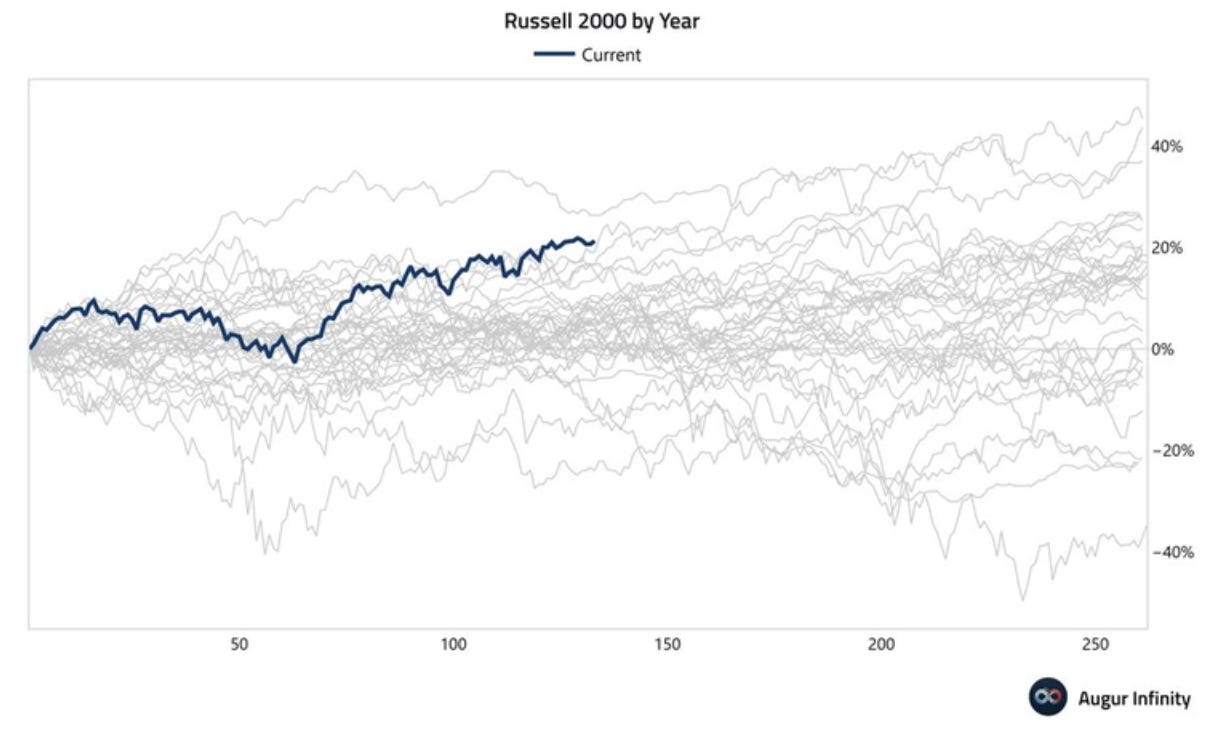
The iShares Russell 2000 ETF (IWM), a popular fund tracking the broader index, is already up some 22% year-to-date as of Tuesday morning trading.
Link to Seeking Alpha News Article - Jul 07, 2026
XLK 0.00%↑ QQQ 0.00%↑ IGV 0.00%↑
[Newsletter Exclusive] ETFs give investors a faster exit when markets turn, analyst says
For gold investors, Chambers said a diversified approach can include physical gold exposure, ETFs, and mining stocks. “Diversification, you cannot beat diversification,” he said.
Liquidity is central to Chambers’ ETF thesis. He said large, established ETFs can allow investors to buy or sell exposure quickly during volatile markets, a key advantage over physical commodities and thinly traded small-cap stocks.
Chambers warned that investors should consider how they will exit a position before entering it. In physical silver markets, for example, dealers may be willing to sell inventory during a price surge but reluctant to buy it back at the same time. The result can be wide discounts and limited liquidity for sellers.
He also urged investors to consider whether their brokerage platforms can function during periods of heavy market activity. Chambers said market stress can overwhelm trading systems, leaving investors unable to execute orders when they most need flexibility.
For that reason, Chambers said he increasingly avoids positions that cannot be sold easily. While he still sees opportunities in smaller and less-liquid stocks, he prefers investments that can be exited efficiently.
“ETFs by good ETF providers are very convenient,” Chambers said. “I won’t these days go into any stock that I can’t sell with one click.”
Link to Seeking Alpha News Article - Jul 07, 2026
Netflix signs deal with digital publishers for homepage content
Netflix (NFLX) will soon feature content on its streaming service covering everything from travel to cooking to fashion from publications like Condé Nast, People (PPLI), and Penske Media through a partnership with leading digital publishers.
The video offerings will range anywhere from 3-minute shorts to 20-minute episodes and feature on the Netflix (NFLX) homepage beginning August 3, available to subscribers in the U.S., Canada, UK, Ireland, Australia, and New Zealand.
According to The Hollywood Reporter, the deal with publishers encompasses a mix of licensed archival footage and ongoing series, such as BuzzFeed’s 30 Questions, Architectural Digest’s Walking Tour, and Travel + Leisure’s Travel Unfiltered.
“Members don’t just want to watch a show or film and move on; they want to keep exploring the stories and personalities they love long after the final credits roll,” said John Derderian, Netflix’s VP of Animation Series and Kids & Family TV.
Link to Seeking Alpha News Article - Jul 07, 2026
Trump says Iran ceasefire is ‘over’ after renewed strikes
U.S. President Donald Trump said his tentative ceasefire with Iran is over after Washington launched a fresh wave of strikes against the country and tightened sanctions, escalating tensions between the two nations.
“For me, I think it’s over,” he said on Wednesday in Ankara, sitting next to NATO Secretary General Mark Rutte at the military alliance’s annual summit. “As far as I’m concerned it’s just a waste of time.”
Trump’s remarks came after the U.S. launched a new wave of strikes against Iran and revoked a waiver that allowed the sale of Iranian oil. The moves followed attacks on three commercial vessels transiting the Strait of Hormuz, which Washington blamed on Iran. Tehran has repeatedly said it will not allow ships to pass through the strategic waterway without its permission.
The halt in attacks on commercial shipping and the U.S. waiver on Iranian oil sales were key elements of a memorandum of understanding that ended hostilities between Washington and Tehran and established a 60-day window for negotiations on a broader peace agreement.
U.S. forces launched another round of military strikes against Iran Wednesday afternoon in retaliation for Tehran’s attacks on commercial ships around the Strait of Hormuz, according to U.S. Central Command.
Link to Seeking Alpha News Article - Jul 08, 2026
Link to Seeking Alpha News Article - Jul 08, 2026
Nvidia trades at its cheapest valuation since pre‑AI boom
The stock has fallen about 16% since reaching a record high on May 14, erasing roughly $1T in market value.
The selloff has left Nvidia trading at about 18 times projected earnings over the next 12 months, its lowest forward valuation since early 2019, according to Bloomberg-compiled data. The stock now trades at a lower earnings multiple than both the S&P 500 (SP500), which is valued at more than 20 times forward earnings, and the Nasdaq 100 (NDX), which trades at nearly 23 times.
Despite being projected to deliver the fourth-fastest revenue growth in the S&P 500 this year, Nvidia now trades at a lower valuation than about half the companies in the index, including Hershey (HSY) and Dominion Energy (D).
Nvidia’s rally has also cooled sharply after an explosive run fueled by AI demand. The stock surged more than 1,100% between the end of 2022 and 2025 as demand for its graphics processing units (GPUs) skyrocketed, but it has gained just 5.6% so far in 2026, lagging the S&P 500’s 9.6% advance and the Nasdaq 100’s 16% rise.
Meanwhile, the Philadelphia Semiconductor Index (SOX) has climbed ~74% this year, putting it on track for its strongest annual performance since 2003. The rally has been led by Micron (MU), whose shares have surged 229% in 2026 after jumping 239% in 2025, driven by soaring demand and prices for high-bandwidth memory chips.
Link to Seeking Alpha News Article - Jul 08, 2026
Spire Global deploys ten satellites on SpaceX’s Transporter-17 rideshare
Spire Global (SPIR) has successfully launched ten satellites aboard SpaceX’s (SPCX) Transporter-17 rideshare mission, the company said on Wednesday. The satellites were integrated by Germany’s launch integrator Exolaunch.
Included in the launch were two satellites for GHGSat to monitor greenhouse gas emissions, expanding the company’s constellation dedicated to high-resolution methane detection.
Spire has manufactured and now operates a total of seven satellites for GHGSat, supporting its goal of providing actionable insights that help industries and governments track and reduce greenhouse gas emissions.
The mission also included seven satellites for Spire Space Services customers, as well as one satellite to replenish Spire’s constellation.
Link to Seeking Alpha News Article - Jul 08, 2026
[Newsletter Exclusive] Most S&P 500 tech stocks are 20% below their highs, while Micron and AMD lead XLK ratings
Almost 60% of S&P 500 technology stocks are now in bear-market territory, trading at least 20% below their 52-week highs, underscoring the uneven nature of the sector’s recent performance.
While the broader S&P 500 Information Technology index remains near elevated levels, weakness beneath the surface has spread across a majority of its constituents.
Link to Seeking Alpha News Article - Jul 08, 2026
#BlueOrigin
Blue Origin set for $10B fundraising round, valuing company at $130B - NYT
Blue Origin (BORGN) is closing in on a $10B fundraising round, which is expected to value the company at ~$130B, marking the first time that outside investors buy a piece of Jeff Bezos’ spaceflight company in its 25-year history, The New York Times DealBook reported Wednesday.
Asset manager Coatue Management is expected to lead with a $4B commitment, Bezos himself is set to contribute an additional $2B, and the $4B likely will come from large institutional investors, according to the report.
Link to Seeking Alpha News Article - Jul 08, 2026
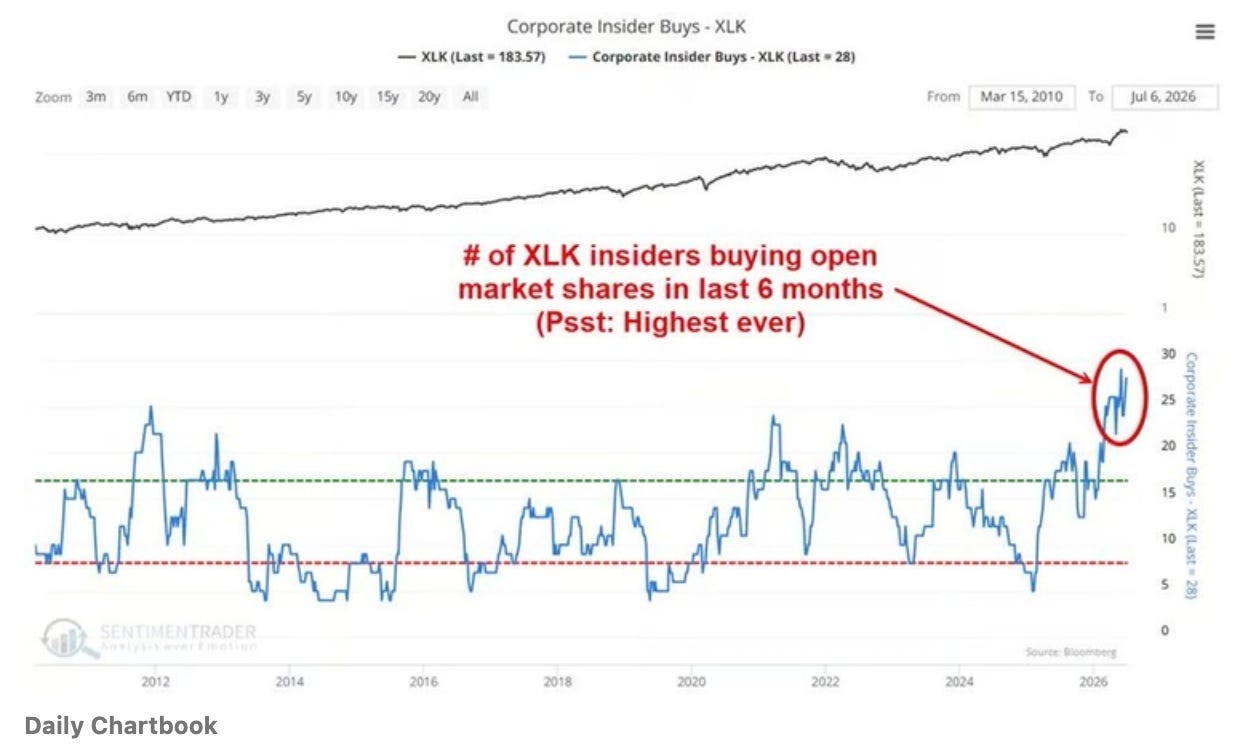
[Newsletter Exclusive] Tech insiders are buying like never before
Corporate insiders in the technology sector are buying up shares of their own companies at an unprecedented pace, signaling strong internal confidence despite shifting market dynamics.
The number of tech insiders purchasing open-market shares within the Technology Select Sector SPDR Fund (XLK) has spiked to its highest level since tracking began in 2010, according to data compiled by SentimentTrader.
Link to Seeking Alpha News Article - Jul 08, 2026
TSM 0.00%↑ IBM 0.00%↑ #Rapidus
Rapidus plans to establish its 2nm foundry process at or less than TSMC’s pricing
Rapidus, a Japan-based semiconductor foundry, plans to set the pricing for its 2-nanometer process, which is scheduled to begin mass production during the second half of fiscal 2027, at or below competitor Taiwan Semiconductor Manufacturing (TSM), according to its CEO, Atsuyoshi Koike.
Rapidus’ development of its 2nm process is forged through a strategic joint partnership with IBM (IBM). IBM is providing the packaging technology for high-performance semiconductors.
Link to Seeking Alpha News Article - Jul 08, 2026
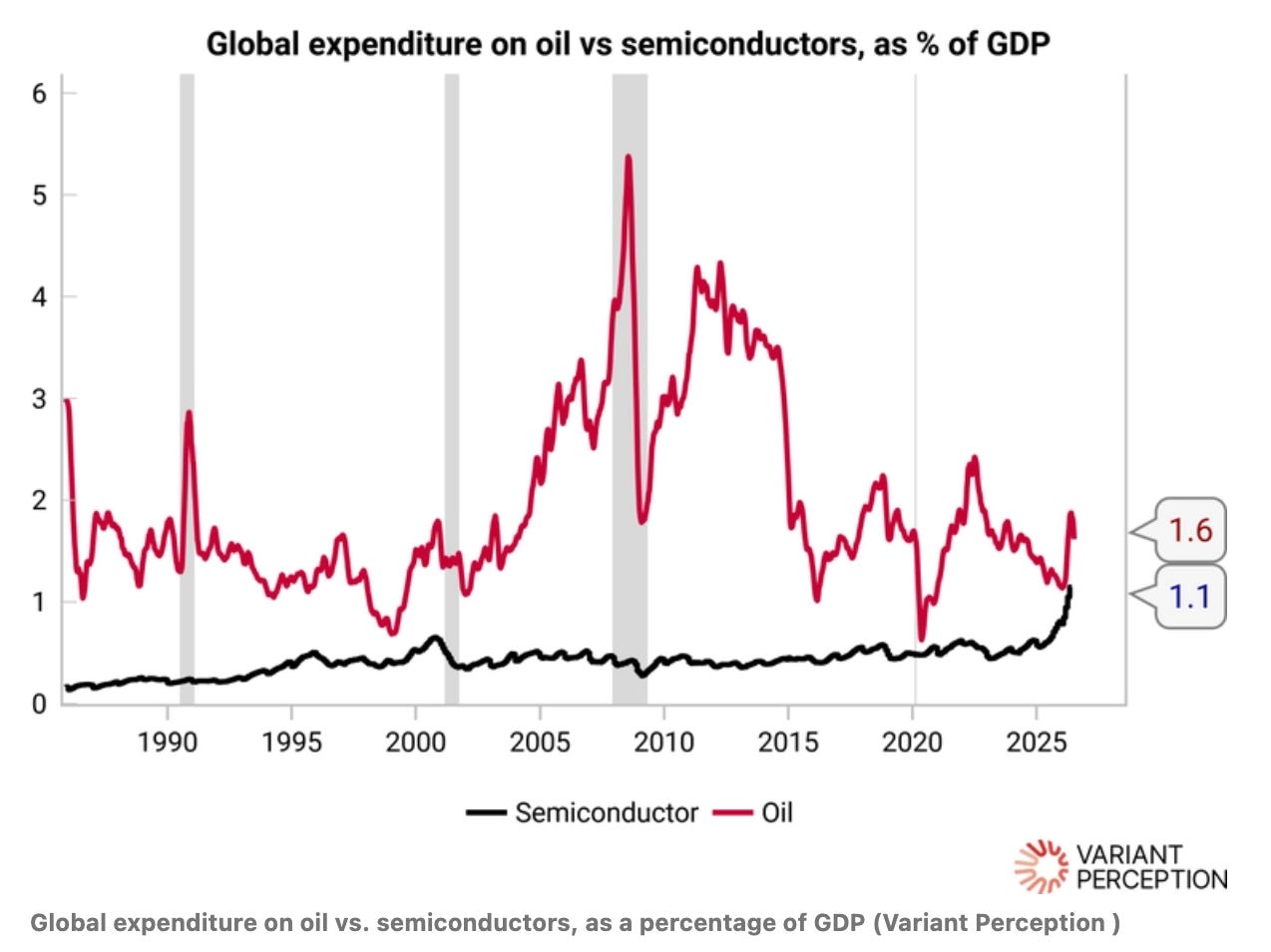
[Newsletter Exclusive] Global capex on semis is catching up to oil capex as a percentage of GDP
Global expenditure on semiconductor companies has risen to 1.1% of GDP, very close to the 1.6% of global expenditure on oil as a percentage of GDP.
The global expenditure on crude oil (CL1:COM) reached about 2.2%-2.3% of global GDP before dipping to 1.6%. This ratio is sitting below the long-term historical average of 2.6%.
Link to Seeking Alpha News Article - Jul 08, 2026
D-Wave crowned as “top global quantum leader” by IDC: CEO comment inside
D-Wave Quantum (QBTS) announced that it has been named a Leader in the IDC MarketScape: Worldwide Quantum Computing 2026 Vendor Assessment, becoming one of only two companies placed in the Leaders Category.
The recognition highlights D-Wave’s commercial deployments progress across industries, including manufacturing, telecom, logistics, and defense.
The company said more than 200M problems have been submitted to its systems, while usage of its Advantage2 system increased 314% YoY, and its Stride hybrid solver grew 114% over six months as of early 2026.
Link to Seeking Alpha News Article - Jul 08, 2026
Cerebras Systems eyes multi-billion-dollar Europe investment
AI infrastructure company Cerebras Systems (CBRS) is significantly expanding its presence in Europe with plans to launch its first regional data center capacity by the end of 2026.
According to a statement from the company cited by AFP, Cerebras plans to invest several billion dollars in Europe as part of the expansion.
The company said it will rapidly build out infrastructure across France and the Nordic region, targeting 200 megawatts of total capacity by the end of 2027. A portion of that capacity is expected to support OpenAI (OPENAI) workloads under the companies’ existing partnership.
“We are contracting significant capacity for 2027, with data centers slated for Norway and Finland as we actively build across Europe,” said Cerebras co-founder and CEO Andrew Feldman. “These deployments will enable us to move decisively on what our customers have been asking for: fast, high-performance AI compute located in Europe.”
The company claims its flagship Wafer-Scale Engine 3 (WSE-3) is the world’s fastest commercially available AI processor. The company claims the chip is 58 times larger than the leading GPU and delivers AI inference up to 15 times faster than Nvidia’s (NVDA) GPU-based systems while using a fraction of the power per unit of compute.
Cerebras designs chips, but not like Nvidia. Nvidia makes GPUs — lots of small-ish dies. Cerebras makes the WSE (Wafer Scale Engine) — instead of cutting a silicon wafer into hundreds of individual chips, they use the entire wafer as one giant chip. It’s the largest chip made commercially, optimized for extremely fast AI inference (running trained models, not training them) because everything sits on one piece of silicon with huge on-chip memory bandwidth, avoiding the bottleneck of chips talking to each other over a network.
Link to Seeking Alpha News Article - Jul 09, 2026
WealthWise Research - Jul 09, 2026
AIQ 0.00%↑ IGV 0.00%↑ SBUX 0.00%↑ MSFT 0.00%↑ IBM 0.00%↑ ORCL 0.00%↑
Starbucks eyes AI-built software to reduce Microsoft, IBM spending - report
The coffee store is building alternatives to Microsoft’s (MSFT) inventory management system and IBM’s (IBM) maintenance management software, with some internally developed applications expected to roll out by the end of next year, pending testing, the report said.
CTO Anand Varadarajan told employees earlier this year that Starbucks (SBUX) spends about $400M annually on software and sees “clear opportunities to reduce the spend in software.”
The company is reviewing every technology contract and service and, in some cases, building its own software to replace applications that engineers already heavily customize. Starbucks (SBUX) has also been working for several years on a point-of-sale system designed to replace Oracle’s (ORCL) Simphony platform.
AI-assisted coding played a key role in developing the platform that could replace IBM’s (IBM) tool, according to the internal presentation.
The enterprise technology team is on track to reduce its budget by about $30M in the fiscal year ending in late September, including about $10M in software savings and another $13M primarily from reducing contractor spending and replacing some roles with in-house staff.
Link to Seeking Alpha News Article - Jul 09, 2026
QQQ 0.00%↑ QQQM 0.00%↑ IQQ 0.00%↑
Why BlackRock’s new Nasdaq 100 ETF matters to tech investors
Nasdaq 100 ETFs have become more important to tech investors since MSCI and S&P Dow Jones Indices changed the definition and constituents of the GICS sectors in 2018. “Tech-driven” stocks Meta, Alphabet, and Netflix were moved from the Technology sector to the Communications Services sector, and Amazon was moved from the Technology sector to the Consumer Discretionary sector.
Before 2018, the favored ETF for many tech investors who wanted to own all the big tech and “tech-driven” stocks was the State Street Technology Select Sector SPDR ETF (XLK), or the similar ETFs VGT, IYW, and FTEC. But since the GICS change, tech- and growth-focused investors who want to own the most popular names, including Nvidia, Apple, Micron, Alphabet/Google, Microsoft, Amazon, Meta, and Netflix, couldn’t do so with a single sector ETF.
While the S&P 500 ETF includes all the large-cap tech and “tech-driven” stocks, it also includes many lower-growth companies and sectors, such as real estate, energy, and utilities. So it’s not sufficiently focused for tech and growth investors.
This is where the Nasdaq 100 comes into play: It includes all the large-cap tech and “tech-driven” stocks that many tech and growth investors want to own, including Alphabet, Meta, Amazon, and Netflix. Not surprisingly, the original Nasdaq 100 ETF (QQQ), which is owned by Invesco, has $476B of assets under management.
Given the popularity of the original Nasdaq 100 ETF (QQQ), why did Invesco rename it “The Invesco QQQ Trust, Series 1 ETF” and launch an essentially identical Nasdaq 100 ETF, the Invesco NASDAQ 100 ETF (QQQM)? The answer is that due to competition in the ETF market, Invesco had to offer an ETF with a lower expense ratio if it wanted to acquire new assets.
Why didn’t Invesco just cut the expense ratio of QQQ? Because many investors are locked into QQQ due to large unrealized capital gains. If they switch out of QQQ to an identical ETF with a lower expense ratio, they will trigger capital gains tax obligations that exceed the value of a lower expense ratio.
To maximize profits, Invesco kept QQQ at a higher expense ratio (currently 0.18%) to profit from the locked-in assets and launched an identical ETF (QQQM) with a lower expense ratio (currently 0.15%) to attract new assets. QQQM now has $97B of assets under management.
Note that BlackRock used the same strategy with EEM (expense ratio 0.76%) and IEMG (expense ratio 0.09%), and with IAU (expense ratio 0.25%) and IAUM (expense ratio 0.07%). State Street did the same with GLD (expense ratio 0.40%) and GLDM (expense ratio 0.10%).
However, QQQM’s expense ratio of 0.15% is high relative to other massive US equity ETFs. For example, the Vanguard 500 Index Fund ETF (VOO) has an expense ratio of 0.03%.
This provided an opportunity for BlackRock.
The new iShares Nasdaq 100 ETF (IQQ) undercuts QQQM on expenses: it will have a gross expense ratio of 0.12%, with a waiver reducing the expense ratio to 0.10% through July 31, 2027.
With the new iShares Nasdaq 100 ETF (IQQ), BlackRock now offers a Nasdaq 100 ETF that includes all the tech and “tech-driven” mega cap stocks, with the lowest expense ratio of the Nasdaq 100 ETFs.
Link to Seeking Alpha News Article - Jul 09, 2026
Aehr Test Systems wins follow-on order from lead silicon photonics customer, shares jump
The order is for a fully automated FOX-XP Wafer-Level Burn-In System. The system will support high-volume production burn-in of silicon photonics devices used in AI optical interconnect and hyperscale data center applications.
This customer took delivery of its first FOX-XP with fully automated WaferPak Aligner production system in fiscal 2026.
Aehr didn’t name the customer.
Link to Seeking Alpha News Article - Jul 09, 2026
[Newsletter Exclusive] Nvidia in focus as Citi weighs in on investor concerns
After speaking with Nvidia’s investor relations team, Citi analysts said that not only is the company’s product roadmap fully intact (referring to a recent report that suggested its next-gen Kyber line would be delayed), but the NVLink domains that were highlighted at Computex have not changed either.
The Jensen Huang-led company also reiterated that co-packaged optics for scale-out is in production with Spectrum-X, and more details about customer adoption will be released later this year. The company did add it expects adoption levels to be “high.”
Nvidia also said that in 2028, customers will have the option to use NVLink with co-packaged optics or copper for its Feynman line.
The debate of open vs. closed models was also brought up, and Nvidia believes both are important, with frontier models used to drive performance and open-source models used by enterprises and sovereigns to adopt, ramp, and scale AI.
Link to Seeking Alpha News Article - Jul 09, 2026
AAPL 0.00%↑ BABA 0.00%↑ #PrismML
Startup PrismML shrinks a large AI model for use in Apple’s iPhone: report
AI startup PrismML has shrunk down Alibaba’s (BABA) open-source large language model Qwen 3.6 to run on Apple’s (AAPL) iPhone 17 Pro, The Information reported.
The model has 27B parameters and can help determine the complexity of the data a model can process. In contrast, most models that run on mobile phones have only a few billion parameters active at a time.
The largest AI models, which can measure in the trillions of parameters, are still too big to run on mobile devices. However, the model PrismML got working on an iPhone is capable oftasks such as complex chat, reasoning, fully autonomous agents, and software coding, according to the startup. The open-source model will be available for download next week on Tuesday, the report added.
PrismML uses a mathematical trick to reduce the Qwen 3.6 model to a fraction of its original size. Shrinking models usually results in worse performance, but the company claims its method for miniaturizing AI model sizes does not hinder their performance. PrismML has compressed the size of Qwen 3.6 to less than 4 gigabytes, down from about 54, according to the report.
PrismML’s approach may appeal to Apple. At the company’s Worldwide Developers Conference in June, Apple announced its Siri overhaul based on Google’s (GOOG) (GOOGL) Gemini models. The most advanced parts of Siri are still so big that they require Apple to use Nvidia (NVDA) chips running in Google Cloud. As part of the new Siri announcement, Apple noted that some of the iPhone’s new AI capabilities would run on devices.
One new on-device Apple model has 20B parameters but uses a so-called sparse architecture, in which only 1B to 4B parameters are active at a time. In the case of PrismML’s on-device model, all 27B parameters are active at the same time, the report added.
Link to Seeking Alpha News Article - Jul 09, 2026
nLight surges 30% after laser weapon system contract from Pentagon
The U.S. Department of War has awarded an initial $86M to Lockheed Martin (LMT) and nLight (LASR) to advance the next-generation cruise missile and unmanned aerial system, or UAS, defense architecture.
The Department of War said that by developing containerized high-energy laser weapons, it aims to provide combatant commanders with scalable, cost-effective intercept solutions for high-tier adversary threats. These prototype systems offer critical operational advantages over traditional kinetic systems, including speed-of-light engagement, deep magazines, and lower cost-per-intercept, the agency noted.
Link to Seeking Alpha News Article - Jul 09, 2026
Fervo Energy surges as faster Cape Station drilling seen lowering cost concerns
Fervo Energy (FRVO) up 14.1% in Thursday’s trading after reporting a 143% improvement in drilling rates at its Cape Station geothermal development, with the Sawtooth 7 well reaching a measured depth of 19,448 ft with a 7,500-ft lateral in just 21 days.
The company said its record drilling pace on its most complex well design to date reflects a 70% reduction in drilling time compared to its first commercial horizontal well and supports its “core strategic thesis that incremental learnings will drive meaningful productivity gains and reduce costs over time.”
Sawtooth 7 uses Fervo’s (FRVO) more complex Generation 3.0 design, reaching hotter 460°F rock with longer laterals and larger casing while still matching the 21-day drilling timeline achieved by the simpler Phase I well design.
Wells are a major cost driver in enhanced geothermal development, and shorter drilling times can lower capital intensity, improve project returns, and help Fervo (FRVO) move closer to its target of reducing installed costs from an expected $5,500/kW at Cape Phase II toward $3,000/kW over time.
“With this momentum from initial Phase II drilling, we expect Fervo’s 3.0 well design to produce substantially more megawatts per well and significantly improve the unit economics of future GeoBlocks,” Fervo (FRVO) CEO Tim Latimer said.
Link to Seeking Alpha News Article - Jul 09, 2026
Netflix exploring live TV, streaming bundles to revive slipping viewer engagement: WSJ
Netflix (NFLX) is reportedly looking into live TV and streaming bundles to counteract slipping viewer engagement, even as the streaming giant enjoys rising profits and industry-low cancellation rates.
According to a Wall Street Journal report, the streamer is rethinking some of its core strategies to compete with rivals.
Top Netflix (NFLX) executives who gathered for its annual business review this spring discussed subscriber engagement, which was showing signs of decline, even as it had hit franchises including “Bridgerton” and “Stranger Things,” the report said.
It has since become a frequent topic of discussion at meetings, people familiar with the matter noted.
Link to Seeking Alpha News Article - Jul 10, 2026
XPeng starts employee testing of robotaxi platform
The launch comes about eight months after XPeng unveiled its Robotaxi initiative at AI Day 2025. Chairman and CEO He Xiaopeng became the first employee to complete a fully autonomous robotaxi trip, placing a ride request through the platform and traveling end-to-end without human intervention.
“Robotaxi represents an important step in XPENG’s expansion from smart electric vehicles to robotic vehicles,” said He Xiaopeng, Chairman and CEO of XPENG. “Over the next decade, Physical AI will increasingly evolve into robots. For XPENG, Robotaxi is not simply a new business, but one of the most important milestones in unlocking the real potential of Physical AI.”
Following the employee testing phase, XPeng plans to begin trial operations and establish regular demonstration services in 2026, starting in Guangzhou. The company also said it is exploring potential robotaxi partnerships in Europe, the Middle East and Southeast Asia.
Link to Seeking Alpha News Article - Jul 10, 2026
MongoDB differentiates from Snowflake, Datadog; Needham retains Buy rating, raises target
MongoDB (MDB) is routinely grouped with Snowflake (SNOW) and Datadog (DDOG), but Needham said this is an unfair comparison as each of these companies operates at different layers of the infrastructure software vendor stack when it comes to AI monetization.
“The more applicable relationship is Snowflake (data warehouse) to MongoDB (database), but even this breaks down,” said Needham analysts Mike Cikos and Matthew Calitri in a Friday investor note. “The reason is Snowflake is largely tied to OLAP-based (online analytical processing), internal-facing applications. If the use of AI results in an error, it’s ugly but can be overcome. Meanwhile, MongoDB’s positioning with OLTP-based (online transaction processing) applications needs large external-facing use cases to achieve mass scale to begin benefiting the model, which requires a higher threshold for security, fidelity, and governance before moving into production - since these applications are based on real-time data and customer-facing.”
Needham retained its Buy rating on MongoDB and increased its price target to $430 from $400.
“We believe MongoDB is accelerating its value as a premier database technology as it adds new features that would have required separate solutions for customers to integrate,” Cikos noted. “Moreover, prior investments in enterprise features for Atlas appear to be paying dividends as the company has noted solid strength within Enterprise customers. MongoDB’s popularity with the Developer community is a key component to the strategy and our investment thesis. We believe the company is leading the pack in addressing the next-generation database market, which MongoDB estimates at ~$105 billion today.”
Link to Seeking Alpha News Article - Jul 10, 2026
$SKHY
SK hynix hits Nasdaq at $171; CEO expects memory crunch to extend beyond 2030
SK hynix (SKHYV) hit the Nasdaq shortly before noon on Friday at $171.21, with shares briefly hitting as high as $179.
The prolific South Korean memory maker sold 177.9M American Depository Receipt shares priced at $149 each, which raised $26.5B. This made history as the largest initial public offering ever by a foreign company in the U.S. It closed at $169.21.
Although it is currently listed under the ticker SKHYV, it is expected to switch to SKHY on Monday, July 13.
SK hynix CEO Kwak Noh-Jung said in an interview on Friday he expects the current memory shortage to extend beyond 2030, according to Bloomberg. He indicated that customers are signing up for long-term contracts because “they believe that the shortage situation will last for longer.”
Link to Seeking Alpha News Article - Jul 10, 2026
Disclosure: We own positions in some/all of the tickers mentioned in this article.