Alpha Coverage #172
AI, Robotics, Space, Quantum Computing, Climate Change/Energy Transition, Biotech/Genomics

Weekly newsletter bringing you a summary of unbiased, critical, thesis changing stock market news for long term impact. We cover news articles, opinion pieces and all forms of media to help you stay ahead of the curve. WealthWise Coverage Universe (Only for paying subscribers).
A Seeking Alpha subscription would help. Here is a 7 Day Free Trial + $30 off coupon to help you get started (Affiliate Link).
This Week’s Alpha Coverage: YouTube Playlist or Weekly Compilation.
Editor’s Pick:
[News] AMD rises after Microsoft plans to deploy AMD Helios racks on Azure for AI inference
Microsoft will deploy the AMD Helios Rackscale Solution to power frontier model AI inference for Microsoft and its AI customers and support Azure AI services.
Azure — Microsoft’s cloud computing platform — will also add two new AMD EPYC CPU-powered VM series and broaden its deployment of Pensando Data Processing Units, or DPUs, according to the companies.
AMD said Helios combines Instinct MI455X GPUs, AMD EPYC Venice CPUs, Pensando networking and ROCm software in an open, integrated rackscale platform built for large-scale AI training and inference.
Link to Seeking Alpha News Article - Jul 20, 2026
[News] Tesla adds Orlando and Tampa to robotaxi service network; But Fleet Size Stays Small
Tesla (TSLA) has expanded its robotaxi service to Orlando and Tampa, Florida, with the company announcing the addition of the two cities in a post on X as it works to broaden its autonomous ride-hailing operations.
Tesla (TSLA) began its robotaxi service in Austin, Texas, in June last year and has since extended the service to Dallas, Houston, and Miami. The company is also carrying out supervised testing in California’s San Francisco Bay Area.
Fleet size for the new cities wasn’t disclosed — but independent tracking of Tesla’s public robotaxi app puts the unsupervised Austin fleet at around 17 cars (down from ~25 in April), with Dallas at about 4 — figures Tesla itself hasn’t confirmed.
Link to Seeking Alpha News Article - Jul 21, 2026
WealthWise Research - Jul 21, 2026
[News] SpaceX faces massive share unlocks as investors brace for insider selling
SpaceX (SPCX) will begin releasing large blocks of previously restricted shares next month, with insiders becoming eligible to sell stock worth as much as $116 billion in the first phase of a staggered lock-up schedule following the company’s blockbuster IPO.
The first restrictions expire on Aug. 6, shortly after SpaceX reports quarterly earnings. Under the company’s unusual lock-up structure, about 911.5 million shares will become eligible for sale initially, with hundreds of millions more potentially unlocking immediately if the stock meets a performance target tied to its post-IPO share price.
By early December, more than 5.3 billion shares could be available for trading, compared with roughly 639 million today, according to the company’s IPO filing.
Chief Executive Elon Musk, who controls about 60% of the company’s outstanding shares, remains subject to a longer lock-up and is not expected to begin selling until more than a year after the June IPO.
Link to Seeking Alpha News Article - Jul 21, 2026
[News] Rocket Lab wins $266M contract for 12 suborbital launches; shares rise after hours
Rocket Lab (RKLB) secured a $266M firm-fixed-price contract for 12 suborbital launches for the U.S. government, with an option for six additional launches.
Launches will take place from the Pacific Spaceport Complex in Alaska, while the work is expected to be completed by Dec. 31, 2028.
About $112M in FY2025 research, development, test, and evaluation funds was obligated at the time of the award.
The Space Systems Command is the contracting agency.
Link to Seeking Alpha News Article - Jul 21, 2026
[News] Oklo, X-Energy to join Trump administration effort to speed nuclear reactors for AI - Bloomberg
Oklo (OKLO) up 5.8% and X-Energy (XE) up 7.1% post-market Tuesday following a Bloomberg report that the advanced nuclear reactor suppliers are joining tech giants in a program led by the Trump administration intended to speed the development of new power plants for AI data centers.
The program seeks broadly to address rising concerns that the growth of data centers needed to feed the artificial intelligence boom has caused electricity prices to spike nationwide.
Among the goals of the latest initiative are steep reductions in time needed to design, license, and build new plants, as well as cuts in the number of staff needed to run them, the report says.
Link to Seeking Alpha News Article - Jul 21, 2026
[News] Joby Aviation rises after finalizing Virgin Atlantic deal
Joby Aviation (JOBY) shares rose nearly 7% in premarket trading on Wednesday after the electric air taxi developer finalized its partnership with Virgin Atlantic, converting an agreement announced in 2025 into a binding, multi-year commercial deal.
The agreement establishes Virgin Atlantic as Joby’s exclusive airline partner for air taxi services in the UK. Travelers will be able to book Joby’s air taxi flights through Virgin Atlantic’s website and mobile app alongside long-haul flights.
Joby plans to launch services from Virgin Atlantic’s hubs in London and Manchester, with initial routes expected to include Manchester Airport to Leeds in about 15 minutes and Heathrow to Central London in as little as eight minutes.
Under the partnership, Joby will oversee aircraft operations, route planning, and regulatory approvals from the UK Civil Aviation Authority, while Virgin Atlantic will support infrastructure integration and customer acquisition at both hubs.
The collaboration builds on Joby’s existing partnership with Delta Air Lines (DAL), which holds a 49% stake in Virgin Atlantic.
Link to Seeking Alpha News Article - Jul 22, 2026
AMD 0.00%↑ #Anthropic
[News] AMD, Anthropic sign chip and investment deal worth billions
As part of the deal, Anthropic will deploy up to 2 gigawatts of AMD’s MI450 AI accelerators, starting in the first half of 2027. The Claude maker will deploy AMD’s Helios rack-scale solutions, including its MI455X GPUs, with its EPYC Venice CPUs, Pensando networking solutions, and ROCm software.
In addition, AMD will invest up to $5B in Anthropic in the future, the chipmaker added.
KeyBanc analyst John Vinh estimated the full 2-gigawatt deployment could be worth a potential $27.2B in revenue for AMD, adding there are “positive implications as AMD is further validated as a credible AI accelerator alternative.”
Link to Seeking Alpha News Article - Jul 22, 2026
NBIS 0.00%↑ CRWV 0.00%↑ IREN 0.00%↑ GOOGL 0.00%↑
[News] Google plans to use third-party data-center capacity in Q3; These stocks are benefiting.
While Google upped its 2026 spending forecast, the company also made the disclosure that it is going to start relying on third parties to help with the “supply constrained environment,” as demand for AI continues to skyrocket.
“And given the supply constrained environment, we plan to expand the use of third-party capacity in Q3 as a bridging strategy while we build up more internal capacity,” Google CFO Anat Ashkenazi said on the earnings call. “This strategy allows us to keep growing our customer base and capture greater overall value. However, it will create modest margin pressure in the near term as we utilize this capacity.”
Ashkenazi’s comments aided shares of neocloud computing companies such as Nebius Group N.V. (NBIS), CoreWeave (CRWV), and IREN (IREN), which were up between 1% and 2.5%, respectively.
Link to Seeking Alpha News Article - Jul 23, 2026
[Opinion] Solid Power: Upgrading On Commercial Prospects
SLDP has adopted a B2B licensing and supply model. The model ensures it can partner with incumbent manufacturers, helping them stave off threats from potential replacement technologies.
The SLDP electrolyte can be used in existing roll-to-roll manufacturing of battery cells, making the technology highly compatible with existing large-scale manufacturing plants and reducing adoption costs by up to 90% compared to building entirely new production lines.
The core of SLDP’s technology is its sulfide-based solid electrolyte, which replaces the flammable liquid electrolytes found in traditional Lithium-ion batteries.
The company is currently moving from “batch” processing (30MT/year) to a continuous manufacturing process expected to hit 75MT/year by the end of 2026 and 140 MTons by end 2028.
Several scientific research papers suggest that sulfides are the most promising among solid-state electrolyte technologies.
A substantial advantage of solid batteries could be the ability to incorporate lithium and silicon anodes. Silicon anodes are a short-term prospect (Amprius (AMPX) is making real progress, and I am a repeat investor), and lithium anodes are probably more medium-term.
SLDP has proven its electrolyte works; it has demonstrated this with the cathode and the anode. I also believe they can make it at scale. The issue is, can solid-state batteries be made at scale?
Scaled production of the batteries is the final hurdle for them to jump.
SLDP is not going to make the battery or the cells; they are hoping existing battery companies can solve this final issue.
Two large battery manufacturers have committed to installing pilot lines and moving to commercial production:
The original agreement, signed in 2024, is valued at $50 million and has three parts. An R&D license for SLDP’s products and processes. A commitment to build a pilot production line at SK On’s site in Korea and an electrolyte supply agreement.
Construction on the pilot line started almost immediately and is now in the commissioning phase. Factory acceptance was completed in early 2026, and the focus will shift to supplying sample cells to OEM customers. SK recently pulled forward the commercialization date by 1 year to 2029.
A second Korean manufacturer, Samsung SDI, has joined the SLDP team.
Samsung has joined the BMW/SLDP joint venture and will manufacture prismatic cells for BMW under the SolidStack brand using SLDP electrolyte and know-how.
BMW released a prototype BMW i7 demo vehicle late last year and intends to have early functional prototype vehicles running later this year.
The SLDP/BMW/Samsung SDI deal is unique in the industry, creating a distributed manufacturing model that could serve as the basis for SLDP’s business model going forward.
Link to Seeking Alpha Opinion Piece - Apr 30, 2026
[Opinion] Pony AI: Buying The Wuhan Whiplash
Pony delivered an outstanding set of Q1 results, raised its full-year 2026 guidance, and achieved unit operating break-even in its core tier-1 Chinese cities.
The company dramatically increased its TAM with a new L4 autonomous light-duty truck co-developed with the battery giant CATL, which will reduce per-kilometer operating costs by 45%.
In April, Pony was the first company to start large-scale robotaxi operations in Europe, following a landmark agreement with UBER and Verne to roll out a fleet of thousands of robotaxis across Europe.
The CATL truck and the UBER taxis use the same tech and business model. PONY will provide the virtual driver, no CAPEX from PONY, and no need to own large fleets of vehicles. The asset-light business plan is showing its ability to scale.
During the evening rush hour on March 31st, around 200 Baidu robotaxis suddenly applied their emergency brakes. They simultaneously stopped all over the city, many on high-speed highways, bridges, and main commuter routes. The sudden braking caused multiple rear-end collisions (thankfully, no significant injuries); it caused traffic chaos across the city, and the cars remained stuck for several hours, with people unable to get out as they were in the middle lane of highways, no one was physically trapped inside, but it was hours before they were able to continue their journey.
The Chinese authorities instituted a “cooling off” period, stopping the launch or expansion of any robotaxi services. It brought growth in the Chinese robotaxi market to an abrupt halt. This event triggered the price decline, which has been exacerbated by the broader tech/AI sell-off in recent weeks, bringing PONY to its current bargain-basement price.
The fault has been traced back to a cloud outage, and, almost inconceivably, Baidu cars were unable to operate without a full-time link, so they just hit the emergency brake, every single one of them. Having a single fail point that disables the entire fleet was poor engineering, likely corner-cutting.
The CTO said in the Q1 earnings call:
“Every single Pony’s Robotaxi features a full stack multilayer redundancy architecture for both software and hardware. This gives us good operational capability. If any component fails during a trip, the system stays fully functional. The car will continue to drive safely to the secure spot and pull over, avoiding traffic congestion and rear end crashes.
Furthermore, our car can drive normally even when there’s no network or GPS signal, both of which can easily drop in urban environments. We also do not rely on high-definition maps.”
Pony uses Edge Computing Redundancy rather than Centralized Cloud Dependency, with Pony’s virtual driver running locally (inside the vehicle) on NVIDIA Drive Orin processors.
Following a record-breaking start to the year, Pony aggressively raised its 2026 targets in the Q1 earnings call (delivered after Wuhan). It raised total fleet guidance from 3,000 to 3,500 units and guided to FY 2026 robotaxi revenue to increase by 350%. Pony maintained its 20+ cities forecast for 2026, with a 50/50 China-international split.
Pony reported accelerating momentum in its Q1 earnings with revenue growing 145% YoY, gross margin increasing to 16%, and a net loss of $41 million. Robotaxi monetization is tracking well and grew 395% YoY to $8.6 million, driven by an increase in direct fare collection of 457%.
PONY reported breakeven unit economics for its taxi operations in Shenzhen earlier this year. Profitable robotaxi operations are a big deal.
Fleet size, registered users, and paid orders grew sequentially every month, average monthly users doubled in May, and Labor Day volumes were up 544%, surpassing the previous record high of Chinese New Year.
International expansion continues, in addition to the European growth already discussed. Pony expects the driverless pilot in Dubai to go fully commercial in H2 2026 with “several hundred” taxis. Passenger operations are now live in Singapore, and Chinese authorizations continue to track higher.
The robotruck operation, often missed by many investors, continues to expand. In Q1 it delivered $10 million in revenue, up 31%. The fourth-generation battery-electric heavy truck is scheduled to enter thousand-unit-scale mass production in H2 2026.
Pony has a fleet of class 8, fully autonomous trucks authorized to travel in 1+4 convoys. (one human-driven truck and 4 autonomous ones following). Field data suggests a 29% reduction in freight costs.
Pony has a fortress balance sheet with $1.7B of shareholder equity and zero debt.
Link to Seeking Alpha Opinion Piece - Jun 27, 2026
News, Facts, Analyst & Market Commentary - Short Reads:
USO 0.00%↑ ITA 0.00%↑ TLT 0.00%↑ GLD 0.00%↑ SPY 0.00%↑
Iran says it’s suspending ceasefire commitments with U.S. after escalating strikes
Iran says it is suspending all commitments reached with the U.S. under the Islamabad Memorandum of Understanding a month ago, accusing Washington of violating the deal through a wave of military strikes.
The U.S. military launched airstrikes targeting Iran’s Islamic Revolutionary Guard Corps on Sunday in retaliation for an attack in Jordan that killed two American service members and wounded four others, further escalating the conflict between Washington and Tehran.
Link to Seeking Alpha News Article - Jul 18, 2026
Link to Seeking Alpha News Article - Jul 20, 2026
Oil cushion thins as U.S. crude supply falls to 45-year low
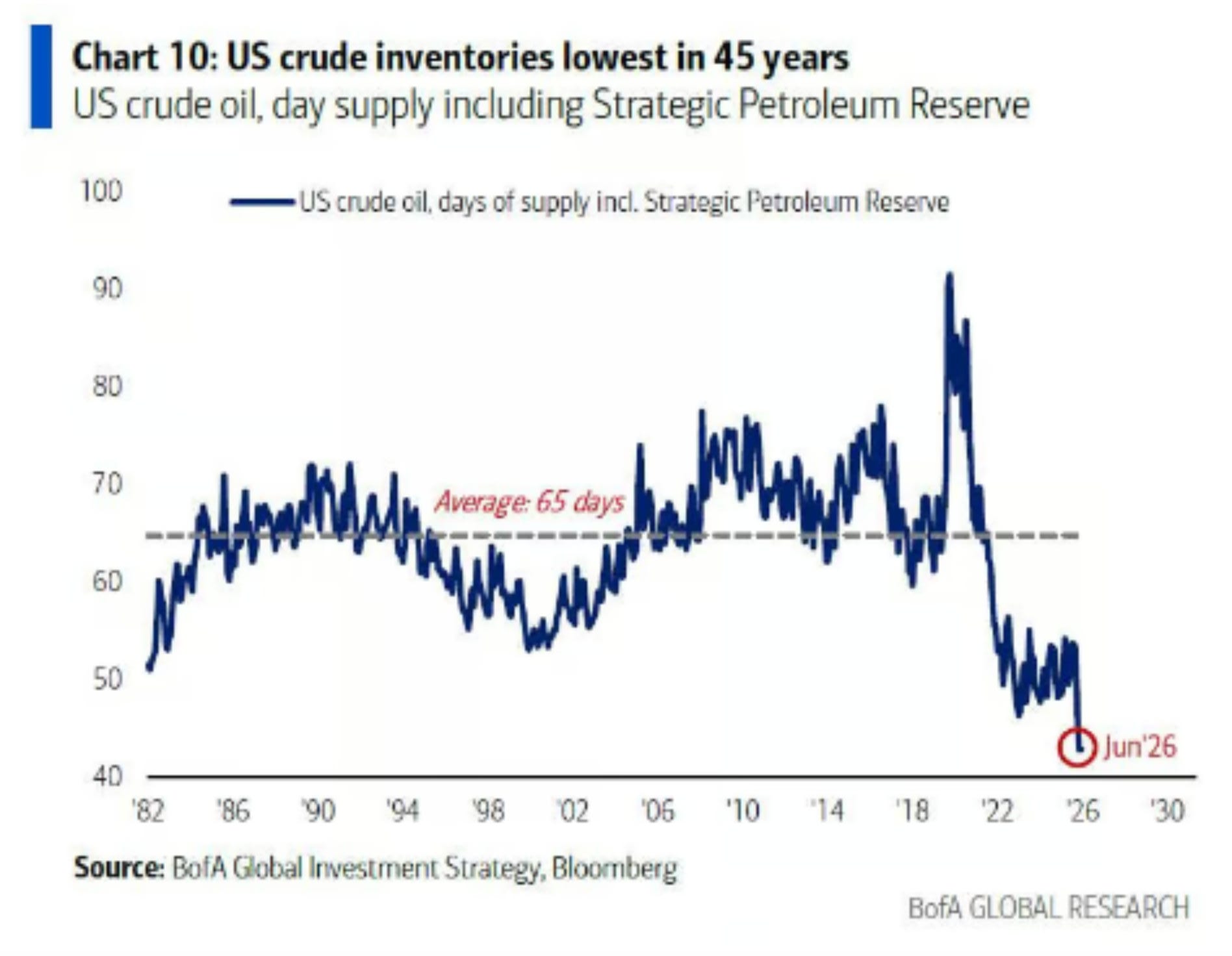
In a post on X, Barchart shared a Bank of America Global Research chart showing the U.S. had about 43 days of crude oil supply, including the Strategic Petroleum Reserve, compared with a long-term average of around 65 days.
Based on Bloomberg data, the chart showed the measure falling to its lowest level since the early 1980s.
The International Energy Agency’s member countries still hold “a substantial volume” of emergency oil reserves, including more than 1B barrels of government-controlled stocks, despite the largest coordinated release of strategic reserves on record, the agency reported Tuesday.
While the report offers some comfort, Birol added there is “no room for complacency” regarding oil security, as tensions escalate again in the Middle East.
Link to Seeking Alpha News Article - Jul 20, 2026
Link to Seeking Alpha News Article - Jul 21, 2026
IREN gains on $2.8B in multi-year AI cloud contracts; boosts 2026 ARR target above $4B
IREN (IREN) has signed new multi-year cloud services contracts with leading AI developers totaling approximately $2.8B in contract value and has raised its year-end AI Cloud annualized run-rate revenue (ARR) target from $3.7B to more than $4B.
IREN said contracted pricing has strengthened and that recent agreements include customer prepayments representing about 45% of the associated GPU capital expenditure for those deployments.
IREN reported that its customer contracts have a weighted average term of approximately four years and that demand across hyperscalers, enterprises, AI developers and frontier labs exceeds its available and planned capacity.
The company noted that its customer base now includes Microsoft (MSFT), Nvidia (NVDA), Perplexity & Figure AI, amongst others.
Link to Seeking Alpha News Article - Jul 20, 2026
Link to Seeking Alpha News Article - Jul 20, 2026
ACHR 0.00%↑ #Anduril
Anduril and Archer unveil autonomous military tiltrotor aircraft at Farnborough
Anduril Industries and Archer Aviation (ACHR) unveiled Thunder, an autonomous military tiltrotor aircraft designed to operate alongside crewed helicopters.
Anduril said Thunder is a Group 5 autonomous rotorcraft designed to support attack, reconnaissance and logistics missions while operating with crewed aircraft.
The aircraft uses a tiltrotor design that combines vertical takeoff and landing with fixed-wing cruise flight. According to the companies, Thunder is based on a dual-use platform developed with Archer Aviation (ACHR) and incorporates hybrid-electric propulsion technology originally developed for commercial aircraft.
According to Anduril, Thunder features modular payload bays that can be configured for precision-guided missiles, rockets, electronic warfare equipment, cargo or counter-drone systems.
The company said the aircraft can be adapted for missions including strike operations, maritime patrol, contested logistics and carrying air-launched drones.
Anduril also said multiple Thunder aircraft could operate alongside a single crewed helicopter using autonomous software. As an example, the company said pairing three Thunder aircraft with one AH-64 Apache helicopter could increase the formation’s available weapons without adding additional flight crews.
The aircraft will use Anduril’s Lattice for Mission Autonomy software, which the company said enables autonomous formation flying, route planning and mission coordination with crewed aircraft.
The companies said Thunder has already undergone multiple surrogate flight tests using full-scale aircraft as development continues toward the planned 2027 flight demonstration.
Link to Seeking Alpha News Article - Jul 20, 2026
BMNR 0.00%↑ #ETH
Bitmine Immersion tops $11.5B in assets: Inside ETH purchases, 5.5M-share buyback
Bitmine Immersion (BMNR) announced on Monday that its crypto, cash, marketable securities, and “moonshots” holdings reached $11.5B as of July 19.
The company held 5.78M Ethereum (ETH-USD) worth about $10.9B, 207 Bitcoin (BTC-USD), $385M in cash and marketable securities, a $180M stake in Beast Industries, and a $58M stake in Eightco Holdings (ORBS).
The company bought 7.43K ETH during the past week, increasing its holdings to 5.78M ETH, representing 4.8% of the total 120.7M ETH supply.
Moreover, the company repurchased 5.5M common shares at an average price of $15.62 under its existing $4B share buyback program.
Chairman Tom Lee said the slower pace of ETH purchases reflected the company’s decision to prioritize share repurchases while continuing to buy ETH every week.
Link to Seeking Alpha News Article - Jul 20, 2026
SMH 0.00%↑ COHR 0.00%↑ AMD 0.00%↑ #IFNNY
Chip industry lead time continues to accelerate, pricing rises, Susquehanna says
Lead times saw their largest monthly increase in the current cycle in June, rising five days month-over-month to 19.4 weeks, analyst Christopher Rolland said. The increases are still “broad-based,” as roughly 81% of the companies he covers saw their lead times as flat to up, while all distributors saw gains.
Lead times for all product categories were also up on a monthly basis, which Rolland said suggests the “upcycle is now broadening beyond analog parts.” Nonetheless, there is still tightness in power discretes, as power integrated circuits and Metal-Oxide-Semiconductor Field-Effect Transistors, or MOSFETs, rose by more than 10 days.
For company-specific news, Rolland said Onsemi (ON), Diodes (DIOD), Renesas, and Japan-based Rohm Semiconductor saw large increases in lead times, while others, such as Texas Instruments (TXN), Microchip (MCHP), and Infineon (IFNNY), had lead times that were “generally stable.”
Others, such as Skyworks Solutions (SWKS), MaxLinear (MXL), and Coherent (COHR), also saw “material increases” (more than 10 days) in lead times. There was also tightness in field programmable arrays, as Lattice (LSCC) and Xilinx, which is owned by AMD (AMD), saw an expansion in the lead times by two weeks for the fifth consecutive month.
Other notable data points include that supply on passives is rapidly tightening as well, with lead times at Vishay and Murata both increasing. Additionally, industry pricing saw the “largest monthly increase in June, expanding 5% MOM amid soaring component costs and rising demand,” Rolland added.
Link to Seeking Alpha News Article - Jul 20, 2026
Vertical Aerospace completes public eVTOL transition flight at Farnborough
Vertical Aerospace (EVTL) completed a public demonstration flight of its electric vertical takeoff and landing, or eVTOL, aircraft at the Farnborough International Airshow on Monday, showcasing the aircraft’s ability to transition between vertical flight and conventional wingborne flight.
According to the company, Chief Test Pilot Simon Davies flew Vertical’s full-scale prototype, taking off vertically before transitioning to forward wingborne flight and then returning to vertical flight for landing.
Vertical Aerospace (EVTL) also announced that it inked a Memorandum of Understanding with Sigma Air Mobility, under which Sigma intends to purchase and operate Vertical’s (EVTL) Valo electric vertical take-off and landing aircraft and collaborate toward launching commercial electric air mobility services.
The agreement outlines Sigma’s intended acquisition of Valo aircraft and a joint framework to move from initial operational testing to fully commercial services, covering aircraft operations, commercial readiness, and customer requirements.
Vertical Aerospace (EVTL) updates that it has about 1,500 pre-orders for Valo across four continents from major customers such as American Airlines (AAL), Avolon, Bristow, GOL (GOL), and Japan Airlines. The company is progressing toward Critical Design Review to establish the certifiable design baseline for Valo ahead of producing and testing certification-conforming aircraft.
Link to Seeking Alpha News Article - Jul 20, 2026
Link to Seeking Alpha News Article - Jul 20, 2026
BETA Technologies unveils hybrid-electric military VTOL aircraft at Farnborough
BETA Technologies (BETA) introduced a new hybrid-electric vertical takeoff and landing aircraft designed for military logistics missions at the Farnborough International Airshow, marking the company’s latest push into the defense market.
The new aircraft, called the MV250, is an autonomous hybrid-electric VTOL platform intended to transport cargo and supplies in contested environments.
BETA said the aircraft has a repositioning range of 1,300 nautical miles and can carry a 2,000-pound payload over a tactical range of 250 nautical miles.
The company said the aircraft is designed to move equipment, ammunition, medical supplies and other cargo while reducing maintenance requirements through a hybrid-electric propulsion system.
BETA said the MV250 is based on technologies already used in its ALIA electric aircraft platform, including propulsion systems, flight controls, batteries and manufacturing processes.
The aircraft’s hybrid-electric turbogenerator is being developed with GE Aerospace under a joint technology development agreement. The system is based on GE’s CT7/T700 turbine technology and is intended to extend the aircraft’s operating range.
BETA also said the aircraft can operate with Sikorsky’s MATRIX autonomous flight system as well as the company’s own autonomy software under an open-architecture flight control system.
Loganair signed a term sheet to purchase five all-electric aircraft from BETA Technologies (BETA), with options for five additional aircraft, as the U.K. regional airline moves toward introducing electric aviation on short-haul routes.
The agreement covers BETA’s ALIA CX300 conventional takeoff and landing aircraft, which the companies expect to enter commercial service in 2029.
Loganair said the aircraft will be used for passenger and cargo operations across its regional network.
The announcement follows a demonstration program completed in March, when BETA’s aircraft conducted 23 flights over 10 days across Loganair’s Scottish network.
According to the companies, the aircraft flew more than 1,000 nautical miles while operating from airports including Glasgow, Dundee, Aberdeen, Inverness, Wick and Kirkwall. The demonstrations evaluated aircraft performance, charging, ground operations and integration with existing airport infrastructure.
Loganair said the electric aircraft could reduce operating costs by as much as 80% compared with conventional aircraft on certain routes, although the companies did not provide supporting financial assumptions.
Link to Seeking Alpha News Article - Jul 20, 2026
Link to Seeking Alpha News Article - Jul 20, 2026
Fervo Energy jumps as Jefferies upgrades to Buy following recent slide
Jefferies upgrades the geothermal company to Buy from Hold with a $34 price target following the stock’s ~40% pullback from its May IPO highs, “with investors seemingly grouping FRVO with high-beta nuclear peers such as XE, OKLO, and SMR.”
While long-duration stories with commercialization timelines five or more years away “seem to have fallen out of favor amid AI-bubble concerns and geopolitical uncertainty,” Jefferies analyst Julien Dumoulin-Smith says the high-risk/long-term reward comparison is unfair, since Fervo’s (FRVO) next major catalyst is “months away, not years, and the company has already demonstrated repeatable success at its pilot site, supporting a more attractive risk-reward profile than trading implies.”
Fervo (FRVO) has successfully demonstrated its technology through a ~3 MW pilot, establishing a foundation for scaled deployment, and while commercial operations have yet to begin, the company has secured 15-year power purchase agreements across 658 MW, representing ~$7.2B of backlog and highlighting strong demand, Dumoulin-Smith says.
Link to Seeking Alpha News Article - Jul 20, 2026
[Newsletter Exclusive] TSMC to raise chip manufacturing prices by up to 10% in 2027: Nikkei
Taiwan Semiconductor Manufacturing (TSMC) plans to raise prices for both advanced and mature chip manufacturing services by as much as 10% in 2027, citing higher costs for materials, production equipment, and the construction of new overseas fabrication plants, Nikkei Asia reported.
TSMC — which produces chips for some of the world’s largest tech companies, including Apple (AAPL), Nvidia (NVDA) and AMD (AMD) — has informed customers of planned price increases, with base hikes ranging from 5% to 10% depending on the product and customer, the report said, citing people with knowledge of the matter.
Orders for additional high-performance computing chips beyond customers’ original forecasts could face an extra 10% to 15% premium on top of the base increase, pushing total price increases above 10% for some advanced chips, the people said.
For mature-node production, covering 12-nm, 16-nm, 28-nm technologies and other legacy processes, TSMC plans to raise prices by up to 10%, although increases for some products will be below that level, the sources told Nikkei Asia. Mature-node chips accounted for about 23% of the company’s revenue in the latest quarter.
Negotiations reportedly began in June and concluded in July, with the new pricing expected to take effect at the start of 2027.
Link to Seeking Alpha News Article - Jul 21, 2026
[Newsletter Exclusive] Vicor tops Q2 estimates as AI demand drives backlog; shares fall on outlook
Vicor press release (VICR): Q2 GAAP EPS of $1.04 beats by $0.40.
Revenue of $143.4M (+49.3% Y/Y) beats by $5.02M.
Product and royalty revenues for the second quarter ended June 30, 2026 totaled $143.4 million, a 26.9% sequential increase from $113.0 million in the first quarter of 2026, compared to $141.0 million from product revenues, royalty revenues and a patent litigation settlement of $45.0 million for the corresponding period a year ago.
Backlog for the second quarter ended June 30, 2026 totaled $380 million, a 26% sequential increase from $301 million at the end of the first quarter of 2026, and increased 145% from $155 million for the corresponding period a year ago.
The company also said it is preparing for a second fabrication facility for its next-generation power delivery products as existing manufacturing capacity approaches full utilization. Management argued its second-generation vertical power delivery technology is well positioned to solve power density challenges facing future generations of AI processors.
Link to Seeking Alpha News Article - Jul 21, 2026
Link to Seeking Alpha News Article - Jul 21, 2026
Mobileye jumps on deal to supply Stellantis with cloud-enhanced ADAS
Mobileye (MBLY) shares rose more than 5% in premarket trading on Tuesday after it announced it would put its cloud-enhanced advanced driver assistance system technology into select Stellantis N.V. (STLA) vehicles, starting in 2027.
Stellantis will become the latest automaker to use Mobileye’s REM Road Experience Management technology, a crowdsourced intelligence stream that covers more than 95% of public roads in the U.S. and Europe, Mobileye said in a statement. REM will be enabled through the cloud-enhanced ADAS to aid safety and convenience features in certain future Stellantis models, including intelligent lane keeping on unmarked roads to hands-free, eyes-on driving in designated areas and conditions, Mobileye added.
The first planned apps are set to come to certain U.S. models next year, with additional integration to come.
Link to Seeking Alpha News Article - Jul 21, 2026
JOBY 0.00%↑ ACHR 0.00%↑ BETA 0.00%↑ EVTL 0.00%↑
FAA pushes to clear path for air taxis, supersonic jets
The U.S. Federal Aviation Administration is stepping up efforts to modernize aviation regulations, aiming to accelerate the arrival of electric air taxis, supersonic passenger aircraft, expanded drone operations and commercial space launches, Reuters reported Tuesday from the Farnborough International Airshow.
FAA Deputy Administrator Chris Rocheleau said the agency is updating its regulatory approach so safety standards can evolve alongside new technology rather than unnecessarily restricting innovation.
The FAA’s electric vertical takeoff and landing, or eVTOL, pilot program now includes eight participating companies operating across 26 states. Information gathered through those demonstrations is expected to help shape future certification standards as the aircraft move closer to commercial service.
The FAA is also moving to revive commercial supersonic passenger travel. The agency has already proposed one rule needed to replace a decades-old ban on overland supersonic flight and plans to issue a second proposal covering acceptable aircraft noise levels during takeoff, landing and cruise. Officials expect both rules to be finalized by the middle of 2027.
Once the regulatory framework is complete, aircraft manufacturers will still need to obtain FAA and international certification before supersonic passenger service can begin.
Link to Seeking Alpha News Article - Jul 21, 2026
[Newsletter Exclusive] AMD appears likely to narrow, maybe surpass, hardware gap with Nvidia: GF Securities
“We expect Advancing AI to showcase a technology roadmap and continue to see AMD narrowing the hardware gap with MI450X and pulling ahead of Nvidia with MI550X,” said GF Securities analyst Jeff Pu in a Tuesday investor note. “It is also widely anticipated that AMD will unveil its third GW-level customer, Anthropic (ANTHRO), where we expect the scale to exceed that of prior deals of Meta (META)/OpenAI (OPENAI). In addition, we view Venice as a strong CPU cycle supported by a robust supply chain build plan, driving higher ASPs into 2027.”
“Rack‑level ramp‑up remains one of the key focuses and appears on track for 4Q26,” Pu noted. “We also expect more disclosure on MI450X and MI550X, with the latter ahead of Rubin Ultra in hardware due to a 4‑die package and larger HBM.”
Link to Seeking Alpha News Article - Jul 21, 2026
Honeywell to lead European air mobility project for eVTOLs and cargo drones
The initiative, known as Project VERTI GO, was announced at the Farnborough International Airshow after Honeywell was selected to lead the program under the European Union’s SESAR Joint Undertaking, a public-private research partnership focused on modernizing European air traffic management.
Vertical Aerospace will provide piloted eVTOL aircraft for flight demonstrations, while Odys Aviation will supply remotely operated cargo drones.
The project will examine two operational paths: piloted passenger eVTOL flights and remotely operated cargo drone operations. Areas of study include digital flight planning, vertiport management, emergency landing procedures and automation tools for pilots and air traffic controllers.
Flight demonstrations using a Vertical Aerospace prototype aircraft are expected to take place between Malaga and Marbella, Spain, in 2028 under the supervision of aviation authorities.
Separately, demonstrations involving cargo drones are intended to support future European standards for more complex remotely operated flights.
Honeywell said the project is designed to support the European Union Aviation Safety Agency’s framework for integrating advanced air mobility aircraft into existing airspace while maintaining safety alongside conventional aviation.
Link to Seeking Alpha News Article - Jul 21, 2026
KWEB 0.00%↑ MAGC 0.00%↑ KSTR 0.00%↑ BABA 0.00%↑ #Anthropic
US plans to sanction Chinese AI models if distillation evidence appears: Bessent
U.S. Treasury Secretary Scott Bessent said the Trump Administration is entitled to sanction open-weight models from China if evidence of distillation from American models is verified.
“If we see, especially that overseas models are stealing from our great companies, we have the ability to sanction them because of this theft,” Bessent said during an interview on Fox Business on Tuesday morning.
The China-based startup Moonshot AI, which is backed by Alibaba (BABA), released Kimi K3 last week, which it said is the world’s largest open-weight AI model. And on Monday, Alibaba released a preview its flagship Qwen 3.8 Max.
Last month, Anthropic issued a letter to White House officials and U.S. Senators claiming that Alibaba was using a technique called distillation to improve the performance of its models. It is a training method where less capable models are improved by utilizing outputs from stronger models. Anthropic said it had evidence showing that operators linked to Alibaba’s Qwen AI lab conducted 28.8M exchanges with Claude through about 25,000 fraudulent accounts.
“We are finding watermarks of our U.S. large language models on many of the Chinese models, and that’s unacceptable,” Bessent said. “We’re going to be looking at that in the coming days or weeks.”
U.S. and China officials are reportedly planning to hold meetings on AI in September. The AI talks, a significant outcome of the U.S. President Donald Trump and Chinese President Xi Jinping’s meeting in May, will likely take place before Xi’s planned Sept. 24 visit to the U.S.
Link to Seeking Alpha News Article - Jul 21, 2026
BAM 0.00%↑ CCJ 0.00%↑ BWXT 0.00%↑ LEU 0.00%↑
U.S. signs landmark nuclear cooperation pact with Saudi Arabia
The U.S. and Saudi Arabia signed a landmark agreement to develop a civilian nuclear program in the kingdom and potentially open the door to uranium enrichment on its territory, the U.S. Department of Energy announced Wednesday, confirming previous reports.
The 30-year, multibillion-dollar deal gives U.S. companies a central role in developing Saudi nuclear infrastructure while shutting out foreign competitors but also raises concerns about nuclear proliferation in the volatile Middle East.
The controversial deal is expected to be submitted to Congress for review in the coming days, but it will be difficult to block, since doing so would require a joint resolution and a two-thirds majority vote if needed to override a potential presidential veto.
Saudi Arabia, which currently produces virtually all of its domestic energy from fossil fuel, insists its intentions are peaceful, although Crown Prince Mohammed bin Salman has said that if Iran ever develops a nuclear weapon, his nation will follow suit.
Westinghouse Electric and its AP1000 reactor—which produces ~1,100 MW of electricity, enough to power a midsize city or a major AI data center—likely would rank among the biggest beneficiaries of the deal.
Westinghouse is jointly owned by Canada’s Brookfield Asset Management (BAM), a major investor in energy infrastructure, and Canadian uranium producer Cameco (CCJ).
The agreement would allow Westinghouse, Bechtel, BWT Technologies (BWXT), Centrus Energy (LEU), and other companies to sell sensitive nuclear equipment to Saudi Arabia, Jonathan Hinze, president of nuclear consultancy UxC, told CNBC.
Other potentially relevant companies include GE Vernova (GEV), Oklo (OKLO), Nuscale Power (SMR), X-Energy (XE).
Link to Seeking Alpha News Article - Jul 22, 2026
ARM 0.00%↑ AMD 0.00%↑ NVDA 0.00%↑
Arm servers overtake x86, AI infrastructure spending to reach $497B in ‘26: IDC
Non-x86 (Arm) accelerated server value jumped to $53B in the first quarter of 2026, up from $47.5B in the fourth quarter of 2025 and $29.8B in the third quarter of 2025. The x86 accelerated value fell to $34.6B in the first quarter of 2026 from $42.7B in the fourth quarter of 2025 and $51.9B in the third quarter of 2025.
The first quarter results confirm that AI infrastructure investment has moved beyond initial proof-of-concept phases into a sustained, multi-year capital commitment cycle while the competitive battle has shifted from how much compute gets bought to which platform wins it, the report noted. Enterprise technology buyers, cloud service providers, and national governments are making long-term decisions about where to build, how much to spend, and which AI workloads to prioritize.
Server spending was $87.6B, representing 97.6% of total AI infrastructure value in the first quarter of 2026, and within that, a growing share of AI-centric demand is landing on infrastructure that is not GPU-accelerated at all. AI orchestration tooling, data-pipeline workloads, and CPU-only inference clusters that hyperscalers are running as a cost-mitigation strategy alongside their GPU buildouts, the report added.
The report noted that the crossover, which started in the fourth quarter of 2025, reflects large buyers consolidating around Nvidia (NVDA) NVL72/GB200-class rack-scale platforms and redistributing volume away from custom x86 rack designs. Forecast will depend on how offerings evolve. Which platform ultimately prevails remains to be seen, as supply challenges across the industry persist, the report added.
Deferred storage investment is catching up. After redirecting the budget toward GPU and AI server spending for the past one to two years and treating storage refresh as postponable, enterprises can no longer put those purchases off, according to the report.
Pent-up storage refresh is now landing on top of genuine AI-driven demand, reinforcing the urgency behind external storage strategy even as AI-centric storage remains a small share (2.4%) of total AI infrastructure value, the report added.
Link to Seeking Alpha News Article - Jul 22, 2026
[Newsletter Exclusive] GE Vernova GAAP EPS of $2.47 misses by $0.71, revenue of $11.1B beats by $330M
GE Vernova press release (GEV): Q2 GAAP EPS of $2.47 misses by $0.71.
Revenue of $11.1B (+22.0% Y/Y) beats by $330M.
Orders of $24.2B, +88% organically led by robust growth in Power and Electrification.
Q2 EBITDA loss in GE Vernova’s (GEV) Wind business widened to $275M, compared to a $165M loss in the prior-year quarter, and revenue from the unit fell 9.8% Y/Y to $2.03B, with the company blaming the weakness on lower equipment volumes for onshore wind and higher costs for offshore projects.
The company also said global tariffs would boost its costs by $100M-$200M in 2026.
On the positive side, revenue in the Electrification unit jumped 68% Y/Y to $3.64B, Power revenue rose 14% to $5.48B, and total Q2 orders rose to $24.2B from $12.4B a year earlier.
Backlog growth of $13.0B sequentially from equipment and services.
GE Vernova is raising its 2026 financial guidance and now expects revenue of $45.5-$46.5 billion vs $45.48B consensus, up from $44.5-$45.5 billion, and free cash flow* of $11.5-$12.5 billion, up from $6.5-$7.5 billion; adjusted EBITDA margin* guidance remains 12%-14%.
David Arcaro, Morgan Stanley, Research Division: asked if 2026 could be “peak orders” for gas turbines; (CEO Strazik) replied, “we see a very clear pathway to continuing to grow our contracted gigawatts on order beyond this year.”
Link to Seeking Alpha News Article - Jul 22, 2026
Link to Seeking Alpha News Article - Jul 22, 2026
Link to Seeking Alpha News Article - Jul 22, 2026
[Newsletter Exclusive] Garmin buys TrainingPeaks and TrainHeroic
Garmin (GRMN) said it has acquired TrainingPeaks and TrainHeroic, two training platforms for athletes and coaches, in a move to expand its fitness ecosystem.
Financial terms of the deal were not disclosed.
The acquisition adds customizable coaching experiences for endurance, strength and performance-focused athletes across different stages of their fitness journeys.
Link to Seeking Alpha News Article - Jul 22, 2026
[Newsletter Exclusive] LightPath lands $13M follow-on defense orders for optical assemblies
LightPath Technologies (LPTH) announced on Wednesday that it received $13M in follow-on purchase orders from a leading C-UAS and defense systems supplier for optical assemblies.
The company expects to complete deliveries under the orders during calendar 2027.
The award supports growing demand for counter-drone systems from the U.S. military and allied nations.
The orders also highlight the growth of the company’s optical assemblies business and its in-house manufacturing capabilities for defense applications.
CEO Sam Rubin said the award is part of a multi-year program expected to expand as demand for counter-drone technologies continues to grow.
Link to Seeking Alpha News Article - Jul 22, 2026
FTAI Aviation surges after scoring $1.46B gas turbine generator order
FTAI Aviation (FTAI) up 8% pre-market Wednesday after saying it secured a $1.465B initial purchase order from a “leading international cloud service provider” for its Mod-1 aeroderivative gas turbine generator sets through J&F Power Systems, the company’s joint venture with Jereh Group.
Under the terms of the five-year master agreement, J&F will supply the gas turbine generator sets supporting the customer’s power infrastructure buildout, with equipment to be delivered in batches through November 2027, and allow the customer to issue additional purchase orders to expand the relationship.
Payments will be made on a milestone basis, beginning with an advance payment at signing and followed by progress payments through production, testing, and completion of on-site commissioning.
FTAI Aviation (FTAI) said the five-year master supply agreement will represent a substantial portion of its targeted 2027 Mod-1 CFM56 aeroderivative unit deliveries.
Link to Seeking Alpha News Article - Jul 22, 2026
[Newsletter Exclusive] Standard Nuclear says Tennessee, Idaho fuel facilities substantially complete
Standard Nuclear (STDN) said Wednesday that construction of its two new advanced nuclear fuel production facilities in Tennessee and Idaho is substantially complete, advancing toward commissioning, regulatory approval, and initiating production.
The two new identical facilities, which will be capable of collectively adding up to 5 metric tons/year of additional TRISO nuclear fuel production capacity once fully scaled, have received preliminary documented safety analyses approval from the U.S. Department of Energy, the company said.
Standard Nuclear (STDN) operates an existing facility in Oak Ridge, Tennessee, which currently produces TRISO nuclear fuel with the ability to produce up to 0.5 metric tons/year of uranium.
The company said it also continues to build out another fuel line as a part of its joint venture with Framatome, Inc., leveraging the latter’s existing NRC license, in Washington state.
Link to Seeking Alpha News Article - Jul 22, 2026
Vertical Aerospace signs Saudi agreements to support electric aircraft operations
Vertical Aerospace (EVTL) said it signed two agreements with Saudi organizations aimed at supporting the future introduction of electric vertical takeoff and landing, or eVTOL, aircraft in the Kingdom.
The first memorandum of understanding was signed with Saudi Arabia’s General Authority of Civil Aviation, or GACA, to explore the regulatory and operational framework needed to support advanced air mobility in the country.
Separately, Vertical signed a memorandum of understanding with Cluster2 Airports Company, a Saudi airport operator, to study potential eVTOL operations across its airport network.
The company is developing the four-passenger Valo eVTOL aircraft as well as a hybrid-electric variant designed for longer-range missions.
Link to Seeking Alpha News Article - Jul 22, 2026
[Newsletter Exclusive] Archer unveils Halo autonomous aircraft, names Marubeni Aerospace as launch partner
Archer Aviation (ACHR) unveiled Halo, the commercial version of a new autonomous vertical takeoff and landing aircraft platform developed with defense technology company Anduril, at the Farnborough International Airshow.
The announcement follows Anduril’s introduction of the defense version of the aircraft, called Thunder, earlier this week. The two aircraft share the same airframe, hybrid-electric propulsion system and core technologies, while using different payload configurations for commercial and military missions.
The aircraft uses a hybrid-electric powertrain paired with dual tiltrotors, which are designed to improve efficiency during different phases of flight while reducing noise during takeoff, landing and low-altitude operations.
According to the company, the aircraft is designed for long-range missions, can transport heavy payloads and operates autonomously without a pilot. Archer said the aircraft can also be transported in a standard shipping container for deployment by air, road, rail or sea.
Archer said Halo is designed for applications including offshore energy logistics, freight transportation, humanitarian aid, medical cargo delivery and maritime operations.
Archer also named Marubeni Aerospace Corporation as its first strategic launch partner for Halo.
Marubeni Aerospace is part of Japan’s Marubeni Corporation and represents several international aircraft and helicopter manufacturers.
Link to Seeking Alpha News Article - Jul 22, 2026
ISRG 0.00%↑ JNJ 0.00%↑ MDT 0.00%↑ PRCT 0.00%↑
Intuitive Surgical, Medtronic down as J&J wins FDA nod for surgical robot
In a statement before the market opened, the New Jersey-based healthcare giant said that the FDA granted its De Novo authorization for Ottava to perform soft-tissue-related surgical procedures such as appendectomy.
The platform, which has robotic arms integrated into the operating table itself, will be available for a select group of customers as part of its initial U.S. launch, the company said, adding that it plans to seek approval in other geographies and for other procedures in parallel.
An ongoing clinical trial in inguinal hernia procedures, one of the most common operations in the U.S., could lead to a second regulatory submission for Ottava early next year, Reuters reported, quoting TD Cowen analyst Michael Nedelcovych.
While J&J (JNJ) is not new to the robotic-assisted surgery market, with its robotic systems already available in the U.S. for procedures such as bronchoscopies, Ottava marked its entry into soft-tissue surgeries, which account for the most common surgical procedures.
In December, Medtronic (MDT) entered the market with the FDA nod for its Hugo robotic-assisted surgery system for prostatectomy and other urology procedures, which account for about 230K surgeries in the U.S. annually.
Link to Seeking Alpha News Article - Jul 22, 2026
Aurora uses next-gen hardware to add more driverless trucks in the Southeast
Aurora Innovation (AUR) announced on Wednesday the launch of its second-generation driverless trucks in the U.S.
Before the launch, Aurora (AUR) closed its safety case, its well-established bar for operations on public roads without a person behind the wheel, for the new truck and hardware. The second generation of self-driving hardware from Aurora (AUR) led to observers being removed from the trucks.
Of note, Aurora’s (AUR) self-driving system has now completed nearly 440K driverless miles as of the end of June, and that recent route expansion has helped drive commercial momentum, including a customer plan to buy 500 Aurora Driver-powered trucks.
Aurora (AUR) added that the new trucks are based on the International LT Series and use next-generation hardware designed to be more powerful and last one million miles.
Link to Seeking Alpha News Article - Jul 22, 2026
[Newsletter Exclusive] Cursor unveils intelligent model router, Cursor Router
Cursor, which is owned by SpaceX (SPCX), on Wednesday unveiled the Cursor Router, an intelligent model router for teams and enterprises.
The Cursor Router automatically routes every request to the most capable model, thus providing intelligence at a lower cost.
Cursor Router has three modes—Intelligence, Balance, and Cost—which give customers the ability to adjust where they need to be on the cost-intelligence curve.
The product is available today for Teams and Enterprise plans across desktop, web, iOS, CLI, and SpaceX’s SDK, the company added.
Link to Seeking Alpha News Article - Jul 22, 2026
FLNC 0.00%↑ NRGV 0.00%↑ CSIQ 0.00%↑
[Newsletter Exclusive] Fluence, Energy Vault, Canadian Solar all upgraded at Citi
Citi analysts upgraded three storage-focused stocks on Wednesday—Fluence Energy (FLNC) to Buy/High Risk with a $24 price target, Energy Vault (NRGV) to Buy/High Risk with a $5 price target, and Canadian Solar (CSIQ) to Neutral/High Risk with an $18 PT—generally remaining constructive on names exposed to storage, utility-scale solar, and the AI buildout, while companies with residential exposure continue to face headwinds.
Fluence (FLNC) has a favorable setup into the quarter and an attractive longer-term growth story, with a key opportunity to capture an outsized market share of the growing hyperscaler market, Citi’s Vikram Bagri says, adding that a potential revenue miss this quarter could be overshadowed by any update the company can provide regarding its data center pipeline and an expected FQ3 hyperscaler order announcement.
Energy Vault (NRGV) now trades at a level that offers investors a much more attractive risk/reward, as the story is less dependent on flawless execution of the project development roadmap, Bagri says, adding that consensus EBITDA estimates for FY 2026-27 are also unchanged since June.
On Canadian Solar (CSIQ), the analyst says he sees potential for upside in the shares from the pivot toward higher-margin domestic PV module manufacturing through cutting-edge HJT modules while creating significant value through the capture of 45X credits, and storage business volumes are on track to double Y/Y, while the company could potentially sign its first hyperscaler customer in the next few months.
Link to Seeking Alpha News Article - Jul 22, 2026
Alphabet GAAP EPS of $9.11 beats by $6.22, revenue of $119.8B (+24.2% Y/Y) beats by $2.82B
Net income more than tripled to $112.1M, or $9.11 per share. This does not compare to estimates of $2.91, however, as the figure includes nearly $99M gain from the June equity capital raise.
On the company’s earnings call with analysts, Alphabet (GOOG) issued adjusted EPS of $2.85, which is a miss from $2.91 expectations.
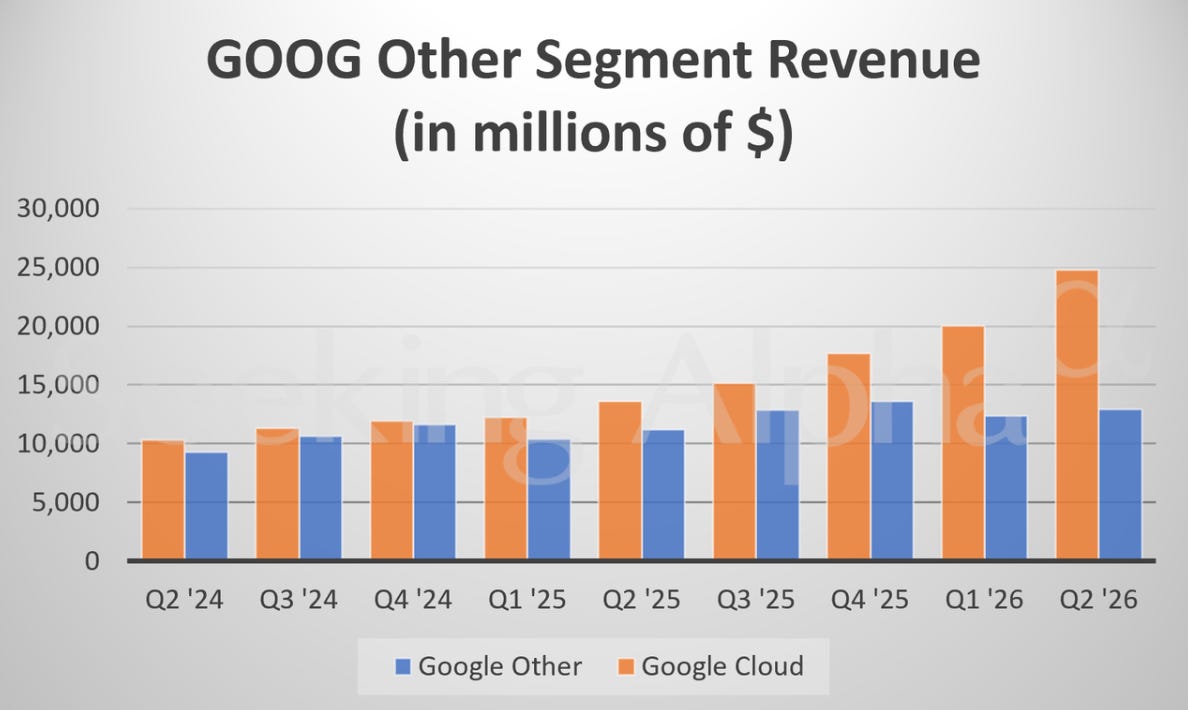
Google Cloud saw a meaningful acceleration in growth as revenues increased 82% (up from +63% last quarter) to $24.8 billion.
YouTube broke its losing streak with 13% revenue growth, beating estimates of $10.81B. The search engine generated $63B in revenue, an increase of 17% from the same quarter last year.
Within the company’s other businesses, “other bets,” which includes its Waymo unit, realized a modest 2.4% growth in revenue to $383M, though less than $401M estimates.
The company also reported 950M monthly average users for its Gemini app.
“We continue to be supply constrained” (CEO & Director Pichai). “Our model APIs are now processing approximately 22 billion tokens per minute. That’s up from 16 billion just a quarter ago.”
“We continue to expect to recognize a relatively small portion of the revenues from our existing TPU system sales agreements this year... The vast majority of the revenues from these agreements will be realized in 2027” (Senior VP & CFO Ashkenazi).
“We are updating our full year 2026 CapEx guidance range to $195 billion to $205 billion” (Senior VP & CFO Ashkenazi). “As we previously shared, we continue to expect our CapEx to increase significantly in 2027.”
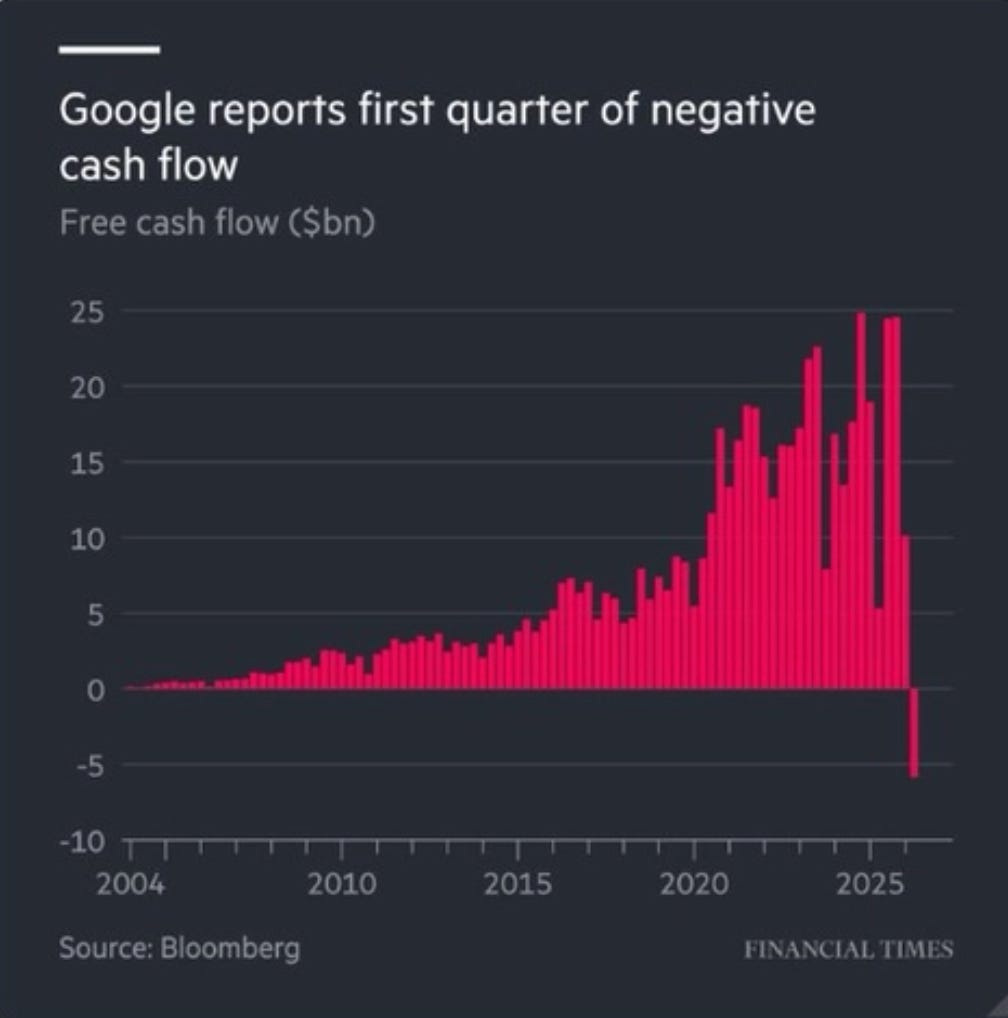
The Google parent reported negative free cash flow of $5.9B for the quarter ended June, well below analyst expectations, after sharply increasing spending on data centers and AI hardware.
Google (GOOG) (GOOGL) disclosed in its most recent 10-Q filing that it owned $94B worth of SpaceX (SPCX) shares after the Elon Musk-led company held its historic initial public offering earlier this year.
The tech giant said $80B of the SpaceX shares are subject to short-term restrictions on the ability to sell, while $14.1B of SpaceX shares are subject to long-term restrictions on the ability to sell through the third quarter of 2027.
Link to Seeking Alpha News Article - Jul 22, 2026
Link to Seeking Alpha News Article - Jul 22, 2026
Link to Seeking Alpha News Article - Jul 22, 2026
Link to Seeking Alpha News Article - Jul 22, 2026
Link to Seeking Alpha News Article - Jul 23, 2026
Link to Seeking Alpha News Article - Jul 23, 2026
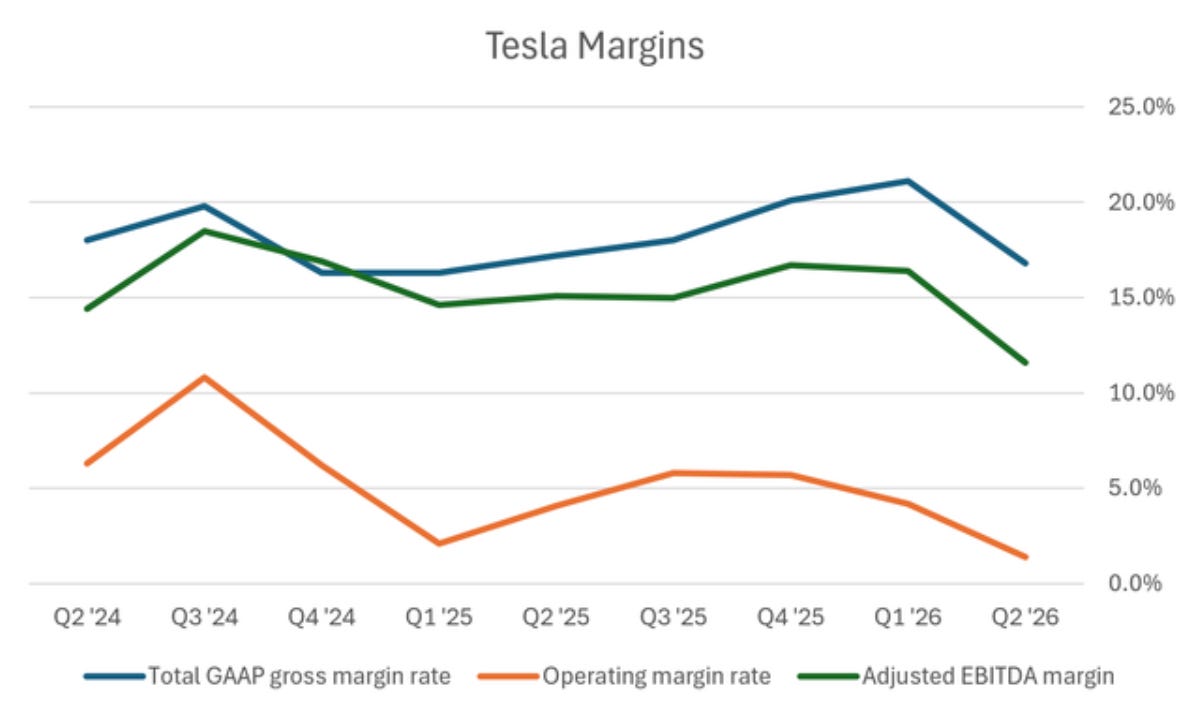
Tesla Non-GAAP EPS of $0.33 misses by $0.21, revenue of $28.24B (+25.6% Y/Y) beats by $1.75B
Capex: $5.79B vs. $2.49B in 1Q26. FCF: $1.09B vs. $1.44B in 1Q26.
“Tesla Semi and Megapack 3 remain on schedule for production starting in 2026. First-generation production lines for Optimus are being installed in anticipation of production in 2026. Capacity build-out and ramp related to our multi-year infrastructure initiatives, including AI compute, solar, battery material, and semiconductor manufacturing, are underway.”
During the earnings conference call, Musk noted the “massive” capex year will pay off with “incredible” returns for investors.
Optimus was also a major topic during the call, as Musk called it one of the company’s largest projects ever, although he noted a substantial production scaling challenge since every part of the process is new. “We’ve had to build the supply chain out entirely. The Fremont production line looks incredible. Optimus will follow the s-curve of the manufacturing ramp, but the initial portion will be flat and long due to the newness of the parts in the robot,” highlighted Musk.
Musk said a new Terafab site will be announced soon and discussed the Tesla Megapod business, which is a self-contained data center hardware system developed for heavy artificial intelligence computing. He described it as pairing the x86 computer with the Tesla AI4 computer in a box. “This allows us to scale AI compute with aggregated electricity production. We can place Megapods at Superchargers and have distributed AI,” updated Musk.
“In Q2, we had in North America, about 55% of our deliveries had FSD subscription at the time of delivery enabled” and “FSD attach rates continue to improve, reaching nearly 1.5 million paid customers globally, of which 55% is upfront purchases and the remaining 45% is subscriptions.” (CFO Taneja)
“We expect that the bulk of the growth in FSD monetization will come from subscriptions as we removed the purchase option in most markets.” (CFO Taneja)
“In Q2, we deployed 13.5 gigawatt hour of energy storage, a 53% sequential increase” and “energy gross margins declined from 39.5% to 20.4%.” (CFO Taneja)
“As previously guided, our free cash flow ended up being negative for the quarter” and “CapEx more than doubled sequentially.” (CFO Taneja)
Alexander Perry, BofA Securities: asked what milestones would trigger faster robotaxi scaling and whether Tesla would partner with rideshare networks; CEO Musk: “We expect to be vertically integrated with robotaxi” and described the constraint as “the March of 9s of reliability” toward “99.999% reliable.”
William Stein, Truist: asked about make-vs-buy for Optimus electronics and FSD hardware upgrades; CEO Musk: “Optimus has a lot of really specialized power electronics and circuit boards” and “for Optimus 4, which will be built in Austin, that will be a much more vertically integrated supply system” with “aspirationally 10 million units a year versus 1 million units a year”; on vehicles, “it will be financially sensible at some point to upgrade” and referenced both an “upgraded AI chip” and “AI5” with volume production “around the middle of next year.” (CEO Musk)
Link to Seeking Alpha News Article - Jul 22, 2026
Link to Seeking Alpha News Article - Jul 22, 2026
Link to Seeking Alpha News Article - Jul 22, 2026
Link to Seeking Alpha News Article - Jul 22, 2026
Link to Seeking Alpha News Article - Jul 22, 2026
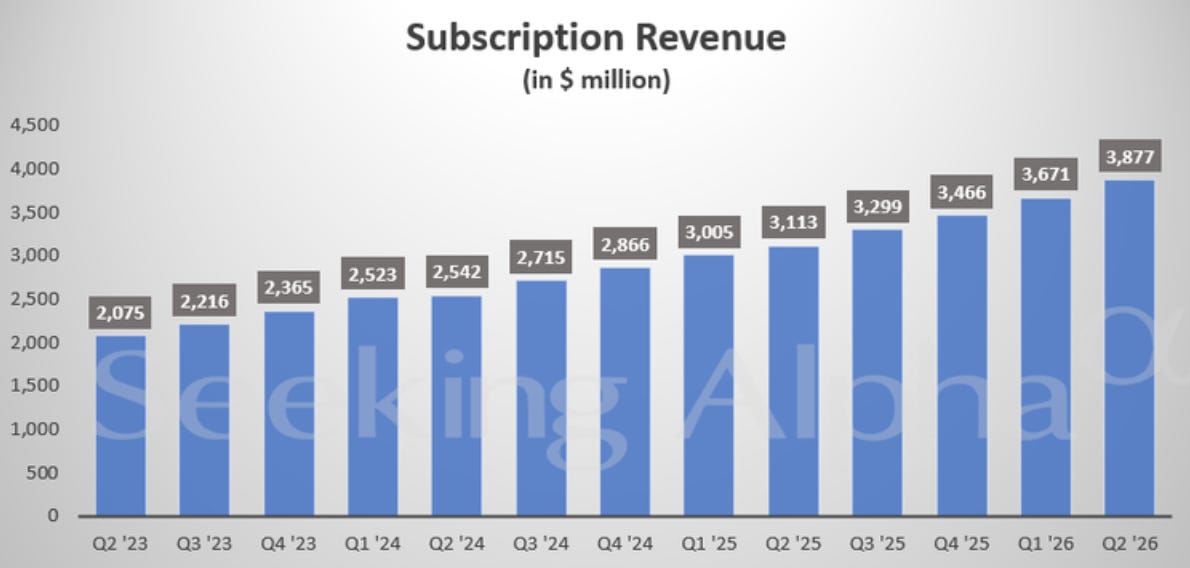
ServiceNow Non-GAAP EPS of $0.90 beats by $0.04, revenue of $3.98B (+23.6% Y/Y) beats by $50M
ServiceNow has increased its revenue by more than 20% year over year for five consecutive quarters.
Looking ahead, ServiceNow expects its third quarter revenue to increase 20.5% year over year to range from $3.975B to $3.98B. This was just short of the $4B estimate.
It projects its full-year subscription revenue to range from $15.76B to $15.78B, which would represent a 22.5% year-over-year increase at the midpoint. The company previously projected $15.74B to $15.78B. The estimate calls for $15.74B.
“We have a big announcement coming very shortly, a business model evolution that expands our TAM with AI-native products,” Chairman & CEO William McDermott said, adding, “This new offering will be a conversational service desk experience, no tickets and AI-coded automation.”
ServiceNow (NOW) dodged the potholes that affected IBM (IBM) and Pegasystems (PEGA) in their latest earnings results and delivered another above-expectations quarter and outlook, prompting praise from an array of analysts.
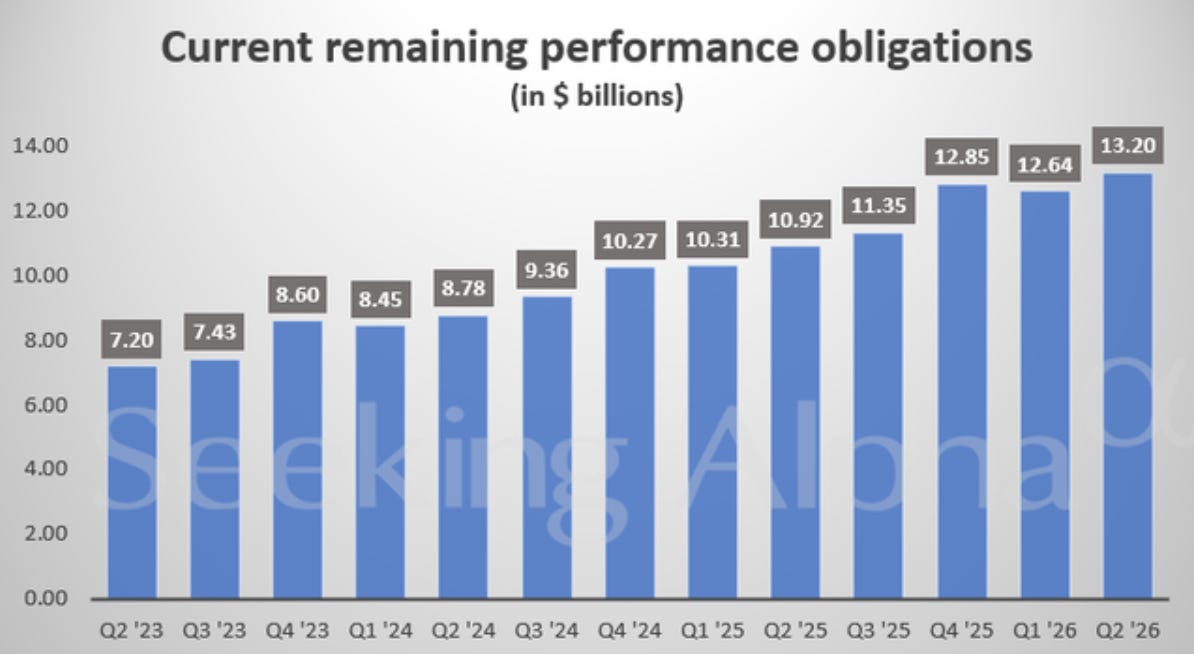
The software giant’s AI annual contract value remains on track to surpass its earlier guidance of reaching $1.5B by the end of 2026. J.P. Morgan reiterated its Buy rating and nudged its price target to $150 from $145.
RBC Capital Markets, which maintained its Outperform rating and $130 target, noted ServiceNow’s increased relevancy in the cybersecurity space, as this segment of the business already generates more than $1B.
“Today, our risk and security business is the fastest growing of the top 10 cyber companies in the enterprise,” ServiceNow CEO Bill McDermott said during the Wednesday evening earnings call. “I’ll make it very clear. We now have a 10-figure cybersecurity business that’s growing faster than all the other top cybersecurity companies.”
This segment was recently bolstered by the acquisitions of Armis and Veza.
“On security, mgmt highlighted AI Control Tower as a key growth driver, with Sec & Risk included in 16 of the top 20 deals and 24 deals >$1M,” said Jefferies analyst Samad Samana in a note.
Link to Seeking Alpha News Article - Jul 22, 2026
Link to Seeking Alpha News Article - Jul 22, 2026
Link to Seeking Alpha News Article - Jul 22, 2026
Link to Seeking Alpha News Article - Jul 23, 2026
[Newsletter Exclusive] United Rentals Non-GAAP EPS of $12.76 beats by $1.17, revenue of $4.41B (+11.9% Y/Y) beats by $200M
Rental revenue climbed 12.7% from a year earlier to a record $3.85 billion, helped by a 3.4% increase in fleet productivity and continued strength in demand across large construction and industrial projects.
The company has raised its 2026 revenue outlook to $17.5 billion to $17.8 billion from $16.9 billion to $17.4 billion, above the Wall Street consensus estimate of $17.26 billion.
The company also raised its forecast for adjusted earnings before interest, taxes, depreciation and amortization to $7.975 billion to $8.125 billion, compared with its prior outlook of $7.625 billion to $7.875 billion.
Link to Seeking Alpha News Article - Jul 22, 2026
Link to Seeking Alpha News Article - Jul 22, 2026
[Newsletter Exclusive] Generac rated Overweight by Cantor Fitzgerald on AI data centers
The bullish call centers on Generac’s (GNRC) expanding commercial and industrial business, particularly backup power systems for AI data centers, while maintaining that the company’s dominant residential generator franchise continues to provide a stable, high-margin earnings foundation.
Lead analyst Manish A. Somaiya wrote that Generac (GNRC) is evolving from a weather-dependent residential generator company into a diversified power resiliency platform with two complementary growth engines: a cash-generating residential business and a rapidly expanding commercial and industrial segment driven by AI infrastructure investment.
While the company had outlined about $650 million in data center revenue for 2027 and $1 billion in 2028 during its March investor day, Cantor estimates discussions with management suggest visibility into roughly $1 billion of 2027 revenue already exists through an initial hyperscale customer opportunity and approximately $400 million in colocation backlog, before contributions from a second hyperscale customer. Somaiya cautioned that this represents visibility rather than firm backlog until project-level purchase orders are received.
Despite enthusiasm around AI infrastructure, Somaiya argued that Generac’s (GNRC) residential business remains its core competitive moat.
The analyst estimates the company controls roughly 75% to 80% of the North American home standby generator market, yet penetration remains just 6.75% of an estimated 63 million addressable U.S. homes. Beyond its products, Generac (GNRC)benefits from an extensive dealer, installation and service network that would be difficult for competitors to replicate, the report said.
Link to Seeking Alpha News Article - Jul 22, 2026
[Newsletter Exclusive] X-Energy joins $60M project for AI-accelerated advanced nuclear deployment
X-Energy (XE) said it joined the Prometheus project as a Tier 1 partner with board of directors representation, providing $10M in private capital and the use of its proprietary HTGR design and fuel fabrication data, while the company’s Xe-100 small modular reactor and TRISO-X fuel will serve as a technical platform for the research campaign.
The company said it expects to directly leverage advancements to help accelerate commercial deployment across its 11 GW commercial pipeline across the U.S. and U.K., with commercial Xe-100 projects underway with Dow, Amazon, and Centrica.
Link to Seeking Alpha News Article - Jul 22, 2026
USO 0.00%↑ ITA 0.00%↑ TLT 0.00%↑ GLD 0.00%↑ SPY 0.00%↑
Crude oil adds to gains after Houthis attack two Saudi tankers in the Red Sea
The Houthis said they attacked the two vessels with missiles and drones for violating their declared blockade of Saudi shipping in the Red Sea, identifying the tankers as the Encelia and the Layla.
The first attacks on tankers in the Red Sea open up a new front in the war after Iran attacked vessels in the Strait of Hormuz in recent days.
Ship tracking data showed five tankers changed course in the Red Sea on Wednesday, with two signaling the Suez Canal as their new destination, following the Houthis’ warning.
U.S. forces launched a 12th consecutive day of strikes on Iran, which U.S. Central Command said was intended to further degrade the country’s ability to threaten commercial shipping in Hormuz; Iran responded by attacking Kuwait.
President Trump said on Truth Social that the U.S. would “bomb and destroy one bridge or power plant” any time Iran fires at vessels in the Strait of Hormuz.
The market is trying to weigh if Trump “really wants to do that next level of escalation,” Rabobank senior energy strategist Joe DeLaura said in a note.
If the U.S. starts hitting power plants and infrastructure, Iran will start attacking power plants or desalination plants in Saudi Arabia and other Persian Gulf countries, hitting critical water supplies, DeLaura said.
“If we continue to see this kind of escalation, then we’re going to see a very big hike because we’re going to be developing into a much wider and much deeper war,” he said.
Link to Seeking Alpha News Article - Jul 22, 2026
QuantumScape outlines plan to double Eagle Line cell output in H2 2026 while lowering 2026 CapEx guidance to $27M-$37M
“This quarter, we announced a partnership with Honda. This is a multi-year agreement aimed at advancing our solid-state lithium metal battery technology for automotive and other applications in the Honda product portfolio,” said (President, CEO & Director Siva Sivaram).
“In order to serve our diverse and growing customer base, we are establishing three business verticals: QSEV for electric vehicles, QSDC for AI data centers, and QSAS for advanced solutions for applications including aerospace and defense,” said (President, CEO & Director Sivaram). He added, “QSAS has shipped QSE-5 cells to a major American defense prime.”
On pilot manufacturing, (President, CEO & Director Sivaram) said the Eagle Line is “one of our 4 key annual goals,” and that “core tools are showing uptime greater than 90%,” and added, “we aim to further double cell output in the second half of 2026 and anticipate customer sample shipments accelerating across all three verticals.”
On safety and scaling to larger cells, (President, CEO & Director Sivaram) said, “We are pleased to report that larger scale testing continues to show that QSE-5 is a significantly safer cell design compared to both conventional and next generation lithium-ion cells,” and added, “we have demonstrated that our Cobra process can produce larger area separators for higher capacity cell designs.”
“For full year 2026, we reiterate our Adjusted EBITDA loss guidance of between $250 million and $275 million,” said (Chief Financial Officer Kevin Hettrich).
“We ended Q2 with $859 million in liquidity,” said (Chief Financial Officer Hettrich).
Laisha Zaack Carrillo, HSBC: Asked whether QS will expand beyond the three verticals; (President, CEO & Director Sivaram) answered, “Yes is the answer to that question,” and added that advanced solutions includes “aerospace, defense, medical devices, and consumer electronics.”
Yan Dong, Deutsche Bank: Asked next steps with Honda toward a PowerCo-like structure; (President, CEO & Director Sivaram) answered, “Immediate job is to move this joint development into the next level of development and move it along the same template that we have developed with PowerCo Volkswagen.”
Link to Seeking Alpha News Article - Jul 22, 2026
Intel, AMD ink long-term CPU deals with Chinese clients amid price surge: Reuters
The agreements under discussion typically lock in purchase volumes but not prices, the people said. Most cover about a year of supply, although Intel (INTC) and AMD (AMD) have discussed commitments of two years or longer from some customers, one of the people said.
Server CPU prices are still climbing in China, with month-on-month increases topping 10% for some products, one of the sources said. Prices of some CPU products have risen more than 40% in China since the start of the year, the report added.
As per earlier reports, Intel and AMD had notified Chinese customers of lengthy waits for server CPUs, with Intel lead times reaching as long as six months for some products.
Link to Seeking Alpha News Article - Jul 23, 2026
[Newsletter Exclusive] BYD, Chery, Leapmotor accelerate gains in EU auto market amid EV transition
Battery-electric vehicle (BEV) registrations climbed 40.5% Y/Y to 1.22M units during H1, lifting their share of the EU market to 20.7% from 15.6% a year earlier. Hybrid-electric vehicles remained the most popular powertrain, with registrations rising to 2.20M units and accounting for a 37.3% market share. Plug-in hybrid registrations increased to 577,735 units, raising their market share to 9.8% from 8.5%.
Meanwhile, petrol car registrations fell 17.2% Y/Y in H1, with declines across all major EU markets, reducing petrol’s market share to 22.2% from 28.4% a year earlier. Diesel registrations also dropped 16.5%, lowering their share to 7.5% from 9.4%, while the combined share of petrol and diesel vehicles fell to 29.7% from 37.8% in H1 2025.
Chinese automakers continued to gain ground in the EU market, with BYD (BYDDF) registrations surging 168.2% Y/Y to 130,743 units, Chery (CRAUY) jumping 268.7% to 84,987 units, and SAIC Motor (SAIC) rising 19.1% to 127,585 units, while Leapmotor (ZGJLY) posted a more than fivefold increase of 526.7% to 48,261 units. Tesla (TSLA) also strengthened its position, with registrations climbing 75.4% to 124,242 units.
Link to Seeking Alpha News Article - Jul 23, 2026
Tesla-SpaceX merger? Elon Musk weighs in
“As you can tell from the many collaborations on so many fronts with SpaceX (SPCX) – there’s more and more overlap, especially with Terafab, that’s really going to be a gigantic project,” Musk said in response to an analyst’s question on the matter during Tesla’s (TSLA) earnings call.
“But obviously, we can’t talk about combining companies and that kind of thing on an earnings call,” he added. “It’s got to be done with the appropriate process.”
Musk went on to discuss the benefits, pointing to AI assistant Grok in Tesla (TSLA) cars and Starlink being integrated into the vehicles.
Link to Seeking Alpha News Article - Jul 23, 2026
Tilray launches THC pouch-based product Zonna
Cannabis producer Tilray (TLRY) on Thursday launched a THC pouch-based, smoke-free consumable, Zonna.
The product is designed to fit comfortably between the gum and the lip, offering a discreet and odor-free alternative to traditional cannabis consumption methods, the company said.
The launch format includes 15 pouches per container, and each pouch contains 10 mg THC.
“… By combining fast-acting Capsoil™ technology with a controlled-dose pouch, we are expanding choice, creating new occasions for cannabis consumption…” Blair MacNeil, President, Tilray Canada, said.
The proprietary Capsoil technology utilized in Zonna converts cannabis oils into water-soluble nanoparticles, allowing the THC to bypass standard digestive processing.
By absorbing directly through the mouth’s mucosal lining, the pouches deliver an onset time of just 10 to 15 minutes and peak effects within half an hour—closely mimicking the rapid delivery of smoking or vaping in a highly discreet format.
Capsoil is not an open-source manufacturing technique; it is a proprietary, patented platform developed by Capsoil FoodTech (backed by companies like Prodalim).
Link to Seeking Alpha News Article - Jul 23, 2026
WealthWise Research - Jul 23, 2026
Vertiv rated Overweight by KeyBanc on AI data center spending
The report, led by analyst David Tarantino Jr., contends that AI-related investment by hyperscale cloud providers is creating a “stronger for longer” growth environment for data center infrastructure companies, with demand likely extending well beyond current Wall Street expectations.
For investors, the initiation underscores KeyBanc’s view that rising AI infrastructure spending is still in its early stages. The firm believes accelerating capital expenditures by cloud providers, growing power requirements and increasingly complex cooling needs will continue to support revenue growth for suppliers of data center equipment into 2027 and beyond.
KeyBanc called Vertiv the “most pure-play” way to invest in the data center infrastructure theme, noting that about 85% of its revenue comes from data centers. The firm said Vertiv’s engineering expertise, broad product portfolio and strong market position create a sustainable competitive advantage that should support continued earnings beats and estimate revisions as manufacturing capacity expands.
Although Vertiv already trades at a premium valuation, KeyBanc argued the premium is justified by the company’s above-average growth prospects and margin profile. The analysts also believe consensus estimates for 2027 may prove too conservative as demand continues to accelerate.
Link to Seeking Alpha News Article - Jul 23, 2026
$BTC
Cathie Wood’s ARK Invest, Strategy, BlackRock, others collaborate for Bitcoin Security Consortium
The initiative aims to prepare bitcoin for a potential era of quantum computing.
The founding members of the consortium include Anchorage Digital, Cathie Wood’s ARK Invest, BlackRock (BLK), Block (XYZ), Blockstream, Coinbase (COIN), Fidelity Digital Assets, Galaxy (GLXY), and Strategy (MSTR).
Members have pledged an aggregate of $15M over the next three years for the consortium to help fund and support the developers and researchers already working on bitcoin’s security.
In the coming months, the consortium intends to publish and maintain material on bitcoin’s security, updated as developments warrant, and to continue funding and supporting the developer community.
Link to Seeking Alpha News Article - Jul 23, 2026
Samsara initiated with bullish views at Guggenheim
Analysts led by Tamjid Chowdhury said that Samsara launched in 2015 as a cloud Industrial IoT (IIoT) provider just as the Federal Electronic Logging Device mandate took effect, giving it early momentum as transportation companies scrambled for solutions.
However, the analysts noted that Samsara’s real achievement lies not in timing but in execution, rapidly expanding beyond its regulatory starting point to serve fleet operators across diverse verticals. After Fleet Telematics, the company moved into video safety, addressing critical pain points for fleet operators, such as fuel costs, safety outcomes, insurance premiums, and regulatory compliance. Substantial greenfield opportunity remains in both products as Samsara expands internationally into underpenetrated markets, the analysts added.
The analysts said that beyond vehicles, the company has expanded into physical asset management with offerings for tracking and monitoring equipment and employee safety.
“This is critical to the company’s vision of providing customers holistic visibility across their entire physical estate through its Connected Operations Cloud. We also believe AI benefits, rather than threatens, IOT’s asset-based pricing model, as it brings the company’s prior multi-year investments in AI/ML to the forefront at a time when enterprises seek practical AI use cases with demonstrable ROI,” said Chowdhury and his team.
Link to Seeking Alpha News Article - Jul 23, 2026
[Newsletter Exclusive] House narrowly passes $1.15 trillion defense bill as Senate hurdles remain
The fiscal 2027 National Defense Authorization Act passed the House by a 216-212 vote, with most Republicans supporting the measure and most Democrats opposing it.
Democrats raised concerns about continued U.S. military involvement in Iran and a provision that would expand defense technology cooperation with Israel.
The Senate has yet to advance its own version after Democrats blocked consideration last week. Lawmakers must still pass separate House and Senate bills before negotiators can reconcile the differences and send a final version to the White House for the president’s signature.
Link to Seeking Alpha News Article - Jul 23, 2026
[Newsletter Exclusive] Drone makers develop GPS alternatives as electronic warfare reshapes battlefield
Several companies unveiled alternative navigation technologies at this week’s Farnborough International Airshow. Australia’s Q-CTRL is developing systems that use quantum measurements of Earth’s magnetic and gravitational fields, while Israel’s ASIO relies on onboard cameras and computer vision to guide drones without GPS.
Rather than replacing satellite navigation, the technologies are designed to provide a reliable fallback when GPS or other communications are disrupted.
The conflict in Ukraine has underscored the need for such systems. Both sides routinely jam radio links between drones and operators, while GPS interference has reduced the effectiveness of some precision-guided weapons. Even fiber-optic-controlled drones, initially seen as resistant to electronic warfare, have encountered simple physical countermeasures.
Most modern drone navigation systems combine multiple technologies, including inertial navigation, which estimates a vehicle’s position by measuring its movement. While inertial systems can operate without external signals, they become less accurate over time as small errors accumulate.
To address that challenge, U.S.-based ANELLO Photonics has developed a compact fiber-optic laser gyroscope designed to improve navigation accuracy without relying on moving mechanical parts.
Link to Seeking Alpha News Article - Jul 23, 2026
Coinbase launches three new updates for agentic AI
Coinbase Global (COIN) on Thursday shipped three updates to span the agentic economy with specific tools for business, people, and developers.
“We believe agents are going to become the main way we access and navigate the internet across the board,” the company said in a social media post. “This includes agents becoming the most active participants in the digital economy, operating on behalf of people 24/7, at a scale no human ever could.”
The updates come after agentic traffic exceeded human traffic on Coinbase’s (COIN) Base documentation pages for the first time last month.
Beginning this week, Coinbase Business users will be able to accept USDC (USDC-USD) payments from AI agents. As part of the platform, businesses will also be able to manage, reconcile, and cash out agent payments in one account; earn 3.35% in rewards on idle USDC balances; and receive payments without chargeback risks.
For people, Coinbase for Agents will add real-time market views and conditional actions within guardrails set by the user.
For developers, Coinbase Developer Platform will let builders add x402 payment acceptance to any API, MCP server, or web service with three lines of code, the company said.
Link to Seeking Alpha News Article - Jul 23, 2026
AMD expects compute market to reach $2T by 2030 as Helios enters full production
“Today, I’m excited to announce that Helios is in full production,” said AMD CEO Lisa Su. “We have orders ready to ship out by the end of the third quarter.”
Su said she expects the total addressable market for AI accelerators to reach $1.4T by 2030.
“It is going to approach the size of the entire semiconductor market today,” Su said. “We expect GPUs to make up a majority of that market. We also saw growth in the server CPU market due to inference. The number of agents has gone from millions to billions. Every customer we talk to has said this number is just the beginning. We expect the CPU server market to climb from $25B to more than $200B over the next four years.”
“This is not just a data center opportunity,” she added. “As AI becomes a bigger part of our lives, we will need devices that can run it where we are.”
AMD expects the compute TAM to reach at least $2T by 2030 after totaling $365B in 2025.
“It’s really hard to even put this market data up because it keeps changing every few months,” Su added.
Venice, the sixth generation of AMD’s EPYC line of CPUs, made one of the most significant jumps of any prior iteration.
“It allows us to double the memory and IO bandwidth,” Su noted. “Venice is not one chip. It’s an entire family of chips. This is where our chipset architecture has a huge advantage. Next year we are adding Venice X.”
AMD also announced ROCm.AI. It adds an AI-assisted layer on the foundational capabilities of ROCm. It features an AI-assisted integration layer known as Hyperloom. The company said it improves training performance by 2.4 times through optimized kernels.
AMD also launched the Instinct MI350P GPU.
“It’s the easiest way for data centers to add AI,” said Dan McNamara, AMD’s senior vice president and general manager of Compute and Enterprise AI. “The 350P delivers more than four times the tokens per second per dollar than the next best competitor.”
In addition, AMD discussed the Ryzen AI Halo and the Ryzen AI Max PRO 400, which were designed to run AI models offline on a PC.
“Ryzen AI Halo is powerful enough to run models locally,” said Jack Huynh, general manager of computing and graphics at AMD. “It embodies the future of personal AI for everyone.”
AMD revealed an expanded partnership with the AI chipmaker Cerebras (CBRS). The companies are combining AMD Helios rack-scale systems with the Cerebras Wafer-Scale Engine in a single inference workflow aimed at ultra-low-latency AI applications. Cerebras plans to deploy AMD Helios in its data centers, and the joint offering is expected to be available first through Cerebras Cloud in the second half of 2026.
Finally, AMD introduced the KRIA AI System-on-Module, which was designed to serve as a robotic brain.
In 2028, AMD plans to release its seventh generation of EPYC, Florence, and by 2030 its eighth generation of the CPU. Meanwhile, MI500 will be AMD’s next-generation GPU from its Instinct lineup, which Su said will make the biggest generational jump ever for Instinct.
“You should expect to see a new Helios system every year from AMD,” Su said. “This gives our customers a complete and dependable roadmap.”
Link to Seeking Alpha News Article - Jul 23, 2026
Meta launches dedicated Marketplace seller app, adds account verification feature
Meta Platforms (META) on Friday launched a standalone app called Seller for Facebook Marketplace merchants and introduced a free identity verification badge for Facebook users, as the company seeks to strengthen commerce and trust on its social network.
The Seller app is designed for frequent Marketplace sellers, providing tools to manage listings, communicate with buyers, track performance, and grow their businesses outside the main Facebook app. The service is initially available to U.S. users aged 18 and above through Apple’s App Store, with Android testing underway.
The app syncs existing Marketplace listings, messages, and selling history while offering artificial intelligence-powered listing creation tools that can generate product details such as titles, descriptions, categories, and suggested prices from uploaded photos. It also includes inventory management, bulk listing tools, and performance insights.
Meta (META) said Facebook Marketplace now hosts about 430 million listed items globally each month, with some users using the platform to operate small businesses or generate income.
Link to Seeking Alpha News Article - Jul 24, 2026
Nvidia CEO Huang joins X, signs letter to Congress on open AI models
“AI will transform every industry, power every company, and be built by every country,” Huang wrote in his post. “Open models strengthen safety and cybersecurity, accelerate innovation and diffusion, and enable sovereignty. The world needs both frontier closed models and frontier open models.”
Microsoft CEO Satya Nadella also posted on X about the letter and said they are “essential to a healthy AI ecosystem,” while adding they will “strengthen American competitiveness,” expand economic opportunity, and protect national security.
“Our AI leadership will be judged not by one frontier AI model, but by whether the United States builds a strong, open ecosystem that diffuses into every sector,” the letter reads. “This is essential for creating opportunities for innovation and prosperity across the country. It requires expanding access to AI, encouraging competition, robust application layers, and giving Americans greater control over the technology they rely on. Open-weight models—AI models that anyone can download, inspect, modify, and run on their own infrastructure—are an important part of that foundation because they make advanced AI more accessible, adaptable, and widely available.”
Link to Seeking Alpha News Article - Jul 24, 2026
AI capex boom vulnerable to ‘2008-style’ real estate squeeze - Jefferies
The five major hyperscalers—Microsoft (MSFT), Alphabet (GOOG) (GOOGL), Amazon (AMZN), Meta (META), and Oracle (ORCL)—have issued a record $194B in investment-grade bonds year-to-date, making them the largest single issuer in the U.S. debt markets.
Credit markets flash warning signs
The bond market is beginning to take notice. Ten-year bond yield spreads over Treasuries have widened meaningfully for the major hyperscalers since early July. Amazon’s (AMZN) spread has risen from 61 basis points to 78 basis points, Alphabet’s (GOOGL) from 57 to 70 basis points, and Meta’s (META) from 87 to 104 basis points.
More ominously, Oracle (ORCL)—sometimes viewed as the fifth hyperscaler but with a far more leveraged balance sheet—saw its $120B of outstanding debt downgraded to BBB- on July 9, leaving it just one notch above junk status. Its 10-year bond spread has subsequently risen from 176 to 219 basis points.
A 2008 real estate credit angle
Wood’s core structural warning centers on what he calls a “2008 real estate credit angle” embedded in the AI boom. The mechanism is the explosive growth in so-called Remaining Performance Obligations, or RPOs—forward contractual commitments that represent, as Wood describes them, “a promise of future payment in exchange for future compute.”
These RPOs totaled $2.1T at the end of Q1 2026, having grown 184% over the prior four quarters from $740B. Crucially, around half of this contracted backlog is owed by just two companies: OpenAI (OPENAI) and Anthropic (ANTHRO). Microsoft’s (MSFT) exposure to these two names runs to about 49% of its book, while Amazon (AMZN) sits at 51%, Google (GOOGL) at 43%, and Oracle (ORCL) at 54%.
The problem: neither OpenAI nor Anthropic is profitable. The hyperscalers have effectively made concentrated unsecured loans to cash-burning tenants to fill data centers built on the assumption of future demand. It is a classic warning signal for infrastructure investors, Wood noted.
Link to Seeking Alpha News Article - Jul 24, 2026
Canadian Solar opens flagship solar cell factory in Indiana, boosting U.S. presence
Canadian Solar (CSIQ) said Friday it has opened the first phase of its flagship PV cell manufacturing facility at the River Ridge Commerce Center in Jeffersonville, Indiana, seeking to help fill a major gap in U.S. solar manufacturing by producing a key component that is largely made in Asia.
The company said the Jeffersonville PVCells plant is the first U.S. PV cell facility designed to produce heterojunction bifacial N-type solar cells, which it said offers better performance than conventional technologies and has more room for future improvements.
Output from the Jeffersonville plant will be used by Canadian Solar’s module factory in Mesquite, Texas, which is being expanded to 10 GW of annual capacity.
Link to Seeking Alpha News Article - Jul 24, 2026
Waymo explores ending Uber ties as robotaxi rivalry grows
According to the report, Waymo has held internal discussions about exiting its existing agreements with Uber (UBER), which currently operates Waymo robotaxi services in Austin and Atlanta. Uber (UBER) said Waymo has informed it of plans to enter those markets independently from January 2028, when the current contract permits.
The report said the relationship has also been strained by disagreements over service quality, safety issues, and commercial terms.
Waymo has reportedly raised concerns over vehicle routing and cleanliness in markets managed by Uber, while Uber (UBER) has argued that operational constraints and the financial structure of the partnership have limited its ability to expand the service. The ride-hailing company also cited instances of Waymo vehicles becoming unavailable during bad weather.
Despite the tensions, Waymo plans to initially offer rides through both its app and Uber’s platform in Austin and Atlanta, similar to its arrangement with Lyft (LYFT) in Nashville, the report said. Uber, meanwhile, said it intends to continue offering Waymo services in the two cities until the current agreement expires in May 2028.
The report said the companies also remain divided over proposed autonomous vehicle regulations, with each supporting policies that align with their respective business models.
Link to Seeking Alpha News Article - Jul 24, 2026
Disclosure: We own positions in some/all of the tickers mentioned in this article.